Trying to Understand Hamas, Part 1

It isn’t easy to understand what Hamas is trying to accomplish in this latest conflict. The rockets they launch toward Israel are quickly followed by destruction in Gaza. Don’t the leaders of Hamas care about the hundreds of Palestinian deaths, the thousands of injuries and the obliteration of entire neighborhoods in places like Gaza City?

28HAMAS-superJumbo

One way to attempt to understand Hamas’ actions is to consider how this latest round of violence started. The events below are taken from Wikipedia’s detailed timeline, except for two interesting additions, the first for June 11th and the second for June 30th.

6/11: It’s not part of the Wikipedia timeline, but a weekly report for June 10-16th from the United Nations Office for the Coordination of Humanitarian Affairs states on page 4:

On 11 June, the Israeli Air Force targeted an alleged member of an armed group riding on a motorcycle together with a ten-year old child, in the Beit Lahiya area. The man died instantly and the child, who sustained serious injuries, died three days later; two civilian bystanders were also injured. 

The last targeted killing in the Gaza Strip was reported in early March. Following this incident and through the rest of the week, Palestinian armed groups launched a number of rockets at southern Israel.

6/12: Three Israeli teenagers are kidnapped in the West Bank.

6/14: Israel sends troops and police officers into the West Bank to conduct searches and arrests.

6/15: The Israeli Prime Minister claims to know “for a fact” that Hamas was responsible for the kidnappings. Israel further restricts border crossings for both the West Bank and Gaza.

6/16: At least 150 Palestinians have been arrested. The Chief of Staff of the Israeli Defense Force (IDF) announces that many of the arrests are unrelated to the search for the kidnappers. Instead, they are meant to put pressure on Hamas.

Photograph of weapons said to have been found by the IDF after a search:
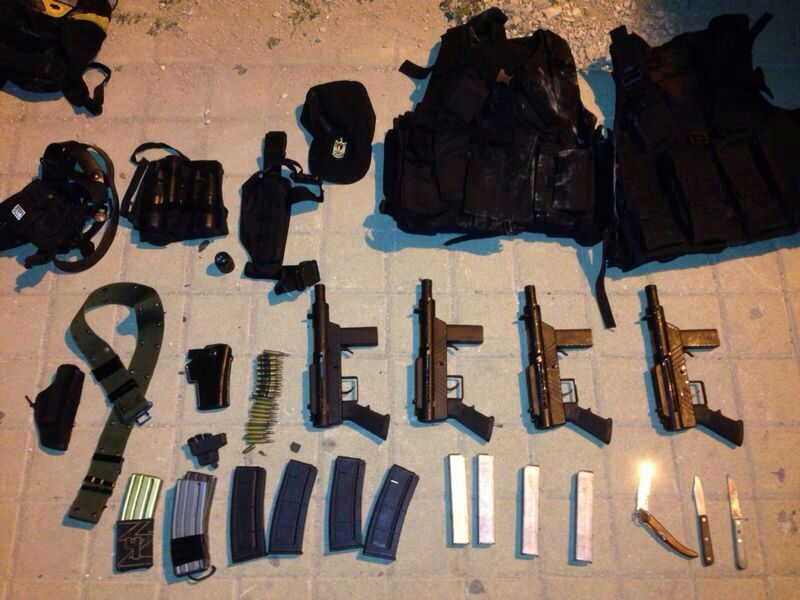
Palestinian_Weapons_Exposed_During_Operation_Brother’s_Keeper_(14256563989)

6/18: After six days, Israeli forces have made 240 arrests, searched 800 structures, put 300,000 Palestinians under curfew and restricted the movements of 600,000.

6/20: Palestinians commit sporadic violence in the West Bank. At least two Palestinians are killed by Israeli forces. Some 1000 buildings have been damaged during searches, mostly private dwellings.

6/22: Three more Palestinians are dead. The Palestinian Authority calls on the U.N. to intervene and stop what it calls “collective punishment”.

6/23: An Israeli officer states that the operation has been a success because it has crippled Hamas’ infrastructure, although no progress has been made in locating the three teenagers. Prime Minister Netanyahu again affirms that Hamas was clearly responsible for the kidnapping.

6/24: Photograph of a nursery said to have been taken after an IDF search:

Nursery_after_search_24_June_2014

6/26: “According to Israel figures, state detentions number 381, of whom 282 are affiliated to Hamas. The number of locations searched rose to 1,955, including 64 Hamas institutions. Palestinian figures state that 566 were detained, 6 were shot dead, and over 120 wounded; 2 elderly people died of heart attacks during Israeli operations, and over 1,200 homes were searched.”

6/30: According to the Times of Israel, but not mentioned in the Wikipedia timeline:

At least 16 rockets were fired at Israel Monday morning [on June 30], most of them hitting open areas in the Eshkol region, the army said. The security sources, who spoke on condition of anonymity, assessed that Hamas had probably launched the barrage in revenge for an Israeli airstrike several hours earlier which killed one person and injured three more. A member of Hamas’s militant wing was killed in the attack, Gaza health official Ashraf al-Kidra said….

Hamas hasn’t fired rockets into Israel since Operation Pillar of Defense ended in November 2012, and has yet to take responsibility for this latest barrage.

Also 6/30: The bodies of the teenagers are found. That night, Israeli forces destroy the homes of two Palestinian suspects.

7/1: “Israeli jets and helicopters struck 34 locations in the Hamas-run Gaza Strip in response to over 20 rockets being fired at Israel from Gaza.” Another Palestinian is shot and killed.

7/2: A Palestinian teenager is abducted and killed. “Palestinians fired nine rockets into Israeli territory, three of which heavily damaged residential buildings”, but no casualties were reported.

7/3: “The Israeli Air Force conducted 15 air strikes in Gaza.”

7/8: Israel announces plans to call up 50,000 reserves as part of Operation Protective Edge. In the early morning, Israel strikes at 50 targets in Gaza, injuring 17. PM Netanyahu instructs the IDF to “take their gloves off” against Hamas and take any means necessary to restore peace to Israeli citizens.

“The Geneva-based nonprofit, nongovernmental human rights organization Euro-Mid Observer for Human Rights, [reports that] the Israeli government has been accused of having stolen around $370,000 in cash and $2.5 million in property, in search of the abducted youths. In 387 incidents throughout the West Bank, the Israeli government has confiscated goods ranging from computers, cars, mobile phones and jewelry, taken from a wide variety of localities, including private homes, clinics, companies and universities, says the report. Spokespersons for the Israeli government say that goods were confiscated from sources that were using them to fund or support terrorism.

Note: On July 25th, a BBC journalist reported that Israeli police spokesman Micky Rosenfeld informed him that the killers of the three teenagers were “definitely” from a “lone cell”, affiliated with Hamas but not under Hamas’ direct leadership. Further, if the kidnapping had been ordered by Hamas’ ledership, the Israelis would have know about it in advance. Later, in seeking to explain his remarks, Rosenfeld reiterated that the suspects were affiliated with Hamas. 

So, given the extreme military imbalance, what moved Hamas to launch those rockets at Israel for the first time since 2012?

Considering the timeline above, one explanation that seems fairly reasonable is that the people in the Gaza Strip who control those rockets got very angry and decided to fight back, whatever the consequences might be. 

Tomorrow: a shorter part 2 regarding different perspectives, real and imagined.

Haaretz’s Correspondent for the Occupied Territories and Israel’s Prime Minister Each Have Something to Say

Amira Hass was born in Jerusalem in 1956 and has been covering Gaza and the West Bank for the Israeli newspaper Haaretz since 1993. She lived in Gaza for three years and has lived in the West Bank for the past seventeen.

Below is most of a recent article of hers. Her thesis is that “Israel’s attack on Gaza is revenge for the Palestinians’ refusal to accept occupation”. 

Quote: 

“There is method in madness, and the Israeli insanity, which refuses to grasp the extent of its revenge in Gaza, has very good reasons for being the way it is. The entire nation is the army, the army is the nation, and both are represented by a Jewish-democratic government and a loyal press. The four of them work together to stave off the great betrayal: the Palestinians’ refusal to recognize the normalcy of the situation.

The Palestinians are disobedient. They refuse to adapt….The insistent, steadfast demonstrations in West Bank villages have not even scratched the surface of the Israeli faith in the normalcy of our domination of another people. The boycott, divestment and sanctions movement did manage to confuse our ego a bit, but it is still not enough to make Israelis want to get the message. The Palestinian reconciliation government seemed to move us another step forward; it had the potential to embark on the path of rejecting the show of normalcy dictated by Israel, but too many forces within Fatah and Hamas did not support it.

Then it was the turn of Hamas’ rockets to disturb the occupier’s rest. Say what you will about it, but they succeeded in doing what the demonstrations, the boycott of Tapuzina orange drink and the concert cancellations did not….

Nation, army, government and press: You have eyes and ears, yet you will not see and you will not hear. You still hope that the Palestinian blood we have already shed and have yet to shed will win a long-term lull, which will bring us back to occupation as usual….

And boy, are you competent when you want to be. The armed Hamas operatives who emerged from the tunnel shaft on Kibbutz Nir Am on Monday were dressed as Israeli soldiers….“Finally, thanks to an aerial photograph taken by a drone, they were found to be Hamas operatives” because “they were carrying Kalashnikov rifles, which the Israeli army does not use”.

So the photographs taken by the drone can be very precise when its operators wish. It can discern whether there are children on the seashore or on the roof — children who, even for the legal acrobats in the Justice Ministry and the army, are not a justifiable target for our bombs. The drone can also discern that a rescue team has arrived to pull out wounded people, that families are fleeing their homes… But for some reason, the eye of the drone that can tell the difference between various makes of rifles cannot tell that this figure over here is a child, and that is a mother or a grandmother….

The Israeliness of the moment is like that drone. It chooses to see blearily. It clings closely to the good, comfortable life of a master nation, unwilling to allow its subjects to interfere with it. Defense Minister Moshe Ya’alon translated that into political language when he said, “We will not agree to recognize the reconciliation government, but other arrangements such as controlling crossing points is something we can accept. [Palestinian Authority Prime Minister Mahmoud] Abbas will control the crossing points, but he will not control the Gaza Strip itself.”

That is the routine we are cultivating. Gaza and the West Bank are cut off. Hamas controls the Gaza Strip, but under conditions that we dictate, just as Fatah and the Palestinian Authority “rule” in their pockets in the West Bank, in accordance with our conditions. If the Palestinians need to be tamed at times, we will tame them with blood and with more blood. And peace be upon Israel.”

End quote.

Concurrently, Israeli Prime Minister Netanyahu brought up Nazi Germany, comparing Israel being bombarded by those troubling but generally ineffective Palestinian rockets to England’s suffering at the hands of the Germans in World War II. From Jerusalem Online:

PM Benyamin Netanyahu met British Foreign Affairs Minister Philip Hammond and compared Israel’s condition in these days to the condition in Britain in World War 2. “Israel’s condition is similar to Britain’s when it was bombed as well”, said Netanyahu, clarifying that Israel’s intention is to go forth with the operation: “There is no guarantee of a hundred percent success, however IDF has shown impressive achievements in the field and we are moving forward with this operation… We aim our fire at those who fire rockets at us”.

An estimated 40,000 people died in England during the Blitz. Since the latest hostilities began, three Israeli civilians have been killed by Hamas and fewer than 30 in the past 14 years. The Palestinian death toll just this month is now over 1,000, mostly civilians, with bodies still being recovered during the temporary cease-fire.

If we’re going to talk about the Nazis, a more apt comparison is to their infamous response to resistance movements in occupied countries. From Wikipedia:

The Kragujevac massacre was the murder of Serbian, Jewish and Roma men and boys in Serbia by German Wehrmacht soldiers on 20 and 21 October 1941. All males from the town between the ages of sixteen and sixty were assembled by German troops and [Serbian collaborators]  and the victims were selected from amongst them.

Field Marshal Wilhelm Keitel had issued an order on 16 September 1941, applicable to all of occupied Europe, to kill 50 communists for every wounded German soldier and 100 for each German soldier killed.

The victims have become victimizers.

beit hanoun

American Creation: Triumphs and Tragedies at the Founding of the Republic by Joseph J. Ellis

American Creation is an excellent summary of what Ellis calls “the Founding Era”, defined as the 28 years between the start of the War for Independence in 1775 and the Louisiana Purchase in 1803.

The author’s method is to focus on six key periods or events: the 15 months between the violence at Lexington and Concord and the signing of the Declaration of Independence; the Continental Army’s winter at Valley Forge, “a pivotal moment” when George Washington realized he could not win the war by winning full-scale battles with the British; the political battle between the Federalists and Anti-Federalists to ratify the Constitution; the approval of the Treaty of New York in 1791 between the United States and the Creek Nation; the beginning of party politics with the creation of the original Republican Party by Thomas Jefferson and James Madison, mainly in response to Alexander Hamilton’s proposed Bank of the United States; and finally the Louisiana Purchase, when President Jefferson doubled the size of the United States but set the stage for the Civil War by ignoring the issue of slavery’s expansion to the new territory.

Being relatively ignorant about the history of this period, it was especially surprising to read about Thomas Jefferson’s checkered career and the creation of the first Republican Party, which later became the Democratic-Republican Party and eventually split into two parties, the Democrats and the Whigs (it’s ironic that the current Republican Party is known as the Grand Old Party, even though the Democratic Party is 30 years older). Jefferson and his follower Madison engaged in all kinds of bad behavior premised on the bizarre idea that people like Washington and John Adams wanted to restore monarchy to America.

The other especially surprising story is the attempt by members of Washington’s administration to create a policy that would protect the interests of the Indians east of the Mississippi. The Creek Nation occupied much of the American South and was lead by Alexander McGillivray, an expert negotiator who was only one-quarter Indian. McGillivray eventually agreed to the Treaty of New York, which reserved a large part of the South for the Indians and included the promise that Federal troops would stop any further settlement in the area by American colonists. As with most treaties between the United States and the Indians, the agreement was immediately broken by the Federal government, mostly because there weren’t enough Federal troops to enforce it.   

One of Ellis’s principal conclusions is that the struggle over the balance of power between the central government and the states was built into the Constitution from the beginning and has defined much of American history, even to the present day. My conclusion is that we’ve been lucky to do as well as we have, given the political and economic conflicts that have existed since the Founding Era and will apparently never be resolved.

Unorthodox Views on Israel and Gaza

Below are some unorthodox views on what’s happening in Israel and Gaza. They’re not necessarily unorthodox in the religious sense, and they’re definitely not unorthodox in most of the world, but they’re out of the mainstream with respect to public opinion and government behavior in both Israel and the United States. 

To back up a little: I’ve been struggling this week to write another post about the massacre in the Gaza Strip. “Massacre” is a more appropriate term than “war” given the numbers published today by Haaretz (Israel’s oldest daily newspaper):

In Gaza, the Palestinian death toll in Gaza since Israel launched Operation Protective Edge surpassed the 800 mark, most of them since Israel entered Gaza a week ago. Israel military fatalities stand at 35 since the operation commenced.

It should also be noted that at least one Israeli civilian has been killed as the result of a Hamas rocket attack.

I’m not sure why this subject has got such a hold on me, since people are being massacred in other places, but I think it’s because so many apparently sensible people insist on defending what Israel is doing. For example, here are selections from three letters printed in The New York Times a few days ago (two other letters were critical of Israel’s behavior):

As to Israel’s response to Hamas [the “Islamic Resistance Movement” voted into power in Gaza in 2006], it is proportional to the number of missiles launched against us. Whether these missile attacks are successful or not is not the point… They have the potential to wreak havoc…So far Israel has been concentrating on destroying tunnels that cross the border and missile stockpiles. I consider that a “proportional” response. As in any war, sometimes people are hurt or killed. Israel has nothing to apologize for.

It is a credit to Israel’s moral stature that it is doing everything it can to limit the killings of innocent civilians in Gaza…

Please report about the civilian bomb shelters in Gaza. Wait, there are none. Instead, Hamas uses its citizens as human shields for munitions and to increase Israeli casualties for the media.

It’s true that Hamas has launched thousands of rockets toward Israel in the past 14 years, which is clearly a violation of international law, but those rockets have caused fewer than 30 civilian deaths. That’s why the author of the first letter only claims that Israel’s actions have been proportional to the missiles launched and not to the actual effect of those missiles, which are unguided and usually don’t hit anything. 

Meanwhile, the Israeli Defense Force (the IDF) announced a few days ago that it had already struck more than 3000 targets in Gaza using its very high-tech weaponry. Since Gaza is about the size of Philadelphia, that’s more than 20 targets per square mile. And since 1.8 million people live in Gaza (300,000 more than in Philadelphia), it shouldn’t be a surprise to anyone that the bulk of the Palestinians casualties have been civilians and a large percentage of those civilians have been children. 

Stating that “sometimes people are hurt or killed in war”, as the author of the first letter does, obviously (I’d say “obscenely”) downplays the extent of this massacre. If the Israeli armed forces are truly doing everything possible to limit civilian casualties, as the second author claims, their efforts are clearly failing. As for whether it’s all Hamas’ fault for not building bomb shelters and storing weapons near people (remember, we’re talking about an area the size of Philadelphia but with a bigger population), the powers that be in Hamas are certainly at fault. But that doesn’t change the fact that it’s the Israelis who have chosen to proceed with their massive assault anyway.

All of which finally brings me to the other unorthodox opinions I wanted to share.

First, after seriously considering the consequences, an Israeli named Etgar Keret wrote an article for his fellow citizens that’s been translated and reprinted by The New Yorker (the full article, which isn’t long, is well worth reading):

In the past week I’ve seen and heard the popular statement “let the I.D.F. win” more and more frequently. It’s been posted on social media, spray-painted on walls, and chanted in demonstrations. Lots of young people are quoting it on Facebook, and they seem to think it’s a phrase that arose in response to the current military operation in Gaza. But I’m old enough to remember how it evolved: first formulated as a bumper sticker, …it contains within it the twisted world view that has been guiding Israel for the past twelve years….

Twelve years, five operations against Hamas (four of them in Gaza), and still we have this same convoluted slogan…. In each of these operations there have been right-wing politicians and military commentators who pointed out that “this time we’ll have to pull all the stops, take it all the way, until the end.” Watching them on television, I can’t help but ask myself, What is this end they’re striving toward? Even if each and every Hamas fighter is taken out, does anyone truly believe that the Palestinian people’s aspiration for national independence will disappear with them?

It’s an awful thing to make a truly tragic mistake, one that costs many lives. It’s worse to make that same mistake over and over again….The only thing that actually changes is Israeli society’s tolerance for criticism. It’s become clear during this operation that the right wing has lost its patience in all matters regarding that elusive term, “freedom of speech.” In the past two weeks, we’ve seen right wingers beating left wingers with clubs, Facebook messages promising to send left-wing activists to the gas chambers, and denunciations of anyone whose opinion delays the military on its way to victory….This road is not a circle, it’s a downward spiral, leading to new lows….

More optimistically, Peter Beinart, an American Jew who is a professor at New York University, suggests a way out of this situation for both Israel and the Palestinians in an article for Haaretz called “Israel’s Best Weapon Against Hamas”, which is also well worth reading in full:

The short answer is that I’d treat the [Hamas] rockets as military symptoms of a political problem. That doesn’t mean Israel shouldn’t return fire. If Hamas and Islamic Jihad can attack Israel with impunity, they may never stop. But returning fire—or even invading Gaza—will never make Israel safe….

So what would I do? First, I’d seek a cease-fire that eases those aspects of Israel’s blockade that have no legitimate security rationale. (That doesn’t mean acceding to Hamas’ cease-fire demands but it means recognizing that a cease-fire that does nothing to address the blockade – as Israel wants – won’t last). [Note: Israel has maintained a land, air and sea blockade of Gaza since 2007. Most observers, including officials representing the United Nations and the Red Cross, consider the blockade to be illegal.] 

Since 2010, Israel has made it easier for goods to enter Gaza. But it still makes it extremely difficult for goods to leave….Essentially barring Gazan exports to Israel and the West Bank — historically Gaza’s biggest markets — is both inhumane and stupid. It’s helped destroy the independent business class that could have been a check on Hamas’ power, and left many in Gaza with the choice of working for Hamas or receiving food aid. In addition to goods, Israel should make it easier for people to leave Gaza, too.

Second, I’d let Hamas take part in a Palestinian unity government that prepares the ground for Palestinian elections. That doesn’t mean tolerating Hamas attacks, to which Israel should always reserve the right to respond. But it means no longer trying to bar Hamas from political participation because of its noxious views.

Without free elections — which means elections in which all major Palestinian parties can run — Palestinian leaders will never enjoy authority in both Gaza and the West Bank nor the legitimacy to make painful compromises on behalf of their people….

Finally, Israel should do everything it can — short of rigging the elections — to ensure that Hamas doesn’t win. Already, polls show that [Palestine President Mahmoud] Abbas would defeat Hamas leader Ismail Haniyeh easily…. But Israel could also help ensure Hamas’ defeat by showing Palestinians that Abbas’ strategy of recognizing Israel, and helping it combat terrorism, actually works. It could do so by freezing settlement growth and publicly committing to a Palestinian state near the 1967 lines with a capital in East Jerusalem. That would give Abbas an instant boost.

Hamas’ great ally is despair…Nothing would weaken Hamas more than growing Palestinian faith that through nonviolence and mutual recognition, they can win the basic rights they’ve been denied for almost half a century. Israel’s best long-term strategy against Palestinian violence is Palestinian hope.

By the way, the unemployment rate in Gaza is roughly 50%. Malnutrition is widespread and the water supply is contaminated.

If you’d like a more complete view of what’s happening in Israel, Gaza and the West Bank, and also be exposed to a broader range of opinion than what generally appears in American media, Haaretz was recently offering a one-month subscription to its website for one dollar. There is a much more vigorous and critical debate regarding the Israeli government’s policies in Israel than in the United States, even though the U.S. contributes billions of dollars in military aid to Israel (a practice that should stop right now).

Addicted to Deadwood

Years ago, I watched an episode of the HBO series Deadwood on a motel television and wondered “what the hell is this?”. A Western overflowing with mud and filth, brutality and extraordinary profanity.

Now, having watched two of its three seasons on DVD, I know what Deadwood is. It’s one of the best television series ever made. Personally speaking (of course), I think it’s better than The Sopranos, The Wire and Breaking Bad. I’d rank it right up there with I, Claudius.

The series is beautifully made, the acting is superb, the characters are fascinating and the writing is out of this world. It’s shocking and funny and beautiful. I can’t believe that the residents of an American mining town in 1876 truly spoke as directly and as eloquently as these characters do, but that doesn’t detract from the pleasure of listening to them speak. If you enjoy the spoken word in all its variety, both coarse and elegant, consider becoming addicted to Deadwood, if you haven’t already.

A few selections: 

Calamity Jane comes looking for Wild Bill Hickock but doesn’t stay long:

Saloon owner and force of nature Al Swearingen discusses a troubling event with Mr. Wu, a local service provider:

Seth Bullock, unofficial sheriff, delivers a very strong message to an unscrupulous visitor: 

E. B. Farnum, sleazy but well-spoken owner of the town’s hotel, bemoans his fate:

Later, the cultured Alma Garret toys with E.B.:

And finally, Doc Cochran and Jewel are both as nimble as forest creatures: