You’ve Probably Never Heard of “Murc’s Law”, But You’ve Seen It in Action Lots of Times

Murc’s Law is “the widespread assumption that only Democrats have any agency or causal influence over American politics”. In other words, Democrats are responsible for  Republicans being the way they are and doing the things they do, either because Democrats provoked them or failed to control them.

It came up recently because of an opinion piece in the New York Times entitled “My Liberal Campus Is Pushing Freethinkers to the Right”. (This widely-ridiculed article was written by a young man the Times identified as a “senior at Princeton”, not mentioning he’s a Republican activist).

Remember when people who live in the real world, especially Democrats, pointed out that not getting vaccinated would cause more people do die from Covid? And that hearing such a thing supposedly upset many Republicans who then decided not to get vaccinated?

Amanda Marcotte wrote about this peculiar phenomenon for Salon last year:

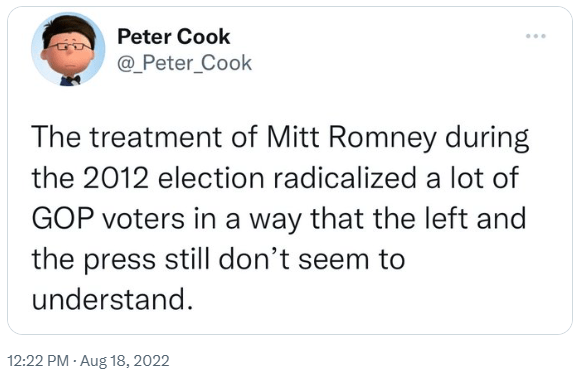
“Murc’s Law” [was] named after a commenter at the blog Lawyers, Guns, and Money who noticed years ago the habitual assumption among the punditry that Republican misbehavior can only be caused by Democrats. Do Republicans reject climate science? Must be because Democrats failed to persuade them! Did Republicans pass unpopular tax cuts for the rich? Must be that Democrats didn’t do enough to guide them to better choices! Do Republicans keep voting for lunatics and fascists? It must be the fault of Democrats for being mean to them! Even D____ T____’s election was widely blamed on Democrats — who voted against him, to be clear — on the bizarre grounds that Barack Obama should have rolled over and just let Mitt Romney win in 2012:
Untitled6

Republicans are about to take power in the House of Representatives once again, and so, with exhausting predictability, we return to a Beltway narrative where none of the choices they will make with that power are their fault: It is somehow all because Democrats have failed to manage Republicans properly. Unsurprisingly, the latest example comes from Politico, which pins the blame for the rise of right-wing superstar Rep. Marjorie Taylor Greene not on the voters who sent her to Congress or the GOP leaders who indulge her or the conservative media that celebrates her. Instead, Greene’s popularity with Republicans is laid at the feet of Joe Biden and the Democrats.

“Biden World once ignored Marjorie Taylor Greene. Now it’s making her the face of the GOP,” announces a headline in Politico. But of course Biden had nothing to do with that, because Republicans had already done it.

Going back to the Times article, David Roberts of the Volts podcast says it’s a perfect example:

Murc’s Law says, basically: only the left has agency; the right is merely reacting, having its hand forced, being “pushed” or “shaped.”

This is not some quirk, it is central to reactionary psychology. Every fascist (and fascist-adjacent) movement ever has told itself the same story: our opponents are destroying everything, they’re forcing us to this, we have no choice but violence.

It is, at a base level, a way of denying responsibility, of saying, “we know the shit we’re about to do is bad, but it’s not our fault, you made us.” Once you recognize the pattern it shows up *everywhere*. (If you know an abuser, you’ll also find it in their rhetoric.)

It’s one thing for reactionaries to cling to this … but what’s irksome is that right-wingers playing the refs have basically trained mainstream political journalists to echo it. It is laced throughout US political coverage.

One of my favorite examples … is the notion that Al Gore “polarized” climate change and thereby forced the right into decades of lies and demented conspiracy theories….  Why’d you do that to them, Al?!

Another instance is when it’s assumed that Democrats could have stopped Republicans from doing something bad if only they’d tried or tried harder or made stronger arguments. A commentator once joked:

… A few more BLISTERING speeches [from Democrats] and Mitch McConnell and Paul Ryan would have totally realized that upper-class tax cuts are wrong!

Headlines that obscure who did what are consistent with Murc’s Law. “Supreme Court overturns Roe v. Wade, ending right to abortion upheld for decades” — no, it was Supreme Court Republicans who did that. “Out of 18 pro-democracy bills in 2022, the US Senate filibuster torpedoed 17 of them” — no, it was Senate Republicans who torpedoed them. “What could happen if Congress doesn’t raise the debt limit?” — no, what could happen if House Republicans don’t vote to raise it?

Likewise, there are events that mysteriously take place. I had one in the blog a few days ago:

The Washington Post said “the [train] derailment [in Ohio] erupted into a culture battle”, as if culture battles simply happen without any help from the people who specialize in starting them and getting them in “the news”.

Here’s an even more recent one. From Investopedia:

Environmental, social, and governance (ESG) investing refers to a set of standards for a company’s behavior used by socially conscious investors to screen potential investments.

Environmental criteria consider how a company safeguards the environment, including corporate policies addressing climate change, for example. Social criteria examine how it manages relationships with employees, suppliers, customers, and the communities where it operates. Governance deals with a company’s leadership, executive pay, audits, internal controls, and shareholder rights.

Senate Republicans and two Democrats (Manchin and Tester) voted to kill a Labor Department rule that allows investment managers to consider ESG. From Talking Points Memo:

We talk about this stuff a lot as part of the “culture wars,” but that bestows a legitimizing gloss on it, as if there is some deeper, truer cultural dispute. There’s not. This a Republican tactic, and a highly effective one… It gets treated like these things just happen, as if Democrats or Fortune 500 companies stumble into previously unseen cultural war ambushes because they lack a feel for flyover country….

Note the passive voice here: “The business world has been pulled into partisan politics”…

This doesn’t just happen. Republicans and right-wing activists make it happen. They devote a lot of time, energy and resources to it. 

By almost any measure, Republicans have already won once they’ve “made it a partisan issue.” What seems to get misunderstood is that that’s the actual goal. Corporations and institutions don’t want to pick sides. They want to play it down the middle. So Republicans keep shifting the “middle” farther and farther right. By this point in these controversies, the game is basically over already. What’s maddening is that everyone keeps getting played.

Finally:

FqLDRTBagAAkHYT

Bring It On, He Said

You probably heard about a train accident in Ohio. The Washington Post said “the derailment erupted into a culture battle”, as if culture battles simply happen without any help from the people who specialize in starting them and getting them in “the news”. Josh Marshall of Talking Points Memo tells Democrats how to respond:

In recent days I’ve seen every major paper write a version of the How Did This Tragic Train Derailment Become a New Culture War story. I didn’t need to ask myself whether any of them gave the actual answer, which I think most of us know [Checks notes…They didn’t].

How is it that a train derailment caused by a major Republican-donating corporation, in a state run by a Republican governor, caused at least in part by regulations rolled back by Republican President D____ T____ … well, how exactly is that a story about Democrats not caring about people in “flyover country”? The Republican crackpot investigations complex is even now prepping to hold hearings about it.

The reality of the situation is that big corporations like Norfolk Southern spend millions in Washington for lax regulation and our railroad infrastructure is woefully aged and deficient — and not just for freight rail. Virtually every upgrade to the country’s railroad infrastructure and the quality of its rail stock pays dividends either in safety or efficiency. Republicans are simultaneously calling out corporations for not caring about ordinary Americans while carrying their anti-regulatory water on Capitol Hill. Democrats should run a freight train right through that contradiction. Only good things can come of it.

Democrats should pound on the fact at every opportunity that the T____ White House not only rolled back those regulations but T____ literally bragged about doing so on Twitter.

But that’s hardly enough. Democrats, led by the White House, should immediately bring forward expansive legislation to bring America’s railroads up to code, to not only add additional health and safety regulations but change the formulas and frameworks through which new regulations are promulgated. (They’re currently held captive by a framework of narrow cost-benefit analysis which does not take into account the true externalities and consequences of man-made disasters like these.) That legislation is the answer to every Republican’s crocodile tears about how did this happen? Why was Norfolk Southern allowed to do this? How do we prevent this from ever happening again?

You call it the Rail Safety and Corporate Accountability Act of 2023. You keep flogging it nonstop and certainly every time the East Palestine catastrophe comes up. It should be Democrats’ focus in any hearings about it. Was it terrible? Yes. Pass the Act. Should the big corporations be held accountable? Definitely. Pass the Act.

But it has to come now, not in response to more caterwauling months from now.

Does this mean the law will pass? It might. Even under a Republican House. There are actually signs of some emerging bipartisan agreement on passing new legislation. But if Republicans refuse to bring such a bill or any reasonable approximation of it to a vote let them explain why they oppose it.

Few things are more important in politics than making clear why things happen or fail to happen. That includes the policies that allow them to happen and the people who keep those policies in place. There is a rearguard chorus from the left saying that Obama should have done more than the limited regulations he advanced within current law and that Biden should have done more in his first two years to restore the regs that T____ turned back. Fair enough. All the more reason to pass the Act.

For Democrats, the policy and the politics line up exactly. They should be leaning into it. Yes, Republicans react to their own policy failures with performative pearl-clutching. Elite media buys it every time. But that’s only a conversation for people already part of the reality-based community. More importantly, being right about that doesn’t make future toxic chemical derailments any less likely. President Biden’s State of the Union address shows the rhetorical mold in which to sell it.

Introduce the legislation and push it hard. Make clear to everyone what the problem is and where everybody stands and increase the chances of actually improving things. Policy and politics line up precisely.

It Used To Be the Blue and the Gray; Now It’s Blue and Red

One of the most moronic members of Congress was in the news recently when she proposed a “national divorce”. Red and blue states would go their separate ways. She’d have us remain one country, but the national government would have much less authority than it does now.

American politics being what it is these days, many of us, probably most of us, have thought it would be a good idea if those other states — the crazy ones — went off and formed their own damn country. Unfortunately, this would be a very difficult thing to do.

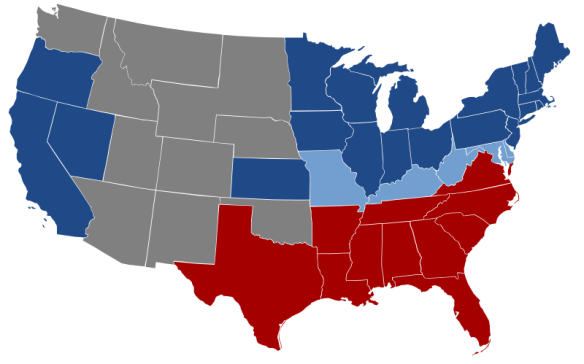
Back in 1861, the country was geographically divided between the North and South. The South  had slavery, its “peculiar institution”, and the North didn’t. But the division wasn’t that clearcut. There were five “border states” (Missouri, Kentucky, West Virginia, Maryland and Delaware, moving from west to east) that permitted slavery but didn’t secede from the Union. They’re the light blue ones below (the gray areas were relatively unsettled “territories” that hadn’t yet become states).

US_map_1864_Civil_War_divisions.svg

President Lincoln’s Emancipation Proclamation was only intended to end slavery in the eleven states that had seceded. It wasn’t until the 13th Amendment to the Constitution was ratified in 1865 that slavery was abolished everywhere. But geography made it relatively easy for the southern states to try to leave.

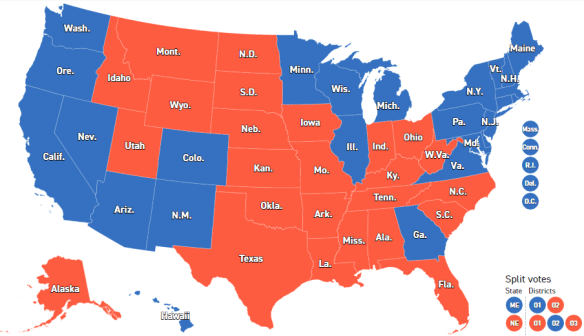
Dividing America by red and blue states is more complicated today. This map shows the results of the 2020 presidential election. The blue states voted for the Democratic winner; the red ones for the Republican loser. The red states are connected; the blue ones aren’t. And look at Georgia all by itself. (That’s where the Republican moron who proposes a national divorce was voted into Congress. Based on this election, she’d want to relocate.)

Untitled This way of portraying an election makes sense in terms of our obsolete Electoral College, since it requires each state to hold its own separate presidential election. In almost every state, a candidate gets all of that states “electoral votes” if they beat their opponent by one vote in that state’s election.

But a state-level map hides something important about American politics. After the 2004 election, the editors of a Seattle alternative paper called “The Stranger” wrote about our Urban Archipelago:

Look at our famously blue West Coast. But for the cities—Seattle, Portland, San Francisco, Los Angeles, and San Diego—the West Coast would be a deep, dark red. The same is true for other nominally blue states. Illinois is almost entirely red—Chicago turns the state blue. Michigan is almost entirely red—Detroit, Lansing, Kalamazoo turn it blue. And on and on. What tips these states into the blue column? Their urban areas do, their big, populous counties….

Liberals, progressives, and Democrats do not live in a country that stretches from the Atlantic to the Pacific, from Canada to Mexico. We live on a chain of islands. We are citizens of the Urban Archipelago, the United Cities of America. We live on islands of sanity, liberalism, and compassion—New York City, Chicago, Philadelphia, Seattle, St. Louis, Minneapolis, San Francisco, and on and on.

And we live on islands in red states too—a fact obscured by that state-by-state map. Denver and Boulder are our islands in Colorado; Austin is our island in Texas; Las Vegas is our island in Nevada; Miami and Fort Lauderdale are our islands in Florida. Citizens of the Urban Archipelago reject heartland “values” like xenophobia, sexism, racism, and homophobia, as well as the more intolerant strains of Christianity that have taken root in this country….

For Democrats, it’s the cities, stupid—not the rural areas, not the prickly, hateful “heartland,” but the sane, sensible cities—including the cities trapped in the heartland.

This map shows the 2020 election by county instead of state. The blue dots are the Urban Archipelago, the United Cities of America. (The map also shows how Biden managed to win by 7.5 million votes, unlike state-level maps that ignore how many people are in those states.)

Untitled

Of course, not everybody in Los Angeles County or Miami-Dade voted for Democrats. But on top of all its other problems, a “national divorce” by state would strand millions of Democratic city dwellers in red Republican states free to become even more reactionary and dangerous to live in.

Even though un-uniting the United States is unlikely, thinking about the possibility helps us understand our country’s political geography. According to a 2019 paper by Will Wilkinson of the Niskanen Center, it’s all about cities and population density. The title of the paper is “The Density Divide: Urbanization, Polarization and the Populist Backlash”. Here’s his summary of his findings:

We’ve failed to fully grasp that urbanization is a relentless, glacial social force that transforms entire societies and, in the process, generates cultural and political polarization by segregating populations along the lines of the traits that make individuals more or less responsive to the incentives that draw people to the city. I explore three such traits — ethnicity, ideology-correlated aspects of personality, and level of educational achievement — and their intricate web of relationships. The upshot is that, over the course of millions of moves over many decades, high density areas have become economically thriving, multicultural havens while whiter, lower density places are facing stagnation and decline as their populations have become increasingly uniform in terms of socially conservative personality, aversion to diversity, and lower levels of education. This self-segregation of the population, I argue, created the polarized economic and cultural conditions that led to populist backlash [note: and the election of You Know Who in 2016].

Because the story of urbanization just is the story of a strengthening relationship between density, human capital and economic productivity, it’s also the story of relative small town and rural decline. The same process that has filtered better-educated, more temperamentally liberal whites out of lower density places has left those places with less vibrant economies, but also with more place-bound, ethnocentric populations.

It’s no shock that leavers leave and stayers stay. What’s surprising is that, if you’re white…,  the personality traits that make you more or less inclined to leave or stay — that make you more or less magnetized to the rising attractive force of the city — also predict how socially conservative or liberal you’ll tend to be, and which political party you’ll tend to support.

So the pull of urbanization has segregated us geographically on those traits, and it has done it so thoroughly that Democratic vote share now rises, and Republican vote share drops, in a remarkably linear fashion as population density rises. The relationship between density and party affiliation is, with few exceptions, similar everywhere — in “red states” and “blue states,” in sprawling metro regions and bucolic small towns — and majorities tend to flip at the density typical of a big city’s outer suburbs. I call this partisan polarization on population density the “density divide.”

When populations segregate geographically on traits relevant to ideology and party affiliation, political polarization is sure to follow. The increasing concentration of the economy in big cities, which is both a cause and effect of urbanization, amplifies this polarization. Rising prosperity reliably produces a liberalizing, tolerant, positive-sum mood. Material insecurity, in contrast, tends to elicit a grim, zero-sum, us-or-them mindset. Because the sunshine of prosperity has become increasingly focused on urban populations, lower density white populations — which, thanks to the sorting logic of urbanization, are already more conservative and ethnocentric — have been left with objectively darkening prospects and a mounting sense of anxiety that is, at once, economic and ethno-cultural.

This combination of conditions created a political opportunity [a certain orange demagogue]  managed to exploit. Because urbanization is reshaping societies everywhere around the world, it has created similar conditions, and similarly illiberal strongman leaders, in other countries as well. If we’re going to be able to do anything about the acrimony of polarization and the peril of ethno-nationalist populism, we’re going to have to get the story straight. This cross-disciplinary account of the social and psychological forces behind the density divide is my preliminary attempt to put us, finally, on the right track.

The Good News About Social Security

Democrats created Social Security in 1937 over the usual Republican opposition. People with jobs put money in while they work and take money out (usually more than they put in) when they retire. The program has been in the news lately because President Biden pointed out that at least one leading Republican had suggested Social Security and all other government programs should cease to exist every year unless the president and Congress agreed to renew them in some form or other (he seems to have backed away from that position after more people heard about it).

Since Social Security and its finances are a big deal, it helps to know the truth. Josh Marshall of Talking Points Memo explains:

Political reporters remain way behind when it comes to seeing through the flimflam of Republicans’ schemes to cut or dismantle Social Security. [Too often,] press accounts of the financing of the program [aare] trapped in Republican talking points. In X number of years, we hear again and again, Social Security will become “insolvent.”

But this isn’t true. At best, it’s a totally misleading way to describe how the federal government pays for things.

Social Security and Medicare are funded (almost entirely) by a payroll tax of approximately 15% on wage and salary income up to a statutory cap, which currently stands at $160,200. That tax is split between the employer and the employee. It funds the two programs. A couple generations ago, Congress increased the tax to build up a surplus to pay for the benefits of the Baby Boom generation. That’s the “trust fund.” Social Security “lent” that extra money to the rest of the federal government, i.e., it purchased government bonds. Eventually the Trust Fund will run out of bonds to cash in. The current estimate is that it will happen in the mid-2030s. This is when Social Security supposedly becomes “insolvent.”

But that’s a meaningless term. The federal government has to pay its promised benefits. If they can’t all be paid out of payroll taxes, the remainder can and will be paid out of general revenues. This was actually the assumption about what would eventually happen back when the program was founded almost a century ago. (Look it up.)

This doesn’t mean it’s a non-issue. It means there will be a funding gap and that’s a budgetary issue to be resolved. It’s not “insolvent.” That’s just scare talk. Now, how can the funding gap be resolved? You could just pay the remainder out of general revenue (the general tax base of income, corporate, capital gains and other taxes that are not tied to any specific program). But there’s another more straightforward approach: just rejigger the payroll tax.

You could simply raise the payroll rate. But that’s a bad idea….Payroll taxes are really regressive. You’re paying about 7.5% on the first dollar you make up to $160,200. No deductions or anything. Every dollar. Most economists would say you’re actually also paying the employer side too because that’s money that goes to the cost of employing people that would otherwise go to the employee. So there’s a good argument that low- and middle-income workers are paying a flat tax of 15% on every dollar they make. It makes no sense to raise that rate. The simpler and more equitable solution is just to raise the cap.

It gets raised every year by a calculus tied to cost of living and related measures… But I mean raise it to a higher level, beyond the annual increase. There are various ways to do this. You can just raise the number from $160k to say $200k or $250k. Or, perhaps more equitably, you could leave the cap at $160k and have it kick in again starting at $500k. That way you put most of the burden on very high income earners.

Obviously there are a limitless number of ways you can do this. The point is that there are really basic budgetary changes that solve the problem — the problem being that there is a larger share of retirees to younger workers. (Another way to help with this problem is to welcome more working-age immigrants.)

Of course, you could just start cutting benefits — as Republicans want to do. But that’s a values question more than an economics one. Who should carry the burden of this shortfall, seniors on fixed incomes or the people getting rewarded most in the current economy? Income inequality is a key part of this equation on every front, both as a matter of equity and adjusting Social Security finances and because rising income inequality has itself weakened Social Security financing. As more income has been pushed into the higher tax brackets, more income has been removed from the Social Security tax base.

The global point is that there’s no “insolvency” or “bankruptcy.” That makes the whole thing sound like some looming crisis, which it’s not.

For example, Senators Elizabeth Warren and Bernie Sanders have proposed changes that would keep Social Security fully funded for 75 years (and increase benefits).

More from Mr. Marshall:

Since we’re talking about whether Social Security survives for future generations, we should start with understanding the various ways the program’s foes propose to limit or get rid of it. Since Social Security is one of America’s most popular government programs, virtually no one says they want to get rid of Social Security…. Plans to cut it or phase it out entirely are almost all framed as ways to “improve it” or “save” it….

For years, the Republican policy of choice was converting Social Security into a 401k-like system of private accounts. This was billed as a way to avoid the program’s inevitable “bankruptcy” and make it “better”…. This is what President Bush tried and failed to do in 2004 and 2005. There’s nothing wrong with a 401k….But it’s not Social Security. [A] 401k places the risk on the individual rather than socializing the risk, which is the heart of what social insurance [like] Social Security is….

The other approach Republicans look toward is to leave the structure of the program more or less as it is and just reduce the benefits. There are three different ways benefit cuts are usually proposed…

The first is simply to increase the age of eligibility [since] people live longer than they did when the program was first created… Regardless, it’s still a cut. Fewer years of eligibility means fewer total dollars you receive. It also means needing to work longer [note: which is fine for people in Congress but not so great if you work in construction or some other physically taxing job].

The second approach is to change the formula that determines the annual increases that allow security benefits to keep up with the cost of living… There is actually some real debate about whether the current cost of living formula is the most “accurate” way to calculate cost of living and purchasing power. It’s highly, highly technical, but the technical issues are mostly beside the point… It’s still a cut from the current formula. A beneficiary in 2060 will get a smaller check than they would have with the current system…

The third broad category is what’s called “means testing”. You save money by seeing how much people really need the money when they retire. Advocates of this approach point out that Bill Gates doesn’t need his Social Security check….In practice, of course, [means testing would have] to apply to a lot more people than  Bill Gates… Otherwise you’re not saving any money….

This very broad overview leaves out a lot of detail, and not just technicalities. Social Security supports a lot of people across the age spectrum [including the disabled], not just retirees. Because my mother died when I was a child, my father (or whoever had been my legal guardian) received Social Security checks to support the costs of raising me until I turned 18….

No one is going to argue with “making Social Security better”. But it’s hard to see how cutting benefits make it better….The only way you can make the argument that cuts make Social Security “better” is if you start with the claim that it’s currently “going bankrupt.” But it’s not.

And one last thing:

Despite the fact that Republicans have been demanding cuts and a phase-out for years and despite the fact they will continue to do so after the current burst of media attention abates, they are now demanding that President Biden not say what their policy is….Indeed, what’s especially weird is how many Republicans can’t help restating their demand for cuts [such as increasing the age of eligibility and means testing] even while denying their demand for cuts….

When It’s Time to Throw in the Towel

Imagine you are one of the millions of high school students who take the Scholastic Aptitude Test in your senior year. You get your results and believe the company that administers the test, the College Board, made a serious mistake. You must have scored much higher than they say. A few people you know think you could be right, but most people you talk to are doubtful. You sue the College Board and a judge, citing your lack of evidence, quickly dismisses your case. So you spend thousands of dollars hiring a respected research firm to confirm your suspicions. They find out if other students are disputing the results. They look at your grades and previous test results. They even give you a practice test and your score is no better than the official result you got in the mail. Would anybody believe you if you said you just know you scored much higher?

Now imagine that you ran for president and lost. From The Washington Post:

Former president T____’s 2020 campaign commissioned an outside research firm in a bid to prove electoral fraud claims, but never released the findings because the firm disputed many of his theories and could not offer any proof that he was the rightful winner of the election, according to four people familiar with the matter. A person familiar with the findings said there were at least a dozen hypotheses that T____’s team wanted tested.

The campaign paid researchers from Berkeley Research Group, the people said, to study 2020 election results in six states, looking for fraud and irregularities to highlight in public and in the courts. Among the areas examined were voter machine malfunctions, instances of dead people voting and any evidence that could help T____ show he won, the people said. None of the findings were presented to the public or in court.

About a dozen people at the firm worked on the report, including econometricians, who use statistics to model and predict outcomes, the people said. The work was carried out in the final weeks of 2020, before the Jan. 6 riot of T____ supporters at the U.S. Capitol….

“They looked at everything: change of addresses, illegal immigrants, ballot harvesting, people voting twice, machines being tampered with, ballots that were sent to vacant addresses that were returned and voted,” said a person familiar with the work who, like others, spoke on the condition of anonymity to describe private research and meetings. “Literally anything you could think of. Voter turnout anomalies, date of birth anomalies, whether dead people voted. If there was anything under the sun that could be thought of, they looked at it.”

The findings were not what the T____ campaign had been hoping for, according to the four people. While the researchers believed there were voting anomalies and unusual data patterns in a few states, along with some instances in which laws may have been skirted, they did not believe the anomalies were significant enough to make a difference in who won the election….

“None of these were significant enough,” this person said. “Just like any election, there are always errors, omissions and irregularities. It was nowhere close enough to what they wanted to prove, and it actually went in both directions”….

The research group’s officials maintained privately that they did not come into the research with any predetermined conclusions and simply wanted to examine the data provided by the T____ campaign in the battleground states….

The findings from Berkeley were among the many streams of information after the election that showed T____ he lost. According to testimony presented to the Jan. 6 committee, T____ was repeatedly told by advisers that he did not win the election, but continued to cast about for others who would entertain his theories and say that he had won. Dozens of judges — including many T____ appointees — rejected his campaign’s attempts to challenge election results in court….

The Berkeley research was done through a subsidiary company called East Bay Dispute and Advisory. FEC filings show the T____ campaign paid East Bay Dispute and Advisory more than $600,000 in the final weeks of 2020. A person familiar with the matter said there were also other researchers commissioned to help prove electoral fraud from outside Berkeley Research Group…..

Those who worked on the report included Janet Thornton, who has about 40 years of experience in accounting and investigations, according to Berkeley Research Group’s website. [The] professional biographies [of others] describe decades of experience in accounting, investigating corporate fraud and handling other complicated inquiries.

They didn’t make the company’s findings public because they just know he won.