The Paranoid Style in American Politics by Richard Hofstadter

The historian Richard Hofstadter (1916-1970) is known outside academic circles for having written a particular book and a particular essay. The book was Anti-intellectualism in American Life from 1963. The essay was “The Paranoid Style in American Politics” from 1964.

This is a book of Hofstadter’s collected essays. His famous essay gives the book its title; there are three other essays on the same topic. “The Pseudo-Conservative Revolt” was written in response to McCarthyism. “Pseudo-Conservatism Revisited” and “Goldwater and Pseudo-Conservative Politics” were written in response to Senator Barry Goldwater’s successful effort to win the Republican nomination for President.

These essays may have been written more than 50 years ago, but they are highly relevant today, given America’s disastrous election two months ago. Our next President ran a classic pseudo-conservative campaign, claiming to be a “conservative” but appealing to the same right-wing extremism that characterized the likes of Sen. Joe McCarthy, the John Birch Society and Barry Goldwater. (The President-elect owes his greater success in 2016 to the fact that “normal” Republicans are much more extreme than they used to be.)

Hofstadter explores the history of right-wing extremism through the 20th century, but concentrates on developments since World War 2. He explains that as more people did well in economic terms, a reactionary minority grew angrier and angrier about changes in society. Conservatism became a form of radicalism, with seething hatred toward moderate politicians and deep resentment of the progress made by women and African-Americans. Anyone who wants to understand how we got to the current low point in American history will benefit from reading Richard Hofstadter.

It’s Been With Us For Years, But Gotten Worse

The historian Richard Hofstadter (1916-1970) is known outside academic circles for having written a particular book and a particular essay. The book was Anti-intellectualism in American Life from 1963. The essay was “The Paranoid Style in American Politics” from 1964. I read the essay a few days ago in a collection of Hofstadter’s work. Anyone who wants to understand how we got to this point in American history will benefit from reading Richard Hofstadter.

He explains, for example, the basis for “economic individualism”, the idea that it’s not only more efficient but more ethical that everyone should sink or swim on their own. Thus, poor or working-class conservatives are often against anyone receiving help from the government, even though they could use that help themselves:

On many occasions they approach economic issues as matters of faith and morals rather than matters of fact. For example, people often oppose certain economic policies not because they have been or would be economically hurt by such policies, or even because they have carefully calculated views about their economical efficacy, but because they disapprove on moral grounds of the assumptions on which they think the policies rest….Deficit spending might work to their advantage; but the moral  and psychological effect, which is what they can really understand and feel, is quite otherwise: when society adopts a policy of deficit spending, thrifty [conservatives] feel that their way of life has been officially and insultingly repudiated [“Pseudo-Conservatism Revisited – 1965”].

Hofstadter borrowed the term “pseudo-conservative” from the German thinker Theodore Adorno. He explained why in an earlier essay written in response to McCarthyism:

There is a dynamic of dissent in America today…The new dissent is based upon a relentless demand for conformity… Its exponents, although they believe themselves to be conservatives and usually employ the rhetoric of conservatism, show signs of a serious and restless dissatisfaction with American life, traditions and institutions. They have little in common with the temperate and compromising spirit of true conservatism in the classical sense of the word…Their political reactions express rather a profound … hatred of our society and its ways – a hatred which one would hesitate to impute to them if one did not have suggestive evidence from clinical techniques and from their own modes of expression [From “The Pseudo-Conservative Revolt”, 1954].

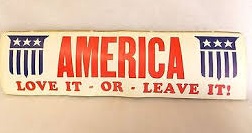
Remind you of anyone you know? I mean, who in public life expresses more contempt for America in the 21st century than the next President and his fans, the vocal minority that wants to make this country “great” (i.e. “white”) again? Maybe the Democrats should have revived those popular bumper stickers from the 1960s, the ones aimed at Volkswagen-driving hippies and protesters.  

download-4

Finally, here’s what Hofstadter said about the Republicans’ first pseudo-conservative Presidential nominee, Senator Barry Goldwater:

Unquestionably, Goldwater’s ideas do retain some shreds and scraps of genuine conservatism, but the main course of his career puts him closer to the right-wing ideologues who were essential to his success, who shaped his tactics, who responded to his line of argument… How are we to explain the character of a “conservative” whose whole political life has been spent urging a sharp break with the past, whose great moment as a party leader was marked by a repudiation of our traditional political ways, whose followers were so notable for their destructive and divisive energies, and whose public reputation was marked not with standpattism or excessive caution but with wayward impulse and recklessness? [“Goldwater and Pseudo-Conservative Politics”, 1964].

Again, remind you of anyone you know?

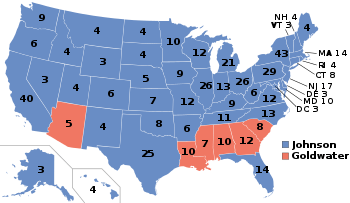
Fortunately, Lyndon Johnson beat Goldwater by 26 million votes (rather than 3 million) and by 61% to 27% (rather than 48% to 46%). Goldwater only won six states in the 1964 election: the five former slave states of the Deep South and his home state of Arizona. That gave him 52 electoral votes compared to Johnson’s 486. 

electoralcollege1964-svg

In addition to being a pseudo-conservative, Goldwater had no particular qualifications to be President. Before being elected to the Senate, he managed the family department store. In the Senate, he played no significant role. In Hofstadter’s words, “his main business there was simply to vote No”. He was still an “outsider” even after 12 years in Washington.

Goldwater’s extreme positions and lackluster qualifications contributed to his historic defeat. Fifty-two years later, due to a variety of circumstances, another pseudo-conservative, this time with no government experience at all, won narrow victories in enough states to win the White House. Given their appeal to the same sorts of voters, and given the fact that our next President is obviously suffering from a personality disorder (whereas Goldwater was relatively normal in that regard), it’s fair to say our democracy is showing signs of wear and tear that are beyond serious.

Addendum:

The journalist James Fallows recently reported the following conversation with a U.S. Senator:

Q:  How many of your colleagues know that there is something wrong with T***p?
A:  All of them, obviously.
Q:  Which Republican will be the first to say so?
A:  Ummmm….

How Shall We Describe the Orange Menace?

Language helps us cope with the world. That’s why using the right words matters. Telling your companion there’s “something” behind her would be accurate, but telling her it’s a “bear” would be better, assuming it really was a bear.

This explains the continuing effort to find the right terminology for President-elect Orange Menace. He’s been called “insane” and a “demagogue”, a “con man” and a “thug”.  He’s been described as an “arrogant orange idiot”.

In fact, those last three words, “arrogant”, “orange” and “idiot” are the three most popular responses at Trump In One Word. That’s the helpful site where you can submit a pungent word of your choice to describe him, see which words have been chosen most often, and even find out what words your (anonymous) neighbors selected (good job, neighbors!).

Which brings me to the “fascist” issue. Some observers think the next President is clearly a fascist or at least exhibits strong fascistic tendencies. Others see similarities but don’t think he satisfies enough of the criteria (yet anyway) to put him in the same category as Mussolini, Hitler or Francisco Franco. All the experts agree he’s an authoritarian, right-wing demagogue, but they don’t all agree that he’s a “fascist”. The truth is they don’t even agree on how to define the term. Hence, the “fascist” problem.

[Before we proceed, please note that I recently began using the Google Chrome extension Rename T___p. That’s why you will see “*****” where the O.M.’s name appears in the text I’ll be quoting. It’s a very nice tool. I chose “*****” for everyday use, but it was gratifying to see that “Orange Menace” is the 13th most popular T___p replacement – not as popular as “Fuckface Von Clownstick”, of course – but still doing very well. The extension is free and available here.]

One scholar, Sarah Kendzior, has argued that we should compare the O.M. to the rulers of a few countries we don’t usually hear about:

Left out – as always – have been the dictatorships of former Soviet Central Asia: Uzbekistan, Turkmenistan, Tajikistan, Kazakhstan, and (to a lesser degree) Kyrgyzstan.

The Central Asian states are dictatorships. They are also spectacular. And it is by examining this–dictatorship as spectacle–that the parallels to ***** emerge… The nation becomes a brand; the dictator, a brand ambassador; the people, a captive audience….

…Spectacle soothes the masses while distracting them from their suffering. *****, a master of the American reality TV genre which has made a spectacle of human suffering – he made “You’re fired!” a beloved tagline … – knows how to make an audience feel included through the theatrical exclusion of others. This tactic carries over into *****’s rallies, where protesters are booted — and sometimes beaten — with fanfare. It also carries over into his policies, which are structured around exclusion: a wall against Mexico, banned entry for foreign Muslims, a database for U.S. Muslims, and a media denied access unless they acquiesce to *****’s demands…

The most obvious corollary to ***** is Turkmenistan’s deceased leader Niyazov … best known for the monuments and dictates bolstering his personality cult. They included building a giant golden statue of himself which rotated to face the sun; renaming the months and common words, like “bread”, after his relatives; and the Ruhnama, a collection of autobiographical anecdotes … and parables which all citizens were required to read. (A giant electronic version of the Ruhnama blared Niyazov’s wisdom from its perch in the capital.)….

“I’m personally against seeing my pictures and statues in the streets, but it’s what the people want,” explained Niyazov when asked about his ubiquitous visage. It is easy to imagine ***** making similar claims… It is also easy to imagine [him] building a giant golden statue of himself that revolves to face the sun.

Unfortunately, there’s no word that means “the leader of a dictatorship in former Soviet Central Asia”. And the phrase “***** is another Niyzaov” probably wouldn’t catch on.

In a similar vein, however, a few writers have suggested that “caudillo” would be a good label for the Orange Menace. It’s Spanish for “leader”. Thus, Franco proclaimed himself “El Caudillo” just like Mussolini was “Il Duce” and Hitler “Der FĂĽhrer”. One might object that ***** isn’t as fascistic as those other villains, but the word has a longer and more varied history than its use in the glorification of Francisco Franco.

Paul Campos at the Lawyers, Guns & Money blog explains:

The classic Caudillo is a charismatic populist, who attacks the existing political and economic establishment with what might be called trans-ideological enthusiasm.  He claims that he and he alone has the ability to solve the nation’s problems, and to be the voice of the dispossessed.  He bullies his opponents, he persecutes any media who do not grovel before him, he boasts of his supposed sexual prowess, he has a narcissistic and therefore unquenchable thirst for public adulation, he is openly contemptuous of formal legal restraints, and he talks constantly of restoring the nation to its former grandeur.  To bolster his political base he uses the latest social media to speak as directly as possible to his followers, cutting out traditional forms of governmental and journalistic intermediation.  And he loves to make lots of absurd and expensive promises, often in the form of spectacularly ridiculous government projects, many of which are designed to keep out or expel contaminating and subversive foreign influences.

Remind you of anyone?

Mr. Campos then asks why this bizarre and dangerous person has made such an alarming dent in our politics:

I suspect the answer has much to do with the extent that the United States economy is coming to resemble many a Latin American breeding ground for narcissistic despots.  In terms of relative levels of economic inequality, the U.S. now looks much more like Latin America than Europe, and the trend is only getting stronger.  As Omar Encarnacion notes:

“… *****, like many caudillos, has capitalized upon his status as a political outsider. This status, ***** argues, best allows him to blow up the current political system and to replace it with something that would work for everyone, but especially for those feeling left behind.”

… All of which is to say that, especially now, it would benefit us all to pay much more attention to both the history and the present circumstances of our various southern neighbors.

Words matter, because they help us make our way in the world. Beginning January 20, the words we use may be more important than any we living Americans have ever used before.

The Red Menace Isn’t What It Used To Be. It’s Not Even Red. It’s Orange.

One thing everyone needs to understand about the Orange Menace’s love for Russian dictator Vladimir Putin is that Russia isn’t a Communist country anymore. Boris Yeltsin banned the Communist Party of the Soviet Union back in 1991, shortly before the Soviet Union was formally dissolved. Putin resigned from the party that year.

In 1995, Putin helped organize the pro-government “Our Home Is Russia” party. In 1999, he joined the new “Unity” party. That’s the same year he described Communism as “a blind alley, far away from the mainstream of civilization”. In 2008, during his second term as Prime Minister, Putin became the leader of the “United Russia Party”.

Although there are still quite a few Communists in Russia, the Communist Party of the Russian Federation is much less popular than United Russia. In this year’s election, Putin’s party got 54% of the vote. The Communists came in second with 13%.

Since Putin isn’t a Communist anymore, what is he? Here’s how Wikipedia describes United Russia:

The Party has no coherent ideology; however, it embraces specific politicians and officials with a variety of political views who support the administration. The Party appeals mainly to non-ideological voters; therefore, United Russia is often classified as a “catch-all party” or as a “party of power“. 

In 2009 the United Russia Party proclaimed “Russian Conservatism” as its official ideology.

United Russia isn’t so much a political party that tries to win elections in order to carry out a set of policies. Instead, it’s one of the tools used by the rich and powerful to win elections so they can maintain their positions at the top of Russian society.

Putin began his political ascent when he was put in charge of the Presidential Property Management Department in the late 1990s. His job was to manage the transfer of overseas property belonging to the Soviet Union and Communist Party to the new Russian Federation. That process had been going on since the fall of the Soviet Union. But instead of being transferred to the new government, much of that property was “privatized”. In other words, it ended up in the hands of a small number of well-placed people, including Putin, who quickly became extremely rich. 

In the words of the economist and lawyer James S. Henry, whose long article “The Curious World of Donald T___p’s Private Russia Connections” tells the sordid story in detail:

…One of the most central facts about modern Russia [is] its emergence since the 1990s as a world-class kleptocracy, second only to China as a source of illicit capital and criminal loot, with more than $1.3 trillion of net offshore “flight wealth” as of 2016…

[It was] one of the most massive transfers of public wealth into private hands that the world has ever seen.For example, Russia’s 1992 “voucher privatization” program permitted a tiny elite of former state-owned company managers and party apparatchiks to acquire control over a vast number of public enterprises, often with the help of outright mobsters.

A majority of Gazprom, the state energy company that controlled a third of the world’s gas reserves, was sold for $230 million; Russia’s entire national electric grid was privatized for $630 million; ZIL, Russia’s largest auto company, went for about $4 million; ports, ships, oil, iron and steel, aluminum, much of the high-tech arms and airlines industries, the world’s largest diamond mines, and most of Russia’s banking system also went for a song.

In 1994–96, under the infamous “loans-for-shares” program, Russia privatized 150 state-owned companies for just $12 billion, most of which was loaned to a handful of well-connected buyers by the state… The principal beneficiaries of this “privatization”—actually, cartelization—were initially just 25 or so budding oligarchs with the insider connections to buy these properties and the muscle to hold them.… 

For the vast majority of ordinary Russian citizens, this extreme re-concentration of wealth coincided with nothing less than a full-scale 1930s-type depression, a “shock therapy”-induced rise in domestic price levels that wiped out the private savings of millions, rampant lawlessness, a public health crisis, and a sharp decline in life expectancy and birth rates.

Is it any wonder at all that Vladimir Putin, the man in charge of this highly successful criminal enterprise, is one of the Orange Menace’s favorite people? T___p built his real estate career on tax breaks from local government (a billion dollars from New York City alone), tax evasion, loans that were never repaid and a number of shady deals, while Putin should be made an honorary member of the Republican Party. Donnie and anti-Muslim, super-secretive white guy Vladimir have a whole lot in common.

It’s remarkable that the Orange Menace hasn’t said a bad word about Putin or Russia since he began running for President, even though he’s criticized just about everyone else on Earth. It isn’t just admiration on T___p’s part. There has been a lot of money involved. Mr. Henry proceeds:

… For many banks, private bankers, hedge funds, law firms, and accounting firms, for leading oil companies like ExxonMobil and BP, as well as for needy borrowers like the Trump Organization, the opportunity to feed on post-Soviet spoils was a godsend. This was vulture capitalism at its worst.

The nine-lived Trump, in particular, had just suffered a string of six successive bankruptcies. So the massive illicit outflows from Russia … from the mid-1990s provided precisely the kind of undiscriminating investors that he needed. These outflows arrived at just the right time to fund several of Trump’s post-2000 high-risk real estate and casino ventures—most of which failed. As Donald Trump, Jr., executive vice president of development and acquisitions for the Trump Organization, [said] in September 2008 (on the basis, he said, of his own “half dozen trips to Russia in 18 months”):

“In terms of high-end product influx into the United States, Russians make up a pretty disproportionate cross-section of a lot of our assets; say in Dubai, and certainly with our project in SoHo and anywhere in New York. We see a lot of money pouring in from Russia.”

All this helps to explain one of the most intriguing puzzles about Donald Trump’s long, turbulent business career: how he managed to keep financing it, despite a dismal track record of failed projects.

According to the “official story,” this was simply due to a combination of brilliant deal-making, Trump’s gold-plated brand, and raw animal spirits—with $916 million of creative tax dodging as a kicker. But this official story is hokum. The truth is that, since the late 1990s, Trump was also greatly assisted by these abundant new sources of global finance, especially from “submerging markets” like Russia. [T___p and Putin] are not evil twins, exactly, but they are both byproducts of the … scams that were peddled to Russia’s struggling new democracy.

So, maybe the Orange Menace did something very bad on one of his trips to Russia and they’re blackmailing him. Maybe one of his fundamental desires is that the U.S. and Russia form an alliance to make weaker countries give up their nuclear weapons (as reported here). Maybe he sees Putin as an ally in the fight against Islamic radicals or a coming war with China. Maybe he views Vlad as a role model, since Putin often has his critics and enemies murdered. It seems likely, however, that it’s mostly about the money.

(For a look at one way Putin plans to rake in the rubles once the new President and the Secretary of State from Exxon are in charge, take a look at this. There’s a whole lot of oil just north of Russia.)

In Case You Missed It, Let’s Review the Crime That’s Still in Progress

Republican Senator Mitch McConnell and Republican FBI Director James Comey, with help from Vladimir Putin and Julian Assange, are in the process of stealing our election. They’ll do it unless the Electoral College does its constitutional, patriotic duty nine days from now and elects Hillary Clinton or some other qualified person.

The indictment:

According to the CIA, and probably the NSA too, neither of which are generally considered left-wing organizations, Russia hacked both Democrats and Republicans this year, but the Russians only gave the Democrats’ stolen information to Wikileaks. Wikileaks then gave the information, some of which was embarrassing to the Democrats and the Clinton campaign, to the world.

In September, President Obama informed Congressional leaders that the Russians had done this in order to elect the Orange Menace. Obama also requested a bipartisan declaration opposing the Russian interference in our election. But Senator McConnell, the Republican Majority Leader, wouldn’t make a joint statement, arguing that it would interfere with the election.

Instead, on October 7th, the Department Of Homeland Security and the Office of the Director of National Intelligence issued their own watered-down joint statement on Russia’s hacking activity, not pointing out that only information damaging to the Democrats was being revealed:

The U.S. Intelligence Community [which includes the CIA, FBI, NSA and thirteen other agencies] is confident that the Russian Government directed the recent compromises of e-mails from US persons and institutions, including from US political organizations…. These thefts and disclosures are intended to interfere with the US election process….We believe, based on the scope and sensitivity of these efforts, that only Russia’s senior-most officials could have authorized these activities.

Furthermore, on October 31st, the Financial Times reported that the Republican Director of the FBI was against making even that announcement:

FBI chief opposed US statement blaming Russia for hacks

Government official says James Comey had election timing concerns

Of course, only three days before, and only eleven days before the election, Director Comey ignored the Department of Justice policy against making such announcements near an election and sent a letter to Congressional leaders announcing a new investigation into emails possibly involving Hillary Clinton.

That letter was immediately leaked to the press and led to a blizzard of news coverage. The Orange Menace immediately declared that “this changes everything”. Although nothing at all came of the investigation, the Clinton and T—p campaigns agree that the FBI’s new suggestion of scandal was the crucial last-minute event that swayed enough voters to change the election. From Politico:

Top officials for both campaigns said the revelation—which turned out to be an inconsequential cache of previously parsed emails kept on the laptop of Clinton aide Huma Abedin’s estranged husband, Anthony Weiner—was a game-changer in a race in which Clinton had little margin for error. Elan Kreigel’s team saw her numbers collapse in the most volatile swing demographic: educated whites who had been repulsed by Trump’s sexual misdeeds.

To sum up: Vladimir Putin releases hacked emails in order to defeat Clinton. Julian Assange makes the emails public. Mitch McConnell and James Comey interfere with voters being told about Russia’s plan on the grounds that it will affect the election, i.e. hurt the Republican candidate. Meanwhile, Comey ignores Department of Justice policy and tells the world that there is more to the supposed Clinton email scandal, not caring that his last-minute “revelation” will affect the election, i.e. hurt the Democratic candidate.

Despite everything, Clinton gets almost 3 million more votes than T—p nationwide. But in three “swing” states that Clinton expected to win, T—p gets 77,000 more votes than Clinton, giving him the Electoral College majority necessary to become President.

As the saying goes, can you spell “coup d’Ă©tat”? How about “treason”? If you think that’s too harsh, how about “putting party ahead of country”?

The solution:

At this late date, the only ones who can prevent this crime from succeeding are the Republican members of the Electoral College. Thirty-seven of them can deny an unqualified, dangerous person the presidency and let the House of Representatives choose someone else. Forty-eight of them can switch to Hillary Clinton and elect the qualified person who got more votes. It’s that simple. 

And yet it’s that unlikely. What are the odds that there are more than a handful of Republicans among the 306 who will vote on December 19th who are sufficiently patriotic and sufficiently respectful of the Constitution to do what Alexander Hamilton said was necessary? Regarding the Electoral College, from The Federalist Papers, number 68:

Nothing was more to be desired than that every practicable obstacle should be opposed to cabal, intrigue, and corruption. These most deadly adversaries of republican government might naturally have been expected to make their approaches from more than one quarter, but chiefly from the desire in foreign powers to gain an improper ascendant in our councils. How could they better gratify this, than by raising a creature of their own to the chief magistracy of the Union?…

But the convention have guarded against all danger of this sort, with the most provident and judicious attention. They have not made the appointment of the President to depend on any preexisting bodies of men, who might be tampered with beforehand to prostitute their votes; but they have referred it in the first instance to an immediate act of the people of America, to be exerted in the choice of persons for the temporary and sole purpose of making the appointment….

All these advantages will happily combine in the plan devised by the convention; which is, that the people of each State shall choose a number of persons as electors, equal to the number of senators and representatives of such State in the national government, who shall assemble within the State, and vote for some fit person as President. Their votes, thus given, are to be transmitted to the seat of the national government, and the person who may happen to have a majority of the whole number of votes will be the President….

The process of election affords a moral certainty, that the office of President will never fall to the lot of any man who is not in an eminent degree endowed with the requisite qualifications. Talents for low intrigue, and the little arts of popularity, may alone suffice to elevate a man to the first honors in a single State; but it will require other talents, and a different kind of merit, to establish him in the esteem and confidence of the whole Union, or of so considerable a portion of it as would be necessary to make him a successful candidate for the distinguished office of President of the United States.

I mean, how amazing would it be, if a band of brave citizens, now being referred to as “Hamilton Electors”, rose to the occasion, saved the world and got complimentary tickets to the Broadway smash “Hamilton” too?

PS – Forgot to mention that T—p is going to appoint Senator McConnell’s wife to a cabinet position. Others in T—p’s cabinet, like the head of Exxon who will be Secretary of State, are very pro-Russian. But emails!

PPS – Nate Silver, respected political analyst and statistician, on Twitter: “Clinton lost 4 states (FL, MI, WI, PA) by ~1 point. If not for Comey/Russia, she probably wins them all by ~2 points & strategy looks great.”