Many States, Not Very United

If you asked them, most Americans would say that winning the Revolutionary War was the crucial step in the creation of the United States. The 13 colonies became a new nation once the British went home. Anyway, that’s the impression you’d get from the Wikipedia article about the Treaty of Paris, which put an end to the war eight years after the first shots were fired: 

The Treaty of Paris, signed in Paris by representatives of King George III of Great Britain and representatives of the United States of America on September 3, 1783, ended the American Revolutionary War. The treaty set the boundaries between the British Empire and the United States, on lines “exceedingly generous” to the latter…. Only Article 1 of the treaty, which is the legal underpinning of United States’ existence as a sovereign country, remains in force.

But this is what Article 1 of the treaty says:

His Brittanic Majesty acknowledges the said United States, viz., New Hampshire, Massachusetts Bay, Rhode Island and Providence Plantations, Connecticut, [etc.], to be free sovereign and independent states, that he treats with them as such, and for himself, his heirs, and successors, relinquishes all claims to the government, propriety, and territorial rights of the same and every part thereof.

Listing all thirteen “sovereign and independent states” from New Hampshire in the north to Georgia in the south is an odd way to refer to a new nation. It made sense, however, because at that point the thirteen colonies considered themselves to be separate states or nations. The “United States” referred to the thirteen countries loosely joined together by the Articles of Confederation:

I.

The Style of this Confederacy shall be “The United States of America”.

II.

Each state retains its sovereignty, freedom, and independence, and every power, jurisdiction, and right, which is not by this Confederation expressly delegated to the United States, in Congress assembled.

III.

The said States hereby severally enter into a firm league of friendship with each other, for their common defense, the security of their liberties, and their mutual and general welfare…

In his book The Quartet: Orchestrating the Second American Revolution, the historian Joseph Ellis says we should think of the United States at the end of the Revolutionary War as something like the European Union. I’d add that it was more like the EU plus NATO, but the point is that the people we call “Americans” considered themselves to be citizens of their respective states, not U.S. citizens. The colonists had banded together to win their independence from Great Britain. Having succeeded, they were willing to remain part of a “league of friendship”, but nothing more. Having won their freedom from a distant, centralized government, they didn’t want another one, even if the capital would be Philadelphia instead of London. 

After what became known as “Shays’ Rebellion”, an armed anti-government uprising centered in western Massachusetts, some feared that the “league of friendship” would fall apart. According to Ellis:

[Some expected] the complete collapse of the confederation leading to civil wars between the states and predatory intrusions by European powers, chiefly Great Britain and Spain, eager to carve up the North American continent… The more realistic scenario was dissolution into two or three regional confederacies that created an American version of Europe. New England would become like Scandinavia, the middle states like western Europe, the states south of the Potomac like the Mediterranean countries.

The New England press enhanced the credibility of such prophecies, observing that the attempt at a national union was obviously a failure because regional differences made political consensus impossible. The only option was a union of the five New England states, “leaving the rest of the continent to pursue their own imbecilic and disjointed plans”.

It should be noted that even during the writing of the Articles of Confederation, the state of South Carolina threatened to walk away over the issue of slavery, a threat that was finally carried out when South Carolina seceded from the Union 80 years later.

Looking back, John Adams wondered how the colonies had ever agreed on anything:

The colonies had grown up under conditions so different, there was so great a variety of religions, they were composed of so many different nations, their customs, manners, habits had so little resemblance and their intercourse had been so rare, and their knowledge of each other so imperfect, that to unite them in the same principles … and the same system of action, was certainly a difficult enterprise.

Considering America’s subsequent history, including the regional conflict that led to the Civil War; the continuing resistance to Federal law in the southern states during Reconstruction and into the 20th century; the current division between consistently “Red” and “Blue” states; the popularity of right-wing news media that cater to a desire for “alternative facts” in opposition to what’s reported in the “mainstream” media; and the bizarre fact that we hold 51 elections, separately administered by the individual states, in order to elect a President, it’s fair to say that creating a United States that’s truly united continues to be a “difficult enterprise” and may never succeed.

Do Your Damn Job!

Ezra Klein of Vox published an important article this week. It’s called “How To Stop An Autocracy” and includes one of those very long subtitles: 

The danger isn’t that T___ will build an autocracy. It’s that congressional Republicans will let him.

Klein begins with a surprising statement:

There is nothing about the T___ administration that should threaten America’s system of government.

Why? Because the men who wrote the U.S. Constitution didn’t want anyone to have too much power:  

The Founding Fathers were realistic about the presence and popularity of demagogues. The tendency of political systems to slip into autocracy weighed heavily on their minds. That power corrupts, and that power can be leveraged to amass more power, was a familiar idea. The political system the founders built is designed to withstand these pressures… The founders feared charismatic populists, they worried over would-be monarchs, and so they designed a system of government meant to frustrate them.

That’s the system we all learn about in school called “checks and balances”.

So why, then, are we surrounded by articles worrying over America’s descent into fascism or autocracy?

One reason, of course, is the President and the goons who carry out his orders or know how to push his buttons. At this point, that goes without saying.

6a00d8341c659b53ef01b8d25a450f970c-50

The more important reason, according to Klein, is that there is no evidence so far that Congress will do its job:

The president can do little without Congress’s express permission. He cannot raise money. He cannot declare war. He cannot even staff his government. If Congress, tomorrow, wanted to compel T___ to release his tax returns, they could. If Congress, tomorrow, wanted to impeach T___ unless he agreed to turn his assets over to a blind trust, they could. If Congress, tomorrow, wanted to take T___’s power to choose who can and cannot enter the country, they could. As [David Frum] writes, “Congress can protect the American system from an overbearing president.” He just thinks they won’t.

It’s unlikely Congress will protect us from the T___ administration because of an historical development the Founders didn’t foresee: the overriding importance of political parties. Klein quotes an editorial from The Salt Lake City Tribune:

All that stuff about the constitutional separation of powers, each of the three branches of government keeping a wary eye on the other two, doesn’t mean very much if it is taken seriously only when Congress and the White House are held by different parties… 

The Constitution assumes that human nature will push officials of each branch of government to jealously guard their own powers, creating a balance that prevents anyone getting up to too much mischief. But when elected officials are less interested in protecting their institution than in toeing the party line, it all falls apart.

That’s why we need to keep the pressure on our Senators and Representatives as the months go by. Klein concludes: 

… it is in Congress members’ districts — at their town halls, in their offices, at their coffee shops — where this fight will be won or lost….The real test will be in 2018 — Democratic turnout tends to plummet in midterm elections, and overall turnout was historically low in 2014. The result, as political scientist Seth Masket writes, is that Republicans are more afraid of their primary voters than general election voters. Their behavior will change if and when that changes.

And that should change. It should change in 2018, and it should change thereafter. Congress is more powerful than the president. It comes first in the Constitution for a reason. The public should demand more of it, and care more who runs it….

In the end, it is as simple as this: The way to stop an autocracy is to have Congress do its damn job.

Speaking of which, our Congressman, Leonard Lance, is one of the 24 Republicans in the country who represent a district that Hillary Clinton won. That means he’s more vulnerable than most of his colleagues. He’s also a perfect example of what’s wrong with Congress. From Wikipedia:

In the 2016 presidential election, Lance … was a strong supporter of [T___], for which he was criticized by the editorial board of The Newark Star-Ledger for becoming part of T___’s “cancer” in the GOP. The editors lamented that Lance was one of the GOP’s “saddest cases”, undergoing a transformation from principled environmentalist and man of integrity to being a toe-the-line party regular.[8] Lance’s 7th district was gerrymandered in 2011 to benefit the GOP… 

Yet he looks like such a nice guy. He could be one of your favorite teachers from high school.

220px-leonard_lance_official_portrait_color

Today, Rep. Lance announced his first town hall of 2016. Only residents of New Jersey’s 7th congressional district will be admitted. I hope he’s ready for some quality feedback.

PS – As I was about to publish this, I saw that the Republican who heads the House Oversight Committee, Rep. Jason Chaffetz, who spent millions of tax dollars “investigating” the Benghazi incident, and who is one of the subjects of Klein’s excellent article (worth reading in full), is holding a town hall in his Utah district tonight. I hope he was ready for some quality feedback too: 

13-Second “Do Your Job!” Video Direct from Utah

The Reformation: A History by Patrick Collinson

A few weeks ago, I read a startling article called “The Calvinist Roots of American Anti-Intellectualism” on a site called 3:AM Magazine. Here’s a selection:

…the Reformation was an open revolt against the Renaissance, against science, against any form of culture, activity, and political or scientific thought that was not directly and irreducibly grounded in some religious leader’s (*cough* Calvin’s *cough*) literal reading of the Bible. It had no truck with religious freedom, and its penalties for going off program only involved decapitation if you were LUCKY…. 

Famously, Voltaire wrote about Calvin and the theocracy he established in Geneva (and about Luther and the reformer Zwingli, who set up a similar operation in Zurich), “If they condemned celibacy in the priests, and opened the gates of the convents, it was only to turn all society into a convent….

The sanitized story about Protestantism that has been passed down to us is that it represented a revolt against corruption in the Church and brought a focus on Biblical writing rather than Church traditions as a source of authority. And it was indeed about those things. Partly. But more than that it was a revolt against an idea, espoused by [St. Thomas Aquinas], that we can come to know nature without the aid of religion (in the insider terminology, we can understand nature without the help of grace). The idea that part of the world could be known and understood without aid of religion helped ignite the Renaissance, but was an idea that Calvin in particular could not tolerate. In his view, separation of grace and nature would lead to no end of troubles; every aspect of our lives (science, culture, etc.) needed to be brought under religious control.

Wanting more information, I took The Reformation: A History off the shelf. It’s a relatively short book written by Patrick Collinson, the Regius Professor of Modern History, Emeritus, of Cambridge University. As you might expect, Collinson treats the subject differently than the author of the 3:AM article.

What I mainly learned from the book is that the Reformation was too complicated to easily summarize. For example, it was helped along by the invention of the printing press and movable type in the 15th century. Although Martin Luther and John Calvin (actually a Frenchman named Jean Calvin) were the two principal figures, many others played important roles, including preachers, theologians, church officials, authors, soldiers, princes and kings, from one end of Europe to the other. Collinson’s chronology begins with the Great Schism of 1378 (which resulted in there being three Popes) and ends with England’s “Glorious Revolution” of 1688 (which gave more authority to Parliament).

Maybe this passage sums up the book and reinforces the thesis of the 3:AM article:

The Reformation was awash with words. The historian who tries to catch its essence finds his net breaking under the weight of words… The formulation “Word of God”, which among Protestants especially became a synonym for the Bible, made the elusive abstraction “the Word” hard and fast, more concrete, anchoring it in biblical texts, which were given a new and absolute authority…The Church was to be validated by the Bible; not the Bible by the Church… Words became as tablets of stone. [pp. 33-34]

There was a shorter passage I couldn’t find, something to the effect that truth was only to be discovered in the Bible. A strange and disturbing idea if you think about it.

What’s Their Deal With Health Insurance Anyway?

It feels odd to write about anything else now that a senseless, malevolent being has taken control of the White House, but here goes anyway:

Four years ago, Dr. Ben Carson, who is expected to be the U.S. Secretary of Housing and Urban Development in the new administration, compared the Affordable Care Act to slavery:

“You know, Obamacare is really I think the worst thing that has happened in this nation since slavery,” Carson … said … in remarks at the Values Voter Summit in Washington. “And it is in a way, it is slavery in a way, because it is making all of us subservient to the government, and it was never about health care. It was about control…”

“And why did [the Obama administration] want to pass it so badly? Well, as I said the other night on television, Vladimir Lenin … said that socialized medicine is the keystone to the establishment of a socialist state.”

As we might expect, there is no evidence that Lenin said any such thing. The “socialized medicine” quote attributed to him by Carson and others was fabricated for a 1949 brochure issued by the American Medical Association. That’s back when the AMA was fighting President Truman’s proposal for national health insurance (and years before they opposed Medicare). But Carson telling that tall tale helps explain why the Republican Party is so opposed to the Affordable Care Act.

The ACA requires individuals to have health insurance (or pay more income tax) and employers of a certain size to offer health insurance to their employees (or pay more income tax). It also requires that health insurance plans meet specific requirements in order to qualify as health insurance for purposes of the law. So that’s one reason Republicans want to repeal the ACA. The law requires that we do something for our own benefit or for the benefit of others. It limits our freedom to do whatever the hell we want. That makes it a prime example of government overreach, or what the right-wing calls the “Nanny State”.

But since Republicans are forced to buy insurance for their houses and cars without making a fuss (let alone bringing up slavery or Nazi Germany), being forced to buy insurance for their bodies (or their employees’ bodies) can’t be the only reason they’re against the ACA.

A second reason is simply political. After decades of trying, a Democratic President finally got a bill passed that takes us closer to universal health insurance. But whatever Obama was for, the Republicans were against. They immediately labeled the ACA as “Obamacare” to help convince right-wingers to oppose the law, even if they didn’t know what the law did (and even if the law would improve their own lives). 

That’s despite the fact that the ACA adopted the conservative approach to universal healthcare that Republicans had been advocating since the 1970s. It’s pretty amazing. A letter to the editor in The Chicago Tribune tells the disheartening story:

Obamacare is virtually the same privatized mandate plan [the Republican Party] pushed since President Richard Nixon first proposed the National Health Strategy in 1971, then again in 1974. Then the GOP revived its privatized mandate plan again in 1993 with … the [HEART] act … an alternative to the [Clinton] single-payer plan… 

Obama — as a compromise to have basic health reform passed — used this same GOP blueprint with one significant change: adding a public option alongside the GOP’s privatized mandate plan … 

Eventually the public option was stripped out of the 2010 ACA bill as a further compromise to attract bipartisan support for the bill, leaving in its place the very plan that the GOP wanted and pushed for decades. Unfortunately, the ACA did not receive a single vote from the Republican Party that created the plan’s primary concepts as an alternative to a single-payer — “Medicare for all” — type of system.

No wonder the Republicans have had so much trouble coming up with a replacement for “Obamacare”. The law they’re so against is the law they used to be for.

A third reason the Republicans oppose the ACA is that it’s the kind of Robin Hood economic redistribution Republicans hate. It takes from the rich and gives to the poor. Paul Krugman explains in a blog post called “Health Care Fundamentals”:

Providing health care to those previously denied it is, necessarily, a matter of redistributing from the lucky to the unlucky. And, of course, reversing a policy that expanded health care is redistribution in reverse. You can’t make this reality go away.

Left to its own devices, a market economy won’t care for the sick unless they can pay for it; insurance can help up to a point, but insurance companies have no interest in covering people they suspect will get sick. So unfettered markets mean that health care goes only to those who are wealthy and/or healthy enough that they won’t need it often, and hence can get insurance….

The thing is, however, that guaranteeing health care comes with a cost. You can tell insurance companies that they can’t discriminate based on medical history, but that means higher premiums for the healthy — and you also create an incentive to stay uninsured until … you get sick, which pushes premiums even higher. So you have to regulate individuals as well as insurers, requiring that everyone sign up — the mandate. And since some people won’t be able to obey such a mandate, you need subsidies, which must be paid for out of taxes…

What [the Republicans] are left with is … voodoo: they’ll invoke the magic of the market to somehow provide insurance so cheap that everyone will be able to afford it whatever their income and medical status. This is obvious nonsense [but] it’s all they’ve got.

The redistribution is related to a fourth reason they’re against the ACA and it might be their biggest reason of all. Not only did the ACA impose fines in the form of tax increases on taxpayers who wouldn’t buy health insurance, it included a separate, relatively large tax increase on the richest Americans. As everyone knows, that‘s anathema to Republican politicians. Repealing the ACA, therefore, would mean a big tax cut for the Republicans’ favorite people. From Slate:

One of the core, very simple things [the ACA] did was raise taxes on the wealthy in order to fund subsidized health care for more Americans. Couples earning more than $250,000 saw a 0.9 percent increase in their top Medicare tax rate, as well as a new, 3.8 percent Medicare surtax on investment income.

If Republicans have their way and successfully repeal the Affordable Care Act, those two taxes will be toast—which will mean a substantial break for some of the country’s wealthiest families. The liberal Center on Budget and Policy Priorities estimates that millionaires would see 80 percent of the benefits from those tax reductions. Based on the most recent IRS data, the think tank roughly projects that the 400 highest income households—which earned an average of more than $300 million each in 2014—would see a $2.8 billion annual tax cut, worth about $7 million on average per filer.

So that’s at least four reasons why Republicans want to scrap the Affordable Care Act:

1) It’s what they call the “Nanny State” in action. 

2) It was an important Obama accomplishment.

3) It’s the kind of redistribution Robin Hood was for and the bad guys were against.

4) It raised taxes, especially for the rich.

In conclusion, Republicans don’t necessarily want millions of Americans suffering and dying without medical treatment. Being concerned about that kind of thing is simply low on their list of priorities.

Submitted For Your Approval

Many of us with gray hair find it almost impossible to encounter a bizarre situation without invoking the title of an ancient television show. It ran from 1959 to 1964 and was in black and white. The program was created and hosted by Rod Serling (1924-1975), a talented writer and Unitarian from upstate New York with a reputation in the TV industry as an “angry young man”.

Sometimes the best part of a Twilight Zone program was when Serling appeared on screen to introduce the show and then later to comment on the weird or scary stuff that just happened. And there was that great theme music!

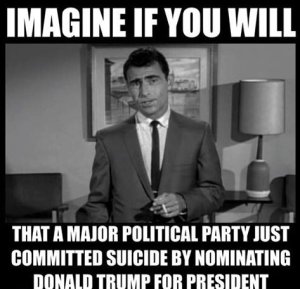
Given the recent tragedy, it’s safe to say that millions of Americans, including whoever created the image below, had the exact same thought: “It’s like we’re in The Twilight Zone“.

serling-and

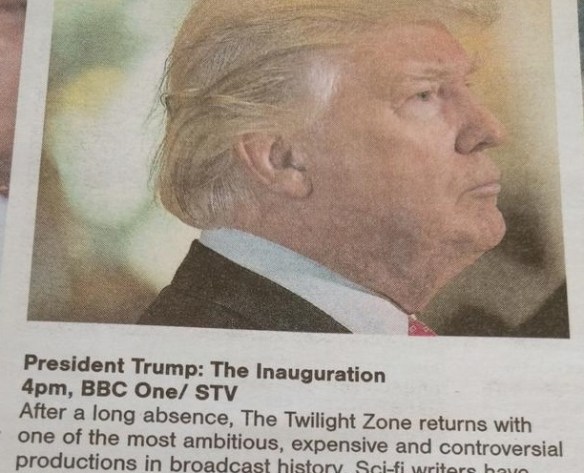
To worldwide acclaim, a reporter for Scotland’s Sunday Herald newspaper named Damien Love used his “TV Highlights” column to brilliantly say the same thing (text below):

trump-tv

 “After a long absence, The Twilight Zone returns with one of the most ambitious, expensive and controversial productions in broadcast history. Sci-fi writers have dabbled often with alternative history stories – among the most common is the “What If The Nazis Had Won The Second World War” setting – but this huge interactive virtual reality project, which will unfold on TV, in the press, and on Twitter over the next four years, sets out to build an ongoing alternative present. The story begins in a nightmarish version of 2017 in which huge sections of the US electorate have somehow been duped into voting to make Donald Trump president. It sounds far-fetched, and it is, but as it goes on it becomes more and more chillingly plausible. Today’s feature-length opener concentrates on the gaudy inauguration of President Trump, and the stirrings of protest and despair surrounding the ceremony, while pundits speculate gravely on what lies ahead. It’s a flawed piece, but a disturbing glimpse of the horrors we could stumble into, if we’re not careful.”

Believe it or not, that was all preface to what I really wanted to share today. 

Some linkages between The Twilight Zone and the current crisis aren’t so successful:

1462548044177-rod_serling

We’ll have to wait and see if the Republican Party committed suicide or not, but the real problem here is that Rod Serling never opened The Twilight Zone with “Imagine if you will”. Nor did he say “Consider if you will”, although he sometimes asked us to “imagine” something.  

How do I know this? Because we have Wikiquotes and internet browsers with a “Find” feature. 

It’s amazing but true. One or more devoted souls have transcribed everything Rod Serling said during the five-year run of The Twilight Zone. You can read every word right here.  

Mr. Serling once said “Pleased to present for your consideration”, but it turns out he preferred the word “submitted” as in “Submitted for your approval”:

“Respectfully submitted for your perusal, a Kanamit. Height: a little over nine feet. Weight: in the neighborhood of 350 pounds. Origin: unknown.” (“To Serve Man”, March 2, 1962)

“Submitted for your approval: the case of one Miss Agnes Grep, put on Earth with two left feet, an overabundance of thumbs and a propensity for falling down manholes.” (“Cavender Is Coming”, May 25, 1962)

“Major Robert Gaines, a latter-day voyager just returned from an adventure. Submitted to you without any recommendation as to belief or disbelief.” (“The Parallel”, March 14, 1963)

“Submitted for your approval or at least your analysis: one Patrick Thomas McNulty, who, at age forty-one, is the biggest bore on Earth.” (“A Kind of a Stopwatch”, October 18, 1963)

He also liked “picture”:

“Picture of the spaceship E-89, cruising above the thirteenth planet of star system fifty-one, the year 1997.” (“Death Ship”, February 7, 1963)

“Picture of an aging man who leads his life, as Thoreau said, ‘in a quiet desperation.’ (“A Short Drink From a Certain Fountain” (December 13, 1963)

When we used to listen to Mr. Serling’s clipped, sonorous tones each week, we supposed the present age would feature marvels like a three-day workweek and astronauts voyaging to Jupiter and beyond. Some things have turned out better than expected, but we haven’t cured the common cold, it’s legal to parade around with a six-gun on your hip in much of the United States and a mentally-ill game show host in thrall to a foreign dictator will soon be the Commander-in-Chief. I mean, it’s like living in The Twilight Zone.