Politics vs. Reality at the Border

Headline from The Washington Post, March 20, 2021, for an article by three political reporters and one who covers immigration enforcement:

‘No end in sight’: Inside the Biden administration’s failure to contain the border surge

Headline from The Washington Post, March 23, 2021, for an article by three political scientists, one of whom heads the U.S. Immigration Policy Center at the University of California in San Diego:

There’s no migrant ‘surge’ at the U.S. southern border. Here’s the data [that] reveals the usual seasonal bump — plus some of the people who waited during the pandemic

From the article by the people who know what they’re talking about:

Last week, at the U.S. border with Mexico, House Minority Leader Kevin McCarthy (R-Calif.) declared that the recent increase in unaccompanied minors attempting to enter the United States was a “crisis … created by the presidential policies of this new administration.”

We looked at data from U.S. Customs and Border Protection to see whether there’s a “crisis” — or even a “surge,” as many news outlets have characterized it. We analyzed monthly CBP data from 2012 to now and found no crisis or surge that can be attributed to Biden administration policies. Rather, the current increase in apprehensions fits a predictable pattern of seasonal changes in undocumented immigration combined with a backlog of demand because of 2020’s coronavirus border closure.

IT’S NOT A SURGE. IT’S THE USUAL SEASONAL INCREASE.

The CBP reports monthly data on how many migrants its agents apprehend at the southern border, including unaccompanied minors. . . .

The CBP has recorded a 28 percent increase in migrants apprehended from January to February 2021, from 78,442 to 100,441. News outlets, pundits and politicians have been calling this a “surge” and a “crisis.”

But the CBP’s numbers reveal that undocumented immigration is seasonal, shifting upward this time of year. During fiscal year 2019, under the [previous] administration, total apprehensions increased 31 percent during the same period, a bigger jump than we’re seeing now. (We’re comparing fiscal year 2021 to 2019 because the pandemic changed the pattern in 2020.) In 2018, the increase is about 25 percent from February to March — somewhat smaller but still pronounced.

But was 2019 an aberration? In the figure below, we combine data from fiscal year 2012 to fiscal year 2020 to show the cumulative total number of apprehensions for each month over these eight years. As you can see, migrants start coming when winter ends and the weather gets a bit warmer. We see a regular increase not just from January to February, but from February to March, March to April, and April to May — and then a sharp drop-off, as migrants stop coming in the hotter summer months when the desert is deadly. That means we should expect decreases from May to June and June to July.
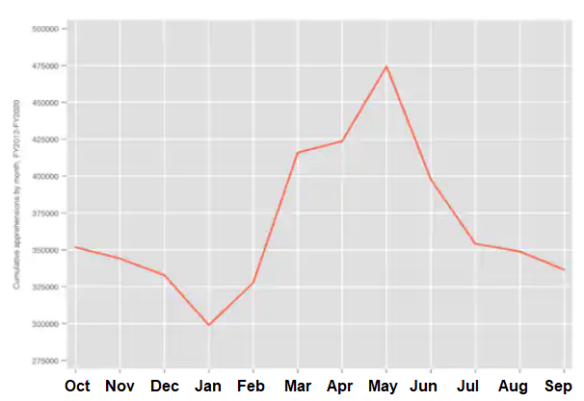
Untitled

What we’re seeing, in other words, isn’t a surge or crisis, but a predictable seasonal shift. When the numbers drop again in June and July, policymakers may be tempted to claim that their deterrence policies succeeded. But that will just be the usual seasonal drop.

SO WHY ARE WE SEEING MORE MIGRANTS SO FAR IN 2021?

The CBP has indeed reported apprehending more migrants in February 2021 than in the same month in previous years. But that too doesn’t mean it’s a surge or a crisis. . . .

2020 was the pandemic, when movement dropped dramatically. Countries around the world closed their borders. Here in the United States, the [previous] administration invoked Title 42, a provision from the 1944 Public Health Act, to summarily expel migrants attempting to enter the United States without proper documentation.

In other words, in fiscal year 2021, it appears that migrants are continuing to enter the United States in the same numbers as in fiscal year 2019 — plus the pent-up demand from people who would have come in fiscal year 2020, but for the pandemic. . . .

This suggests that Title 42 expulsions delayed prospective migrants rather than deterred them — and they’re arriving now.

That would be consistent with nearly three decades of research in political science. Much of this research has been done since President Bill Clinton’s administration ran Operation Gatekeeper, which tried to keep out migrants by increasing funding and staff for border enforcement. Scholars consistently find that border security policies do not necessarily deter migration; rather, they delay migrants’ decisions to travel, and change the routes they take.

REASSESSING OUR UNDERSTANDING OF UNDOCUMENTED IMMIGRATION

So have Biden administration policies caused a crisis at the southern border? Evidence suggests not. The [last] administration oversaw a record in apprehensions in fiscal year 2019, before the pandemic shut the border. This year looks like the usual seasonal increase plus migrants who would have come last year, but could not.

Focusing on month-to-month differences in apprehensions is misleading; given seasonal patterns, each month should be considered in relation to the same month in previous years. Knowing those patterns, policymakers may be better able to plan, prepare and to manage the border.

Unquote. Also, political reporters would avoid jumping on bandwagons being driven by politicians with their own agendas.

Will Bunch of The Philadelphia Inquirer summarizes:

The border situation is neither the first crisis facing the new administration nor close to the biggest — not with a pandemic that has killed more than 500,000 Americans and the related economic crisis leaving 10 million out of work — but it is the nation’s most visible problem that can be so easily demagogued by Republicans looking to score cheap political points against a popular president, or get lapped up by Beltway journalists eager to go back to the brunch of lazy punditry. Indeed, the Sunday morning talk shows — ABC even flew its panelists to an outdoor location at the border — seemed to openly salivate at a return to the days of swinging at Democrats with a club furnished by the Republican National Committee.

There is overcrowding at the border, partly because Biden’s predecessor left a mess behind him. The new administration is working on the problem, which is what we should expect.

When British Rule Became Intolerable

Historians tend to mark the stirrings of the American Revolution with events like the passage of the Stamp Act in 1765 and the Boston Massacre of 1770 (when British soldiers killed five Americans). In her new book, 1774: The Long Year of Revolution, Mary Beth Norton argues that it was only the aftermath of 1774’s Boston Tea Party that unified the colonies and led to revolution. One piece of evidence is how Americans referred to new laws passed by Parliament after the Tea Party as the “Intolerable Acts”.  Another is how residents of all thirteen colonies quickly joined together for the first time, creating the Continental Association (something I don’t remember ever hearing about).

This is from a review by T. H. Breen:

The most serious problem with the claim that the revolution resulted from a long-simmering sense of injustice is that ordinary Americans initially showed very little interest in confronting imperial authority. Resistance to the Stamp Act and the killing of civilians during the Boston Massacre certainly got attention, but even at the moment of greatest discontent, colonists hesitated to voice support for urban protest. In many places people feared that a few radicals were stoking a political crisis that could destabilize an imperial system responsible for widespread prosperity. . . .

The political landscape changed dramatically on the night of December 16, 1773, when the destruction in Boston Harbor of tea imported by the East India Company made the scattered protests that had gone before suddenly seem irrelevant. It took several months for the full implications of the Tea Party to play out in England and America. As Norton explains, the incident served as a political catalyst for the subsequent spread of popular resistance throughout the colonies.

To be sure, an outpouring of anger greeted the arrival of the tea. Everyone knew that by purchasing the imported tea, they would be compelled to pay a tax set by Parliament, a body in which they had no representation. . . .

As with the earlier protests, however, many Americans expressed reservations about what a group of men dressed crudely as Indians had done in Boston Harbor. They worried that extremists had taken protest to an unacceptable level. Of course, no colonists wanted to pay taxes on their favorite drink. But the tea was private property, and not a few people counseled the City of Boston to compensate the East India Company for the lost cargo. . . .

Everyone in Boston expected Parliament to punish the city for this brazen attack on private property. They assumed that negotiations with officials in London would result in censure, and then, after emotions had cooled, relations with the mother country would return to normal. That did not happen. As has occurred so often in the long history of imperial regimes, the leaders of Parliament decided to teach the troublesome Americans a lesson. A mere warning that they should behave themselves . . . would not serve the purpose. Obedience required a show of force.

Speakers in the House of Commons could hardly contain themselves. They insisted that it was time to crush the people of Boston for their audacity. One member of Parliament announced that . . . “the town of Boston ought to be knocked about their ears, and destroyed.” . . . Another MP observed that “the Americans were a strange set of People, and that it was in vain to expect any degree of reasoning from them.”

The punishment was far worse than anyone had anticipated. It was spelled out in four acts known in England as the Coercive Acts. Americans called them the Intolerable Acts. Richard Henry Lee, an influential Virginian, described the legislation as a “shock of Electricity,” causing universal “Astonishment, indignation, and concern.” The most vexing—the Boston Port Act—closed the city to all commerce; other acts restricted town meetings throughout Massachusetts to once per year and gave the royal governor of the colony enhanced authority over political appointments. Trade now had to flow through Salem, which greatly added to the cost of doing business. More disconcerting, the legislation created widespread unemployment in Boston, where many poorer residents worked on the docks.

Bostonians pointed out that it was grossly unfair to penalize the entire population of the city for a crime carried out by a small group, but British officials expressed no sympathy. They suspected that the Americans had absorbed a spirit of democracy. . . .

The show of force did not intimidate the colonists. British leaders greatly increased the chance that the situation in America would explode by appointing a military officer, Thomas Gage, as governor of Massachusetts. He seemed to possess the kind of toughness needed to pacify rebellious colonists. . . . He arrived in Boston on May 13, 1774, accompanied by a large contingent of troops. Not surprisingly, an army of occupation served only to further enflame the populace.

Within weeks imperial authority outside Boston collapsed. Officials appointed by the crown resigned; committees were formed throughout the colony to fill the administrative vacuum. Militiamen began to drill. Local bodies enforced a prohibition on drinking tea. The celebrated orator Edmund Burke had predicted this would be the result of the Coercive Acts. “Have you considered,” he asked the House of Commons, “whether you have troops and ships sufficient to enforce an universal proscription to the trade of the whole Continent of America?” When it became clear that his audience was determined to bring the Americans to heel, Burke concluded, “This is the day, then, that you will go to war with all America . . . ” No one listened.

During the summer of 1774, it became clear that the punitive policies championed by the North administration were stunningly counterproductive. . . . The suffering of Boston soon became the cause of colonists outside the city. They sensed that if they did not support resistance, they too might soon find themselves living under military occupation.

. . . People living in distant colonies sent food to the unemployed workers of Boston. . . . Britain’s show of toughness encouraged ordinary people from New Hampshire to Georgia to reach out to other Americans who before this moment had been total strangers. They began to talk of themselves as if they were no longer British, or at least not as British as they had been before Gage and his army arrived in Boston.

The spreading resistance movement persuaded political leaders of the various colonies to meet in Philadelphia in early September 1774. The first Continental Congress brought Americans of very different backgrounds together. . . . Prominent figures such as . . . the Speaker of the Pennsylvania Assembly presented powerful arguments for reconciliation. Some of his colleagues sensed, however, that the moment for constructive compromise had passed. The people needed direction. Otherwise the defense of American rights would fragment.

The Continental Congress devised a brilliant solution. On October 20, it authorized the creation of the Continental Association, which bound the thirteen colonies in order to bring additional pressure on Parliament by cutting off trade with Britain. Boycotts had been tried before, but because of local jealousies and competition among merchants, they had failed to achieve their purpose. The Continental Association was different. It established precise dates for the cessation of the importation of British goods. It also set down regulations for trade with the mother country. According to the Congress, the goal of the commercial regulations was “to obtain redress of these grievances which threaten destruction to the lives, liberty, and property of his majesty’s subjects in North America.”

The problem was how to enforce these regulations. How could the Congress unite thousands of small communities in a common effort? The answer appeared in the eleventh article of the Continental Association, which transformed the entire character of the resistance movement. A document of such fundamental significance in the history of the United States merits close reading:

That a committee be chosen in every county, city, and town, by those who are qualified to vote for representatives in the legislature, whose business it shall be attentively to observe the conduct of all persons touching this association; and when it shall be made to appear, to the satisfaction of a majority of any such committee, that any person within the limits of their appointment has violated this association, that such majority do forthwith cause the truth of the case to be published in the gazette; to the end, that all such foes to the rights of British-America may be publicly known, and universally contemned as the enemies of American liberty; and thenceforth we respectively will break off all dealings with him or her.

The association signaled the moment in a new revolutionary narrative when ordinary Americans realized that there was no turning back. At the time, almost no one was calling for independence. The groundwork for that break, however, was now in place. The crucial move was that the Continental Congress gave ordinary Americans the responsibility for monitoring commercial violations, but as one might have predicted, these local committees quickly assumed additional duties. By 1775 they were legitimizing popular resistance to imperial rule and channeling mobilization. The Continental Association did something even more important: it revealed the pressing need for some form of centralized authority to oversee the actions of thirteen very different colonies. Unity was essential to sustaining a common cause.

Norton accomplishes something more than a revision of the traditional story of the coming of the American Revolution. She reminds us that even when it seemed inevitable that continuing protest would lead to violent confrontation with British troops, there were intelligent, articulate people in America who wanted desperately to head off the crisis. . . .

It was hard for people such as the Reverend Thomas Bradbury Chandler, an Episcopal minister from New Jersey, to break with the comforting security of a monarchical regime. He wrote an immensely popular pamphlet called “The American Querist”, which consisted of one hundred questions designed to challenge assumptions driving the resistance movement. . . .

[But] writers of Chandler’s persuasion . . . were defending a social system that no longer made sense to many Americans.

The committees that enforced nonimportation seemed to Loyalists to invite anarchy. Mob rule, Chandler and his allies claimed, would destroy the ordered security of a monarchical world. The Reverend John Bullman, an Episcopal rector in Charleston, South Carolina, railed against the notion that ordinary men were capable of judging “the Fitness or Unfitness of all persons in power and Authority.” Bullman rejected the idea that a person “who cannot perhaps govern his own household, or pay the Debts of his own contracting,” should “dictate how the State should be governed.” Chandler shared this opinion. He asked, regarding “interested, designing men…or ignorant men, bred to the lowest occupations,” whether “any of them [were] qualified for the direction of political affairs, or ought to be trusted with it.” . . . . As the events of 1774 demonstrated, however, a great many Americans of the lowest occupations strongly disagreed.

One can appreciate why loyalists equated revolutionary change with disorder. [But] mobilization for the fight for independence did not promote anarchy. Americans followed the Continental Association’s regulations, sacrificing the imported consumer items that brought them so much pleasure. The revolutionaries who came forward in 1774 would have found it hard to understand modern Americans who define liberty as the right to do whatever they please during a time of national crisis, even though they know that their self-indulgence threatens the welfare of the larger community.

Martin, Malcolm and America

From Brandon Terry’s long review of The Sword and the Shield: The Revolutionary Lives of Malcolm X and Martin Luther King Jr. by Peniel Joseph:

. . . The extent to which King’s vision of justice exceeded the horizons of American nationalism is still perhaps the least appreciated element of his public philosophy.

For those used to seeing King situated in a progressive story of American liberalism, it can be surprising to learn that as early as the 1950s, he considered Black freedom struggles to be part of the wave of anti-imperialist revolt in Africa and Asia. “The determination of Negro Americans to win freedom from every form of oppression,” he proclaimed, “springs from the same profound longing for freedom that motivates oppressed peoples all over the world.” He strongly identified with anticolonial liberation movements, meeting veterans of Gandhi’s satyagraha movement in India in 1959 and traveling to Ghana for Kwame Nkrumah’s inauguration in 1960. Like many leftist figures navigating cold war politics, however, King’s criticisms of American foreign policy could often seem restrained, couched in the obligatory tropes of anticommunism or paeans to pacifism.

It was Vietnam that served as the inflection point for King’s radicalization on matters of global justice, but Joseph helps underscore Malcolm’s underappreciated influence on this shift. Malcolm was a prescient critic of the war from the outset, eviscerating its premises with a moral clarity that eluded most commentators, who were gaslighted by lies that US troops were acting as noncombatant “advisers” in Southeast Asia. “You’re not supposed to be so blind with patriotism that you can’t face reality,” Malcolm warned, charging that the war was a “criminal” act made palatable by racism and deception.

Malcolm’s antiwar critique and denunciation of the draft as “the most hypocritical governmental half-truth that has ever been invented since the world was the world” found its most important supporters among the student organizers in the Student Nonviolent Coordinating Committee (SNCC), the first civil rights group to dissent from the war and the draft. How, Malcolm asked, could one accept being drafted to fight on behalf of a supposed democracy, only to return home concerned about how you “can get a right to register and vote without being murdered”?

King, whose political ties to Lyndon Johnson and mainstream liberals made him more tentative in speaking out against the war, became openly critical of the administration after young activists pressed him on the hypocrisy of preaching nonviolence at home while remaining quiet about militarism abroad. Against the private advice and public chastisement of some of his closest advisers, he denounced both the war and the systemic injustices revealed or intensified by the effort to fight it. The war, he charged, represented a threat to free speech and legitimate dissent, and it bred cynicism concerning both the use of violence and the rights of nonwhite peoples for self-rule. Further, he charged the war effort with the “cruel manipulation of the poor,” lamenting its unethical waste of vital resources as well as how it sent

the black young men who had been crippled by our society…8,000 miles away to guarantee liberties in Southeast Asia which they had not found in Southwest Georgia and East Harlem.

In our era of perpetual warfare, with its boomerang effects on domestic liberties and civic trust, such insights remain unheeded.

The questions both men were converging on concerned the worth of citizenship in a society riven by economic domination, racial hierarchy, and belligerent militarism: What, if any, allegiance or sacrifice could such a society demand? The ideal of “radical black citizenship,” which Joseph most closely associates with King, contends that full, equal citizenship for African-Americans requires not just the formal recognition of equal rights but also the fair value of those rights. This means not only the ability to act on them as any other citizen might, but also the inability of a privileged class of citizens to unjustly enrich themselves at the expense of the least powerful.

In Why We Can’t Wait (1964), for example, King wrote that “Negroes must not only have the right to go into any establishment open to the public, but they must also be absorbed into our economic system in such a manner that they can afford to exercise that right.” As Joseph reminds us, his conception of civic equality extended to things like “a good job, living wage, decent housing, quality education, health care, and nourishment.” Or as King put it in 1967, true freedom in an affluent society cannot mean the “freedom to hunger, freedom to the winds and rains of heaven, freedom without roofs to cover [our] heads.”

. . . King’s view of the world that he hoped mass protest would bring into being went far beyond Malcolm’s populist appeals to the “downtrodden masses” left behind by civil rights legislation. For King, equal civic standing, at least in an ostensible democracy, also means that each of us participates in decision-making, determining the contours of our common life together through deliberation. Indeed, one of his principal arguments concerning the evil of segregation was its assault on freedom. Segregation, King said, imposes undue “restraint on my deliberation as to what I shall do, where I shall live, how much I shall earn, the kind of tasks I shall pursue.” Segregation destroys the vital human capacity to authentically “deliberate, decide, and respond” by imposing restrictions on when and where we may enter.

If democratic citizenship is to be free and equal, it must uproot habits, power arrangements, and resource distributions that leave us subject to the arbitrary impositions of others in the most vital domains of life. As Joseph notes, such demands extended to capitalism itself and partly explain King’s skepticism toward its basis in “cut-throat competition and selfish ambition.” In 1967, for instance, he wrote that “if democracy is to have breadth of meaning,” we must overcome the “contemporary tendency in our society” to “compress our abundance into the overfed mouths of the middle and upper classes until they gag with superfluity.”

. . . Malcolm’s criticisms of so-called integrationism never adequately grappled with the leftist tenor of King’s views, which could be better described as “reconstructionist” rather than “integrationist.” For King, authentic integration was “meaningless without the mutual sharing of power.” Kingian integration would involve the widespread redistribution of assets and real democratic participation in economic and political decision-making instead of allowing municipal borders, the dictates of private profit, and existing measures of “merit” to unfairly disadvantage the life chances of so many Americans.

Not 1930s Germany, But 1820s Britain

Prof. Corey Robin, author of The Reactionary Mind, doesn’t see our former president as a political strongman, the harbinger of an American brand of fascism. He sees the Republican Party using the Constitution to hold the line against the majority’s desire for progress, and therefore truly conservative. From The New Yorker:

. . . Fascism called the young to the cause of novelty and creation. Today’s right is nothing like that. It is an artifact of the world’s most ancient and extant legal order, holding on to the Constitution, and the institutions it authorizes, for dear life. . . .

. . . Seeking to counter their waning position, the Republican Party and the conservative movement have come to depend upon three pillars of counter-majoritarian rule: the Senate, the Electoral College, and the Supreme Court. These institutions are not authoritarian or fascist—indeed, they are eminently constitutional—but they are antidemocratic. They are also mainstays of the right. In a remarkable statement, now forgotten, issued three days before January 6th, seven conservative members of the House warned their colleagues that [Republican] presidential candidates have

depended on the electoral college for nearly all presidential victories in the last generation. If we perpetuate the notion that Congress may disregard certified electoral votes—based solely on its own assessment that one or more states mishandled the presidential election—we will be delegitimizing the very system that led [our party] to victory in 2016, and that could provide the only path to victory in 2024.

The current moment is less reminiscent of the last days of Weimar than of Britain in the years before the Reform Act of 1832. With a scheme of representation dating back to the twelfth century, Parliament was the playground of grandees from rural and sparsely populated regions of the South. Growing cities in the Midlands and the North had no representation at all.

Standing atop this “aristocracy of mere locality,” in the words of the historian and Whig politician Thomas Macaulay, were the Tories. For six decades, virtually without interruption, they leveraged this Senate-like system of rotten boroughs to keep the Whigs out of power, enabling an increasingly isolated group of aristocrats and gentry to maintain their privileges. While “the natural growth of society went on” among the middle classes and in the cities, Macaulay said, “the artificial polity continued unchanged.”

Other features of this system will sound familiar. Polling places were few and far between; one of the leading items on the reform agenda was to increase their number. Electoral laws were so byzantine, and generated results so murky, that an army of well-paid lawyers was on the payroll for years, sorting out the returns and arguing over their validity. The “artificial polity” kept politics frozen in time, discouraging both parties from taking up vital economic questions of the day, and preventing new social forces and the partisan realignment that was eventually to come . . .

Still Waiting for Reconstruction

I’ve had a copy of Reconstruction: America’s Unfinished Revolution, 1863-1877 for at least 20 years,  maybe 30, without starting to read it. Written by Eric Foner, it’s the standard history of the period after the Civil War during which the government theoretically tried to heal the South and integrate former slaves into the southern economy. I’ve never tried reading it because the failure of Reconstruction is too depressing. After fighting a terrible civil war, America had a chance to make significant progress and blew it.

Being a fan of Ulysses S. Grant, however, I’m reading Ron Chernow’s long biography of Grant and have finally reached the post-Civil War years. It looks like rough going ahead:

As the year progressed, Grant was drawn ever more deeply into the debate on Reconstruction. In early March 1865, the federal government had assumed responsibility for aiding freed slaves through the creation of the Freedmen’s Bureau. Since it was set up as a War Department agency, drawing funds and staff from it, Grant was directly involved in its operations. The bureau’s mandate was to feed, clothe, and educate former slaves, providing them with medical supplies and legal protection and relocating them on more than 850,000 acres of land the federal government came to control during the war. . . .

Because southern slaves had inhabited a rural culture, the pivotal issue for their future was whether they could receive land from the federal government. With a plot of land, they had a chance for an independent life; if condemned to remain landless, they would be thrown back into servitude to the same plantation barons who had owned them. On August 16, [President Andrew] Johnson issued an order that allowed southern whites to recapture land confiscated from them during the war—a move that made him heroic to whites while dealing a crushing blow to black hopes. It forced freedmen to abandon the forty-acre plots they had started to work, turning the men into powerless sharecroppers, bound to land owned by whites. Within weeks, a white delegation from the former Confederacy rushed to the White House to express “sincere respect” for Johnson’s desire “to sustain Southern rights in the Union.”

By the end of 1865, so-called Black Codes began to forge a new caste system in the South, a segregated world where freed slaves worked as indentured servants, subject to arrest if they left jobs before their annual contracts expired. It was a cruel new form of bondage, establishing the foundations of the Jim Crow system that later ruled southern race relations. In South Carolina, blacks were confined by law to their plantations, forced to work from sunup to sundown. In Florida, blacks who showed “disrespect” to their bosses or rode in public conveyances reserved for whites could be whipped and pilloried. In Mississippi, it became a criminal offense for blacks to hunt or fish, heightening their dependence upon white employers. Thus, within six months of the end of the Civil War, there arose a broadly based retreat from many of the ideals that had motivated the northern war effort, reestablishing the status quo ante and white supremacy in the old Confederacy.

During the summer of 1865, President Johnson sent Carl Schurz, the Prussian-born journalist and Union general, to the South to report on the progress of Reconstruction. His forty-six-page report didn’t present the rosy view of a reconciled South that Johnson preferred. Instead he painted the white South as angry and defiant, still insisting that secession had been legitimate. His portrayal of freed blacks described them as languishing in wretched conditions of poverty, reinforced by Black Codes that trapped them in a new subservience.

Unquote.

Now here we are, more than 150 years later. Republicans have switched places with the Democrats and become the guarantors of white supremacy in the South. There are stories like “Georgia Republicans Are Going All-In on Voter Suppression” and “Why the Georgia [Republican Party’s] Voting Rollbacks Would Hit Black People Hard”. Why bother reading about Reconstruction when some of the same crap is happening now?