In No Uncertain Terms

What kind of language does the current moment deserve? Some prefer measured, unemotional words. Others prefer something more. 

Steve Schmidt is a conservative political strategist who is severely critical of today’s Republican Party. He was John McCain’s senior strategist in the senator’s losing presidential campaign (should we blame Schmidt for the rise of Sarah Palin?). He was one of the founders of the Lincoln Project and is active on Twitter. Here’s some of what he had to say this weekend:

Please watch this and share. I am absolutely fucking outraged and enraged by the nihilistic vandalism of our country for the sake of sustaining T____s’ ONGOING campaign to hold political power at the price of burning it all down. (Twitter)

The immorality of it all is beyond grotesque. It is depraved. It is cowardly. It is shameful and despicable conduct at an epic level. There is a rot, a deep rot within our politics that can only be fixed by purging people like @marcorubio from public life by rebuking them in an election and then silencing them with shame.

No healthy country can have @GOPLeader @marcorubio @mattgaetz @tedcruz @laurenboebert @RepMTG and too many more to conceivably mention in positions of public trust. The cynicism, lying, extremism, weakness, insanity and cowardice combines to create a putrid stench that simply beggars belief. It’s despicable fucking conduct that’s so breathtaking there is no word that comes to mind. The depraved indifference and utter, shocking disregard for the lives of the American people is an act of corruption unequaled in American history.

There are hundreds of Thousands of dead Americans who would be alive but for the stupefying incompetence, carelessness and stupidity of T____, his government, his cabinet secretaries, aides, propagandists, financiers and congressional accomplices. 620.000 Americans are dead yet, the assault on sanity continues unabated. It never ever fucking never ever EVER takes a day off, ever.

Here we are today, the Delta variant raging, the pandemic reignited by an unvaccinated population that has been lied to, deceived by, disoriented by and confused by the deliberate, purposeful premeditated lying of Murdoch, Fox News, Carlson, and hundreds of lesser demagogues and liars. More will die because of this nihilism. Evil.

The country will be consumed by Covid again so that T____, @GOPLeader and all the rest of his nest of nationalists, autocrats, extremists, Racists, fascists and conspiracy loons can blame it all on Biden. They are happy to burn everything down around them for power, including us. Every normal person in this country should be deeply frightened by this. Deeply. I know I am. We have to fight back against the lies and malice that have become virtues to our elected political arsonists. They call themselves Republicans, but that is a disguise for what they have become.

The snarling white faces frozen in photos, screaming in rage and spitting on black children trying to walk into a schoolhouse would no doubt be awestruck at the capacity of technology to allow their children and grandchildren to virtually spit on the greatest champion in the history of her sport, all the way to Tokyo. They would be slack jawed at the progress we have made in America. Their kids and grandkids don’t even have to call black Americans the N word anymore. They just say CRT [Critical Race Theory].

The next chapter of the story, a tragic and deadly farce will be the Blame it all on Biden part. The arsonists will be gleeful in their attacks on the firefighters who are fighting to save lives and extinguish the conflagration. We have to bury this in the next two elections. If we don’t , we lose the country. We will lose it to madness, nihilism; cynicism, greed, hate, racial animus. We will lose it to terrible people, the depraved and extreme, the corrupt and sinister. We will lose it to the T____ family and we won’t get it back next time.

Next:

I’ve driven 1000 miles this week . . . and thought about a lot of things. I’m not sure this is a fair criticism as I’m working through the wretchedness of this dishonest moment and the nihilistic craziness of the overwhelming majority of elected Republican leaders (Twitter).

Many news stories and a great deal of present moment journalism cover our political free fall through a lens that captures each appalling moment, often deeply and compellingly. The stories are framed around an event, something that just occurred, rather than as a puzzle piece, which gives context to a larger, fluid story unraveling before our eyes.

Let’s look at two people as examples. Each has spoken out against T____ in the past. They were precise in their worry and condemnation of his exquisite awfulness. Each knew exactly who T____ was. The one thing T____ deserves great credit for is his absolute consistency, steadfastness and commitment to the truth of sharing who he really is. They all knew what T____ was because they told us. Then they collaborated and discarded every principle they claimed to hold.

We all know this is true. I know it. You know it. They know it and every journalist who ever interviews them knows it.

They are titanic frauds, elected weasels who share a talent for shamelessness, built on a foundation of cynicism and stone cold belief that their supporters are marks, a type of feeble prey that are either too stupid to notice the contradictions and hypocrisy of literally every spoken word or are too lazy and slug-like to care about being abused by constant gaslighting.

How should this be covered? Lie by lie, or is the story the journey of the liar and their deepening commitment to an autocratic movement. For me that is the story. It is a continuum that is dynamic and continually unfolding. This puts a different frame around the consideration @EliseStefanik should be given when she says really stupid and dishonest things like @SpeakerPelosi was the real 1/6 villain and @Liz_Cheney, the pristinely conservative Republican Congresswoman from Wyoming, is a Pelosi Democrat. Why should anyone pretend that @EliseStefanik is on the level about anything? Even she knows she is lying and she knows exactly why she is doing it.

She is doing it for power and self interest. She’s not an actress. She isn’t playing a part in a make believe story. She is an active participant in a movement that is trying to burn down our democracy in both the name of freedom and D____ T____. She is a leader in a movement that has desecrated the compact between us around how we share political power in America. They have rejected the most fundamental aspect of our system of government. What more evidence is needed around her bad faith?

When these members speak they lie. When they lie there seems to be some weird Washington DC courtesy extended in any given story, where whatever it is they are saying is covered through a prism of good faith, despite the accumulation of past statements and gazillions of hours of interviews that prove beyond a shadow of a doubt that it is all an exercise in bad faith.

In short, the individuals who are most effective at demonstrating the depravity of the moment are the collaborators themselves. They indict themselves for the cowards, cynics and opportunists they are with their own words. Shouldn’t the story focus on the cancer that has consumed their public character? American Puritanism turned the question of public character into a sexual one over the last 35 years. Two results followed.

One, previously unimaginable depths of hypocrisy were achieved by @newtgingrich, Ken Starr and legions of others. Second, the concept of public character became so twisted that the behaviors of @EliseStefanik @marcorubio and @LindseyGrahamSC aren’t viewed through a character lens at all. Selling out the country, with purpose and intent for power and self is a betrayal of duty and a despicable act. It is also a plainly obvious one. Why do we have to pretend that the absurdities they utter aren’t easily refutable by them? By their own words.

When @EliseStefanik speaks shouldn’t all of questions that follow be focused on why she is saying the things she is saying as opposed to what she is saying? What is happening in this country is building. It’s gathering. It’s moving, growing and evolving. The signs are everywhere. Yes, a million loathsome moments are all worthy of scrutiny and study. I just wonder if the focus on those moments is causing us to miss the movement towards the destination ahead that while unseen for now is certainly terrible and likely a hellscape from which there is no return. Perspective matters when it comes to orienting to reality and danger.

Sometimes I worry about missing the autocratic forest for the trees.

Finally:

The 1/6/21 attack on America took the form of an insurrection aimed at destroying the Constitutional process that lawfully bestows power to the winner of a Presidential election in the in the the name of the People of the United States who are sovereign in this land. It was incited by a President of the United States and a legion of liars and cynics that include nearly every Republican leader. Of course, that fact alone defines it as the worst and most dangerous attack since the Civil War, but it gets worse (Twitter).

The 1/6 Insurrection by a T____ mob mixed with organized extremist elements including white supremacists, fascists, and violent paramilitary militia groups is the only attack against the nation in our history that has not rallied the whole of the American people to defend America. Instead, tens of millions are broadly sympathetic to the violence and obvious lies that underpin it all. The whole of the Republican Party has weighed in on the matter by siding with the insurrectionists and the defeated disgrace that incited it.

The measurement scale of gauging the insidiousness of their betrayal and collaboration with this Anti-American movement ranges from incitement and active participation in the attack to a dishonest indifference forged by an alchemy of vices; cowardice, fear, ambition, self interest, cynicism and opportunism have overwhelmed any sense of duty, patriotism and love of country.

No other attack against America in our long story has ever produced that response. No other attack has ever produced such sympathy for the attackers. No other attack has ever produced such a fierce determination to deny it occurred at all by politicians who advance their careers on the singularity of their talent to gaslight and deceive the people they swore an oath to serve by preserving and protecting the Constitution of the United States.

There is a name for the Treacherous lot of elected leaders who have forsaken our country. They call themselves Republicans. They serve a master, not an idea or ideal. They serve their leader, T____. The whole world has seen their perfidy. The whole world has seen their rot and the weakness they are spreading in our country. For sure, the Chinese and Russians have seen it.

What they see is a decaying society brought low by the leaders who were elected to strengthen it. They see a country where the lie and truth can stand equally, just like theirs. They must be rejoicing as idealism is being overrun by a cynicism so powerful that it has caused the greatest crisis of faith and belief in the pillars of our Republic since the Civil War. What a tragic moment. It has left us all with a choice. What side are you on?

There are more of us than them but fanaticism, extremism and commitment are on their side. Apathy to the danger through civic disengagement in the name of political exhaustion is what the autocrats are hoping for. Let’s not give it to them.

In fact, let us fight to create a great awakening and fill it with an unyielding resolve to crush the fever dreams of power for people like T____, @EliseStefanik and @marcorubio who have come to hate with deeds what they profess to love with words. Let’s strike them all down in the ballot box. We cannot let freedom slip away in America.
American Hero: Why They Gave Him a Giant Tomb

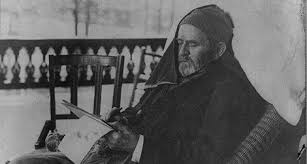
You might not want to read a 1,000 page biography of one of your heroes. After months of reading Ron Chernow’s Grant, I’m more aware of Ulysses S. Grant’s mistakes. But I’m more appreciative of his accomplishments.

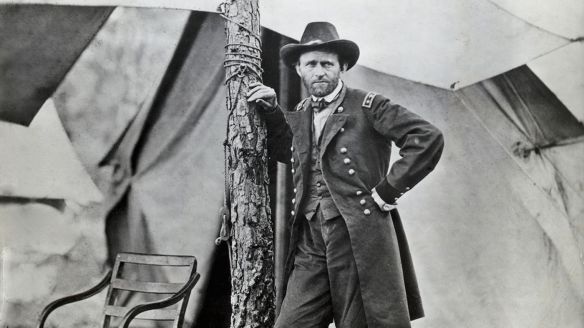
A low-ranked graduate of West Point, he served in the Mexican War while later condemning it as “one of the more unjust ever waged by a stronger against a weaker nation”. He left the military under a cloud, failed at farming and ended up working as a clerk in his father’s store. When the Civil War began, he took command of some Illinois volunteers and was made a colonel. After a series of victories, Abraham Lincoln made him General of the Army, the army’s senior officer, responsible for directing the Union’s entire war effort. In his final campaign, he outmaneuvered Robert E. Lee and respectfully accepted Lee’s surrender at Appomattox.

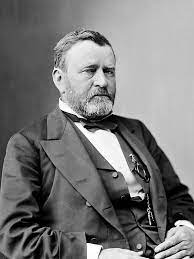
In 1868, the Republican Party, back when they were the liberals, chose him as their presidential candidate. He served two terms, rare for presidents in the 19th century. His administration was plagued by scandals, but none involved him personally. As president, he oversaw the South’s re-entry into the union while protecting the rights of former slaves. He overcame political resistance in order to suppress horribly violent groups like the Ku Klux Klan. He sought peace with the Indians, admitting that white settlers were often the source of conflict in the West. He was the president who most attempted to reform the South in the process known as Reconstruction (which ended when he left office). As the victor in the Civil War and a popular former president, he took a triumphal tour around the world, was the naĂŻve victim of a serious financial scandal, and wrote one of history’s best memoirs while suffering for months from throat cancer.

ulysses-s-grant

These are some of the final pages of that very long biography. They show what the people who knew him best thought of him:

Characteristically, the dying Grant was stoically concerned with his family’s well-being after he was gone, saying, “I hope no one will be distressed on my account.” . .  At 8:08 a.m. on July 23, 1885, Grant died so gently that nobody was quite certain at first that his spirit had stolen away. . . .

With flags lowered to half-mast across America and mourning symbols swathing the White House, the Grant family conducted a private funeral . . . on August 4. Two days later Grant’s casket began a journey southward from Albany to New York City, where three hundred thousand people filed past the open coffin as it lay in state at City Hall. People descended on Manhattan in record numbers for the public funeral on August 8. They poured on foot across the Brooklyn Bridge, descended from elevated railroad stations, and slipped into the city through Grand Central Depot. The 1.5 million people flooding the city would make it the grandest funeral in New York history. At 8:30 a.m. on August 8, Civil War veterans hoisted Grant’s coffin to a waiting catafalque that had black plumes sprouting at each corner. Twenty-four black stallions, arranged in twelve pairs and attended by black grooms, stood ready to pull the hearse. Twenty generals preceded the horses . . .  Every protocol for a military funeral was followed, including the riderless horse with boots facing backward in the stirrups. The funeral was a vast, elaborate affair, befitting a monarch or head of state, in marked contrast to the essential simplicity of the man honored.

The grandeur emphasized the central place that Grant had occupied in the Civil War and its aftermath. “Out of all the hubbub of the war,” wrote Walt Whitman, “Lincoln and Grant emerge, the towering majestic figures.” Whitman thought they had lived exemplary lives that vindicated the American spirit, showing how people lifted from the lower ranks of society could attain greatness. “I think this the greatest lesson of our national existence so far.”

The procession streamed up Broadway until it reached the Fifth Avenue Hotel on Madison Square, where it took on a veritable army of dignitaries, including all the members of the Grant family except for [his wife] Julia, who remained secluded . . . President Cleveland headed an eminent escort that included Vice President Thomas Hendricks, the entire cabinet, and Supreme Court justices. Both surviving ex-presidents, Rutherford B. Hayes and Chester A. Arthur, attended. Congress and statehouses across the country emptied out to pay homage, sending fifteen U.S. senators, twelve congressmen, eighteen governors, and ten mayors to pay their respects. From city halls across America, eight thousand civil and municipal officers converged to participate in the march.

download (1)images (1)

Nobody doubted that William Tecumseh Sherman and Philip H. Sheridan would serve as honorary pallbearers, but Julia Grant knew her husband would have wanted two Confederate generals to balance their northern counterparts, so Joseph Johnston and Simon Buckner represented the South. Predictably, northern military units predominated, but the presence of Confederate soldiers touched onlookers. . . . Contingents of black veterans were liberally represented among the sixty thousand soldiers, supplemented by eighteen thousand veterans of the Grand Army of the Republic. Rabbi E. B. M. Browne acted as an honorary pallbearer . . . At Grant’s death, Philadelphia’s Jewish Record observed, “None will mourn his loss more sincerely than the Hebrew, and . . . in every Jewish synagogue and temple in the land the sad event will be solemnly commemorated with fitting eulogy and prayer.”

Southern reaction to Grant’s death signified a posthumous triumph. His onetime image as a fierce warrior of the Civil War had been replaced by that of a more pacific figure. As the News and Courier of South Carolina editorialized, “Had his life ended but a few years since, the mourning for the great leader would have been more or less sectional in its manifestation. Dying as he now dies, the grief is as widespread as the Union.” Grant had won over unlikely southern converts. When John Singleton Mosby learned of his death, he was bereft: “I felt I had lost my best friend.” In Gainesville, Georgia, a white-bewhiskered James Longstreet emerged in a dressing gown to tell a reporter emotionally that Grant “was the truest as well as the bravest man that ever lived.” In southern towns and border states, veterans from North and South linked arms as they paid tribute to Grant’s passage.

Black churches held “meetings of sorrow” that eulogized Grant as a champion of the Fifteenth Amendment and the fight to dismantle the Ku Klux Klan. Summing up Grant’s career, Frederick Douglass wrote: “In him the Negro found a protector, the Indian a friend, a vanquished foe a brother, an imperiled nation a savior.”

Church bells tolled and muffled drums resounded as the funeral procession glided past buildings shrouded in black, The New York Times likening the uninterrupted flow of humanity to a giant “river into which many tributaries were poured.” The honor guard of mourners stretched for miles, taking five hours to reach the burial site. . . . 

By midafternoon, in bright sunshine, the funeral cortege reached the small temporary brick tomb at Riverside Drive and 122nd Street. Warships floating in the Hudson River let loose a cannonade in tribute to Grant. A lone bugler blew taps at the vault—the same tune that had floated over Grant’s army camps during the war. As the notes drifted over the crowd, Sherman stood ramrod straight, his body shaking with tears. It was a memorable sight: the bête noire of the South, seemingly impervious to softer feelings, overcome with profound emotion.

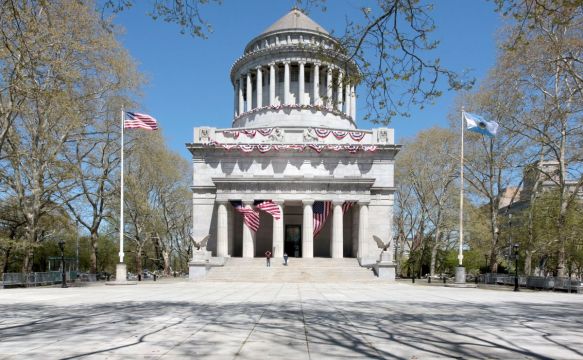
A dozen years later, on a cool spring day, with more than a million people in attendance, President William McKinley presided over the dedication of the General Grant National Memorial—“Grant’s Tomb” in popular parlance—financed by public contributions. Leading the fund-raising drive had been the lawyer Richard T. Greener, the first black graduate of Harvard College, which would have pleased Grant. An opulent domed affair of granite and marble, Grant’s Tomb was the largest mausoleum in North America. When Julia Grant died of heart failure in 1902 at age seventy-six . . . she and Ulysses were entombed together. They lay encased in red granite sarcophagi housed in an open structure much too monumental for these two simple midwestern souls. The mausoleum’s spectacular scale testified to Grant’s exalted place in the nineteenth-century American mind, perhaps rivaling that of Lincoln, and the site soon evolved into New York’s number one tourist destination, drawing half a million people annually.

Perhaps nobody had watched the funeral procession on August 8, 1885, with a wider range of emotions than Mark Twain, who stared down for five hours on the somber pageantry from the windows of his publishing office at Union Square. He would always be indescribably proud to have published Grant’s Personal Memoirs . . .  At the end of the funeral, when the crowds had dispersed, he and William Tecumseh Sherman retreated to the Lotos Club, where they sat down over liquor and cigars to wrestle anew with the mystery of Grant’s personality—a source of never-ending wonder to both men. Sherman always insisted that Grant was a mystery even to himself, a unique intermingling of strength and weakness such as he had never encountered before.

G5MRVU3V2FHS7G4WNEATO5YFLM

BN-HC001_nygard_P_20150223153240

Looking Back at Another Age of Acrimony

I’ve got two big books in a holding pattern. First, there’s Grant, Ron Chernow’s enormous biography of Ulysses S. Grant. I’ve read most of it, but now that the Civil War is over and Grant’s been elected president, I’m having trouble going forward. The other one is the almost equally enormous The Republic For Which It Stands by the historian Richard White. Its subtitle is “The United States during Reconstruction and the Gilded Age, 1865-1896”. I’m only a few pages into that one.

The problem is that White’s book and the next 300 pages of Chernow’s both deal with Reconstruction — the failed attempt to give Black people equal rights in the South after the war — and the Gilded Age — the period from around 1870 to 1900 that featured rapid economic growth and increasing inequality in the whole country. It might be too much to read further about that important and relevant period while living through our own version of the Gilded Age, with its astounding inequality and troubled politics (now featuring dangerous attacks on voting rights).

Anyway, Smithsonian Magazine has an interesting article about the same period. It’s by Jon Grinspan, the author of The Age of Acrimony: How Americans Fought to Fix Their Democracy, 1865-1915. The article is much shorter than any of these books. Here’s most of it: 

. . . Most people don’t often think about the politics of the late 1800s. Call it “historical flyover country,” an era stranded between more momentous times, when U.S. presidents had funny names and silly facial hair. But for our current political crisis, this period is the most relevant, vital and useful. The nation’s wild elections saw the highest turnouts and the closest margins, as well as a peak in political violence. Men and women campaigned, speechified and fought over politics, in a system struggling with problems all too familiar today. . . .

American democracy held revolutionary new promise in the mid-1800s. For all its flaws, the nation was experimenting with a bold new system of government—one of the first in world history to give decisive political power to people without wealth, land or title. Working-class voters predominated at the polls. Poor boys grew up to be president. And reformers fought for votes for women and Black Americans.

At the end of the Civil War in 1865, with slavery dead, the old aristocracy vanquished, and four million formerly enslaved people hoping for new rights, Americans began to talk about “pure democracy.” That concept was never well defined, but for many activists, it meant that it was time for the people to rule. But how to get a busy, distractable, diverse nation to participate?

Decades earlier—from the 1820s to the 1850s—campaigners tried to engage voters by building bonfires, holding barbecues and offering plenty of stump speeches while handing out booze. Then, on the eve of the Civil War, supporters of Abe Lincoln’s hit on a new style. Lincoln’s Republican party introduced the “Wide Awakes” clubs to America. Gangs of young partisans, wearing dark, shimmering martial uniforms and armed with flaming torches, stormed through towns and cities in midnight marches. For the half century after 1860, every political campaign worth mentioning borrowed this approach, organizing massive rallies of tens of thousands of uniformed, torch-waving marchers. Diverse crowds turned out, from boisterous veteran voters to rowdy boys, from grandmothers to young women, from journalists armed with pens to political rivals armed with their revolvers.

Such public politics became, in the words of one comedian, “our great American game.” Political rancor grew precipitously. Saloons resounded with heated debates. On train cars, Americans took straw polls to see how strangers would vote. At dinner tables, families bonded—or broke up—debating an upcoming race. Even when exhausted Americans threw down their newspapers, they looked up only to find partisan broadsides slathered on every wall. “Ignorance is bliss now,” complained one woman as she canceled her political newspapers, weary of the whole spectacle.

For voters, participation meant an even deeper immersion. Election Day was a communal, combative, boozy bacchanal. White’s metaphor was apt, when people voted, they literally got drunk on Election Day. One Norwegian wrote home from Chicago, remarking that “it was fun to see” crowds of workers leaving their factories to go vote, “either before or after stopping at a bar.” During the 1876 election, which drew an unprecedented 81.8 percent turnout—Rutherford B. Hayes’s campaign handed out massive oversize beer steins, despite the fact that Hayes and his wife were devout teetotalers.

All the carousing culminated at a rambunctious polling place, when a voter selected a colorful ticket from his party’s ballot “peddlers,” made his way past the opposing party’s intimidating “challengers,” and placed his vote in a wooden or glass ballot box. Amid singing, shouting and heckling from the other voters in his community, it was a scene of heated, convulsive political theater. The system seemed designed to take over life, distort opinions, attract bad actors, raise voices and destroy civility.

In northern cities, a sneering establishment worried that the system was dominated by a working-class majority who could always outvote them. The celebrated Boston aristocrat Francis Parkman famously complained that democracy didn’t work in his 1878 “The Failure of Universal Suffrage,” a screed that claimed that the voters were “a public pest” and that the real threat to America came not from above, but beneath. Belief in equality and majority rule, Parkman argued, was destroying America.

Equal suffrage met even more aggressive attacks in the South. White supremacist ex-Confederates, who lost the war and had remained on the fringes of politics for most of a decade after, used the Democratic party to terrorize Black voters, end Reconstruction and dramatically suppress voter participation. Within a few short years of the end of slavery, one million formerly enslaved Americans became voters, but most lost their rights nearly as quickly as Reconstruction ended and the Jim Crow era began.

In the North, voter turnouts peaked from 1876 to 1896, and elections were never closer. No president in this period came to office by winning a majority of the popular vote [i.e. the presence of multiple candidates in the elections from 1876 to 1892 meant nobody got more than 50% ]. Even with racial issues falling out of the national spotlight, fights over money and inequality fired up voters.

Though the electorate turned out in huge numbers, marchers filled squares and newspapers attacked rivals, politics failed to bring real change. This system—overheating and yet standing still—led only to anger and agitation. In 1881, the mentally ill drifter Charles Guiteau, who had campaigned for President James Garfield at torchlit rallies, felt slighted and decided that America would be better off if the “President was out of the way.” So Guiteau bought the largest pistol he could find, and shot Garfield—the murder was the second assassination of a president in just 16 years. Within two decades, another madman would gun down President William McKinley. And every seven years, on average, a sitting congressman was murdered.

American politics had hit on an amazing ability to mobilize citizens, but also to agitate them to unspeakable violence. Citizens looked for someone to blame. Presidents were criticized, but really the executive branch was so weak that they could do very little. Powerful party bosses often nominated friendly, malleable do-nothings to the job. More people blamed politicians as a class. Brilliant cartoonists like Thomas Nast and Joseph Keppler mocked politicians as snarling beasts, overfed vultures, sniveling rats and thuggish bosses. Others attacked the rising immigration rates, like Francis Willard, the leader of the Women’s Christian Temperance Union, who blamed America’s out-of-control politics on “alien illiterates.” Others still aimed (more accurate) attacks at railroads, corporations, robber barons and lobbyists who seemed to be buying up America. The muckraking reporter Henry Demarest Lloyd wrote that “liberty produces wealth, and wealth destroys liberty.”

. . . Some well-to-do reformers blamed, not individuals or groups, but the culture and etiquette of American democracy. All those noisy rallies were nothing more than a “silly sort of show,” those busy polling places were “vulgar,” “venal” and “filthy.” American democracy, a growing upper middle-class movement argued, needed an intervention, and in an era of Temperance politics, reformers knew just how to achieve it.

First, they went after the booze. Reform organizations pulled the liquor licenses from political fundraisers, closed saloons on Election Day and passed prohibition laws on the county and state level. Voters were more clearheaded, but those partisan saloons had been key institutions for working-class men. Shutting them down meant shutting many out.

Cities banned marches without permits and used police and militias to punish unlawful assembly. And parties desperate to win over “the better class of people,” as one reformer put it, stopped paying for torches, uniforms, fireworks and whiskey. Campaigners shifted from thrilling street-corner oratory to printed pamphlets. To some, these changes looked like innovations. The Los Angeles Times cheered the citizens who had spent previous elections “on the street corner shouting, or in the torchlight procession,” but could now be “found at home” reading quietly.

Starting in 1887, state after state switched to the secret ballot—a dense government form that was cast privately—and dispatched with party-printed tickets. By isolating each voter “alone with his conscience” in the polling booth, or behind a voting machine’s curtain, he was certainly made more reflective, but also more removed. Those who could not read English, who had previously voted by color-coded ballots, were out of luck with the complicated machines, text-heavy ballots or unsympathetic poll workers. And those who participated in Election Day because they enjoyed the day as a nationwide happening, with its the sense of community and membership, saw little appeal with the new confessional box style.

Predictably, turnout crashed. In the 1896 presidential election, 80 percent of eligible Americans were still voting, but by 1924, voter participation plummeted to fewer than 49 percent. Voters who were poorer, younger, less well-educated, African American, or immigrants or children of immigrants were especially shut out of the political arena. White, middle class Americans cheered the trend, with some even bragging about the low turnouts. “It was gratifying,” reported an Augusta, Georgia, newspaper in 1904 “to see voting booths free of noisy crowds.”

The revolution lasted for a century. What Americans now consider “normal politics” was really stifled Democracy, the post-intervention cool, calm model—lower drama but lower participation. Now, however, those old tendencies may be creeping back.

. . . Tribalism, division and “general cussedness” (as they used to call it) is up, but so is attention and turnout. The two might go hand-in-hand; the 2020 election was the first since 1900 to boast turnouts above 66 percent. . . .

Unquote.

I agree with the author that more democracy would be a good thing. The question is whether more democracy can be achieved without more political turmoil and strife (and more bullshit peddled by one of our major parties).

Let Her Dance

The Bobby Fuller Four was a Texas rock band in the 60s who had one big hit. “I Fought the Law” (and the law won!) made the Top Ten in 1965. It was never a favorite of mine but I wouldn’t change the station when it came on.

Earlier that year, they released “Let Her Dance”. It only reached #133 on the national chart, but it was a minor hit in Los Angeles (#23 on KRLA, #19 on KFWB). I turned 14 when it was on the radio in Southern California, but if I heard it, it made no lasting impression.

Bobby Fuller died under mysterious circumstances a few months after “I Fought the Law”. That was the end of the Bobby Fuller Four.

Wes Anderson used “Let Her Dance” in his Fantastic Mr. Fox animated movie in 2009. I saw the movie but took no notice of the song.

Then, five years ago, I heard “Let Her Dance” on Brian Wilson’s site. (I know it was five years ago because it’s on the internet.) It’s not much of a song — it’s repetitious to say the least — but it immediately became a favorite. I’m still playing it five years later. I’m even writing about it.

Why do some songs appeal to us so much? Why do some songs we love not appeal to other people at all? I have no idea. Just let her dance.

From The Guardian: “The Short Life and Mysterious Death of Bobby Fuller, Rock ‘n Roll King of Texas”.

Of Course It Was Collusion

Which, yet again, is not the same as criminal conspiracy (although it was probably that as well). From The New York Times:

The Biden administration revealed on Thursday that a business associate of T____ campaign officials in 2016 provided campaign polling data to Russian intelligence services, the strongest evidence to date that Russian spies had penetrated the inner workings of the Trump campaign.

The revelation, made public in a Treasury Department document announcing new sanctions against Russia, established for the first time that private meetings and communications between the campaign officials, Paul Manafort and Rick Gates, and their business associate were a direct pipeline from the campaign to Russian spies at a time when the Kremlin was engaged in a covert effort to sabotage the 2016 presidential election.

Previous government investigations have identified the T____ aides’ associate, Konstantin V. Kilimnik, as a Russian intelligence operative, and Mr. Manafort’s decision to provide him with internal polling data was one of the mysteries that the special counsel, Robert S. Mueller III, sought to unravel during his two-year investigation into Russia’s election meddling.

“During the 2016 U.S. presidential election campaign, Kilimnik provided the Russian Intelligence Services with sensitive information on polling and campaign strategy,” the Treasury Department said in a news release. “Additionally, Kilimnik sought to promote the narrative that Ukraine, not Russia, had interfered in the 2016 U.S. presidential election.”

Rachel Maddow responded on her MSNBC program tonight:

We now know the T____ campaign secretly gave their own data to Russian intelligence in the middle of that attack, which again presumably helped what the Russians were doing. . . . 

What’s the definition of collusion again? Not just passively benefiting from somebody else’s crime, but actively helping them commit it? Is that what we call collusion? Tell me more about how the whole Russia thing is a hoax.

Maddow covered the topic for more than 20 minutes. As of this moment, the whole segment  is available on YouTube. Twelve minutes is available from MSNBC.