What Banks Do and What Happens When They Get in Trouble

Prof. Paul Krugman explains why being a bank is a good thing — until it’s not a good thing –and what should happen then:

Do people still read Rudyard Kipling’s “If”? Even if you haven’t, you probably know how it begins: “If you can keep your head when all about you are losing theirs …” Refusing to panic, Kipling asserted, was a great virtue.

But during a bank run, refusing to panic can also be a way to lose all your money.

On Monday, the Nobel Prize in Economics was given to a household name, Ben Bernanke, and two economists’ economists, Douglas Diamond and Philip Dybvig, largely for papers they published almost 40 years ago. So let’s talk about their work and why, unfortunately, it remains all too relevant.

An aside: I sometimes encounter people who insist that the economics prize isn’t a “real” Nobel, because it’s just an award handed out by some Swedes, unlike the other prizes, which are … awards handed out by some Swedes…..

Obviously, Bernanke, Diamond and Dybvig weren’t the first economists to notice that bank runs happen. But Diamond and Dybvig provided the first really clear analysis of why they happen — and why, destructive as they are, they can represent rational behavior on the part of bank depositors. Their analysis was also full of implications for financial policy. At the same time, Bernanke provided evidence on why bank runs matter and, although he avoided saying so directly, why Milton Friedman was wrong about the causes of the Great Depression.

Diamond and Dybvig offered a stylized but insightful model of what banks do. They argued that there is always a tension between individuals’ desire for liquidity — ready access to funds — and the economy’s need to make long-term investments that can’t easily be converted into cash.

Banks square that circle by taking money from depositors who can withdraw their funds at will — making those deposits highly liquid — and investing most of that money in illiquid assets, such as business loans.

So banking is a productive activity that makes the economy richer by reconciling otherwise incompatible desires for liquidity and productive investment. And it normally works because only a fraction of a bank’s depositors want to withdraw their funds at any given time.

This does, however, make banks vulnerable to runs. Suppose that for some reason many depositors come to believe that many other depositors are about to cash out, and try to beat the pack by withdrawing their own funds. To meet these demands for liquidity, a bank will have to sell off its illiquid assets at fire sale prices, and doing so can drive an institution that should be solvent into bankruptcy. If that happens, people who didn’t withdraw their funds will be left with nothing. So during a panic, the rational thing to do is to panic along with everyone else.

There was, of course, a huge wave of banking panics in 1930-31. Many banks failed, and those that survived made far fewer business loans than before, holding cash instead, while many families shunned banks altogether, putting their cash in safes or under their mattresses. The result was a diversion of wealth into unproductive uses. In his 1983 paper, Bernanke offered evidence that this diversion played a large role in driving the economy into a depression and held back the subsequent recovery.

As I said, this was a tacit rejection of Milton Friedman. In the story told by Friedman and Anna Schwartz, the banking crisis of the early 1930s was damaging because it led to a fall in the money supply — currency plus bank deposits. Bernanke asserted that this was at most only part of the story….

What can be done to mitigate the risk of self-fulfilling panic? As Diamond and Dybvig noted, a government backstop — either deposit insurance, the willingness of the central bank to lend money to troubled banks or both — can short-circuit potential crises. Indeed, the mere knowledge that a backstop exists can often quell a bank run; no money need actually change hands.

But providing such a backstop raises the possibility of abuse; banks may take on undue risks because they know they’ll be bailed out if things go wrong. Case in point: the huge costs to taxpayers of bailing out irresponsible players during the savings and loans crisis in the 1980s. So banks need to be regulated as well as backstopped. As I said, the Diamond-Dybvig analysis had remarkably large implications for policy.

Another implication of their work, which unfortunately went unheeded for decades, was that we need to think carefully about what we mean by a “bank.” It doesn’t have to be a big marble building with rows of tellers. From an economic point of view, banking is any form of financial intermediation that offers people seemingly liquid assets while using their wealth to make illiquid investments.

This insight was dramatically validated in the 2008 financial crisis. Conventional banks were, for the most part, unaffected by the panic; there was no mass exodus from bank deposits. By the eve of the crisis, however, the financial system relied heavily on “shadow banking” — banklike activities that didn’t involve standard bank deposits. For example, many corporations had taken to parking their cash not in deposits but in “repo” — overnight loans using things like mortgage-backed securities as collateral. Such arrangements offered a higher yield than conventional deposits. But they had no safety net, which opened the door to an old-style bank run and financial panic.

And the panic came. The conventionally measured money supply didn’t plunge in 2008 the way it did in the 1930s — but repo and other money-like liabilities of financial intermediaries did.

Fortunately, by then Bernanke was chair of the Federal Reserve. He understood what was going on, and the Fed stepped in on an immense scale to prop up the financial system.

Finally, a sort of meta point about the Diamond-Dybvig work: Once you’ve understood and acknowledged the possibility of self-fulfilling banking crises, you become aware that similar things can happen elsewhere.

Perhaps the most notable case in relatively recent times was the euro crisis of 2010-12. Market confidence in the economies of southern Europe collapsed, leading to huge spreads between the interest rates on, for example, Portuguese bonds and those on German bonds. The conventional wisdom at the time — especially in Germany — was that countries were being justifiably punished for taking on excessive debt. But the Belgian economist Paul De Grauwe argued that what was actually happening was a self-fulfilling panic — basically a run on the bonds of countries that couldn’t provide a backstop because they no longer had their own currencies.

Sure enough, when Mario Draghi, the president of the European Central Bank at the time, finally did provide a backstop in 2012 — he said the magic words “whatever it takes,” implying that the bank would lend money to the troubled governments if necessary — the spreads collapsed and the crisis came to an end. “Whatever it takes” was all it took.“Whatever it takes” was all it took.
We Have a Millstone Around Our National Neck

It’s good to have a constitution, but not every constitution is good. Charles Blow of The New York Times evaluates ours:

… I have been thinking about what I would say to Biden about the threats to American democracy. The most acute threat, it’s true, comes from election deniers and the authoritarian mass movement led by the previous president….. But the long-term threat is less an imposition from bad actors and more a constitutive part of our political system. It is, in fact, the Constitution. Specifically, it is a set of fundamental problems with the structure of our government that flow directly from the Constitution as it currently exists.

We tend to equate American democracy with the Constitution as if the two were synonymous with each other. To defend one is to protect the other and vice versa. But our history makes clear that the two are in tension with each other — and always have been. The Constitution, as I’ve written before, was as much a reaction to the populist enthusiasms and democratic experimentation of the 1780s as it was to the failures of the Articles of Confederation.

The framers meant to force national majorities through an overlapping system of fractured authority; they meant to mediate, and even stymie, the popular will as much as possible and force the government to act with as much consensus as possible.

Unfortunately for the framers, this plan did not work as well as they hoped. With the advent of political parties in the first decade of the new Republic — which the framers failed to anticipate in their design — Americans had essentially circumvented the careful balance of institutions and divided power. Parties could campaign to control each branch of government, and with the advent of the mass party in the 1820s, they could claim to represent “the people” themselves in all their glory.

Americans, in short, had forced the Constitution to accommodate their democratic impulses, as would be the case again and again, up to the present. The question, today, is whether there’s any room left to build a truly democratic political system within the present limits of our constitutional order.

In his new book “Two Cheers for Politics: Why Democracy is Flawed, Frightening — and Our Best Hope,” the legal scholar Jedediah Purdy says the answer is, essentially, no“Our mainstream political language still lacks ways of saying, with unapologetic conviction and even patriotically, that the Constitution may be the enemy of the democracy it supposedly sustains,” Purdy writes.

This is true in two ways. The first (and obvious) one is that the Constitution has enabled the democratic backsliding of the past six years. Founding-era warnings against demagogues — used often to justify our indirect system of choosing a president — run headfirst into the fact that [the last one] was selected constitutionally, not elected democratically….

And consider this: In the 2020 presidential election, a clear majority of Americans voted against [the incumbent] in the highest turnout election of the 21st century so far. But with a few tens of thousands of additional votes in a few states, [he] would have won a second term under the Constitution. “A mechanism for selecting a chief executive among propertied elites in the late eighteenth century persists into the twenty-first,” Purdy writes, “now as a key choke point in a mass democracy.”

The Constitution subverts democracy in a second, more subtle way. As Purdy notes, the counter-majoritarian structure of the American system inhibits lawmaking and slows down politics, “making meaningful initiatives hard to undertake”…..

Even if you keep MAGA Republicans out of office (including [their leader]), you’re still left with a system the basic structure of which fuels dysfunction and undermines American democracy….

What makes this all the worse is that it has become virtually impossible to amend the Constitution and revise the basics of the American political system. The preamble to the Constitution may begin with “We the People,” but as Purdy writes, “A constitution like the American one deserves democratic authority only if it is realistically open to amendment.” It is only then that we can “know that what has not changed in the old text still commands consent.” Silence can have meaning, he points out, “but only when it is the silence of those free to speak.”

There is much more to say about the ways that our political system has inhibited democratic life and even enabled forms of tyranny. For now, it suffices to say that a constitution that subverts majority rule, fuels authoritarian movements and renders popular sovereignty inert is not a constitution that can be said to protect, secure or even enable American democracy.

In a speech in Philadelphia last month, Biden did speak publicly on the threats to American democracy. He focused, as almost any president would, on the Constitution. “This is a nation that honors our Constitution. We do not reject it. This is a nation that believes in the rule of law. We do not repudiate it. This is a nation that respects free and fair elections. We honor the will of the people. We do not deny it.”

The problem, and what this country must confront if it ever hopes to turn its deepest democratic aspirations into reality, is that we don’t actually honor the will of the people. We deny it. And it’s this denial that sits at the root of our troubles.

Connecting Global Dots

Josh Marshall of Talking Points Memo looks at the big picture

It’s interesting to step back sometimes and consider … our times. Today we have our ongoing battle over democracy and authoritarianism in the U.S. The UK is in its latest stage of its ongoing national self-immolation. Italy has just elected its first far-right government since Benito Mussolini’s rise to power in the early 1920s. Russia, which has made itself into the international clarion of rightist nationalism, is stumbling through a succession of largely self-inflicted catastrophes in its war of choice in Ukraine.

Let’s go back to the Arab Spring. The Arab Spring unsettles or topples governments across the Arab Middle East. But it triggers long-running civil wars in Syria and Libya. The first especially, but also the second, are the main drivers of the European Union migrant crisis of 2015, in which some 1.3 million refugees/migrants requested asylum in the EU, the most in any single year since World War II. Given the closeness of the vote and the great focus on the migrant crisis in 2015 and 2016, it’s very hard to imagine the UK leaves the European Union without this chain of events … beginning in December 2010.

Less obvious is that you can make a looser but I think still fairly persuasive argument that these events play a key role in the rise of [MAGA-ism] in the United States….The rise of [MAGA-ism] is part of a long progression within the United States. [However, their leader’s] particular platform — to the extent you can call it that — focused on “the wall” and immigrants from Mexico and Central America….

But there’s a somewhat different commonality I am focusing on.

The [reactionary] right is, paradoxically, highly internationalized if not internationalist. There’s a deep confluence and sharing of ideas, imagery and programs between the U.S. and Europe. The narratives of “our out of control migration” and white Christian cultures under threat was a common, interwoven and reinforcing pattern on both sides of the Atlantic….

These are of course only the barest thumbnail outlines of recent history and its relationship to the present…. Why this interests me is that migration flows and their intensity are going to increase over time. The most basic reason is climate. Our potential climate futures range from really bad to truly catastrophic. But anywhere on that spectrum you have lots of people trying to move from places that are less habitable than they used to be or are in the throes of political and economic instability for those same reasons. Telecommunications and transport technology greatly accelerate that process.

A century ago a poor peasant in India or Ecuador may have known in a general way that there were vastly richer societies in Europe and North America. But they couldn’t really know the details and it was close to impossible to get there anyway. Today, almost everyone in the world can see through electronic media how people live in Europe, North America, and other parts of the affluent world and — though it’s hard and often dangerous — it is possible to get there.

What we can draw from this is that the accelerating patterns of global migration which are so central to the politics of the last decade and have helped reshape politics in Europe and North America will almost certainly continue to intensify.

Understanding the Plague of Christian Nationalism

The political ideology known as “Christian nationalism” has little to do with Christianity. Journalist Sarah Posner explains it for Talking Points Memo:

Christian nationalism has been all over the news lately, but it is neither a new term nor a new phenomenon in American politics. The label gained greater usage during [the former administration] because of [that president’s] mobilization of the Christian right around his strongman politics. Interest in the ideology — and the term — grew even more following the January 6 insurrection, where Christian nationalist rhetoric and symbols were on full display, sometimes violently. …Its threat to democracy has never been more vividly apparent.

Many on the Christian right have long rejected the term, but Georgia Rep. Marjorie Taylor Greene has embraced it, and even started selling “Proud Christian Nationalist” t-shirts. “I am being attacked by the godless left because I said I’m a proud Christian Nationalist,” she tweeted in response to criticism. “They hate America, they hate God, and they hate us [no, but we do hate you].

Although Greene made it more popular, not all Christian nationalists wear the label on their sleeve, or a t-shirt. So how can you tell who is a Christian nationalist?

The Christian Founding Mythology

Christian nationalists believe that God had a “providential hand” in America’s founding. They contend that, carrying out God’s will, the founders intended America to be a “Christian nation.” They insist, falsely, that the founding documents prove both this intent and that the separation of church and state is a “myth.” God also intended government to play a limited role in people’s lives, they assert — but to the extent government carries out its functions, it should be done from a “biblical worldview”….

The leading proponent of this revisionist history undergirding contemporary Christian nationalism is David Barton, a prolific writer and energetic speaker whose false and misleading claims about this history have been thoroughly debunked by historians and researchers. Nonetheless, his extensive writings and lectures maintain a kind of doctrinal status within the religious right. Barton first made national headlines in 2004 when the Republican National Committee hired him as a political consultant during the presidential campaign to mobilize evangelical pastors and their flocks. Today, he remains an influential fixture in Christian right circles through his extensive writings, lectures, radio show, and other programs produced by his WallBuilders organization.

The impact of the perpetuation of this ideology is clear. A recent poll by the University of Maryland found that 61 percent of Republicans support officially declaring the United States a Christian nation. That number is far higher — 78 percent — among Republicans who identify as evangelical or born-again.

Restoration and Dominionism

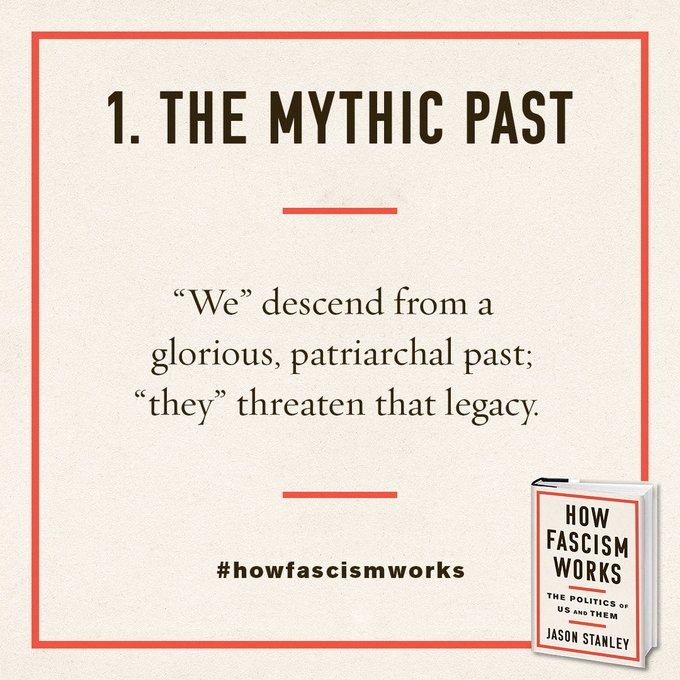
A corollary of the Christian nation founding myth is that if the founders were carrying out God’s will, then any erosion of America’s “Christian heritage” must be fought by patriotic Christians who seek to rescue America from ungodly forces and “restore” it to its Christian foundation. Based on claims that the Bible calls on Christians to “take dominion” over earthly institutions, Christian nationalists contend that it is the duty of Christians to run for office and seek political and judicial appointments to ensure the government crafts law and policy from a [supposed “biblical” perspective].

In nearly two decades of reporting on the Christian right, I have seen this directive manifest itself in myriad ways: activists engaging in “spiritual warfare” and vetting political candidates, evangelical pastors mobilizing “to restore America to her Judeo-Christian heritage”, candidates running for president to Christianize government, governors holding mega-prayer rallies in professional basketball stadiums — all building toward the movement attempting to foment a coup. Greene’s call for the GOP to “lean into biblical principles” showed how the decades-long quest to elect “biblical worldview” representatives continues to bear fruit, and in increasingly radical ways.

Persecution

A key element of this dominionist vision is the claim that Christians are persecuted by social, cultural, political, and legal changes that they claim have undermined the Christian nation. Much of the supposed subversion of Christian heritage and values, and the attendant claimed persecution, stems from both conspiratorial thinking about political adversaries and apocalyptic claims about their ambitions. From the Cold War to the present, perceived enemies of the Christian nation have included Communism, Marxism, socialism, the Rev. Martin Luther King, Jr., mainline Protestantism, atheism, secular humanism, feminism, abortion rights, the “homosexual agenda,” Islam, political correctness, President Barack Obama, “gender ideology,” COVID mitigation policies, the “deep state,” critical race theory, and “wokeness.” Many of these figures, beliefs, and policies might ostensibly have little in common, but they are imagined as conspiring to form a single movement to undermine America — as Greene put it in her tweet, the “godless left.”

In practical legal and political terms, these persecution claims, litigated in the courts and in the court of public opinion by well-funded lawyers and activists, have led tocataclysmic erosions of church-state separation, the reversal of Roe v. Wade, ongoing assaults on LGBTQ rights, and the accompanying elevation of religious freedom rights — for right-wing Christians. 

Anti-Democracy

Subversions of church-state separation, and the imposition of fundamentalist religion to deprive others of their civil and constitutional rights, are in and of themselves signs of a democracy in danger. But since the 2020 election, the Christian right’s embrace of [the] stolen election lie — fueled by the belief that [the unreligious, con man president] is a savior of the Christian nation — has contributed to direct threats to the electoral process itself….

The QAnon movement, which claims that a deep state cabal of satanic pedophiles is running a secret sex trafficking ring inside the government … is not just a conspiracy theory. It is another means of energizing right-wing white Christian voters, who have been steeped in this kind of conspiracism for decades, to take extreme steps to “save” the Christian nation that (they believe) [the ex-president] has so ardently defended. Polling by the Public Religion Research Institute has found that QAnon adherents “express strong Christian nationalist beliefs,” with 71 percent agreeing with the statement that “God has granted America a special role in human history,” and 55 percent saying they believe being a Christian is “at least somewhat important to being a ‘true American.’”

Finally: Is [You Know Who] A Christian Nationalist?

The Bible is just a prop for [him], and, like autocrats throughout history, he uses religion and religious leaders to consolidate the support of enraptured followers. It doesn’t really matter whether [he] himself is a Christian nationalist, since he is a salvific figure to Christian nationalists, one who can achieve their long-sought goals by crushing the “godless left” and giving them more power. One of the leading contenders to be [the former president’s] successor, Florida governor Ron DeSantis, is abusing his current office to engage in fascistic crackdowns on migrants, public education, and LGBTQ kids while making direct Christian nationalist appeals. In recent political speeches, DeSantis has been using a verse from Ephesians 6 (“Put on the full armor of God, so that you can take your stand against the devil’s schemes”), but with a notable substitution: instead of “the devil’s,” he has said “the left’s.” The meaning is not lost on evangelical audiences, who are well familiar with the actual words of the verse….