There Was a Balloon. Other Things Have Happened Too.

President Biden’s Chief of Staff for the past two years, Ron Klain, is leaving the White House. He talked about the administration’s accomplishments last week. I haven’t been able to find the text of his remarks myself but someone at Post.News provided this:

The most significant economic plan since FDR, while managing the largest land war in Europe since Truman.  The biggest infrastructure bill since Ike, the most first-year judges since JFK, the second largest health care bill since LBJ.  The most significant gun control bill since Clinton and the largest climate change bill in any country at any time anywhere on the planet.  All while managing the worst public health crisis since Wilson, with the narrowest Democratic majority in Congress for a new President in 100 years.

But it doesn’t stop there. Student loan debt relief.  Record low black and brown unemployment. The PACT act for veterans. A sweeping marijuana pardon. The Respect for Marriage Act. The most Americans ever with health coverage. Ending the longest war in American history. We’ve seen a dramatic drop in child poverty, the lowest unemployment rate in 50 years, the deficit cut more than any President.  And the most jobs created in any two years in US history.

Not bad for a team and a President that was written off for dead in the winter of 2019, and again in the winter of 2020, the winter of 2021, and again in the first week of November 2022. 

The media reported Klain’s departure, but it what really got people’s attention is that he started to cry at one point. How dare he become emotional when leaving one of the most important, most challenging jobs in the country, especially when you consider the Biden administration’s somewhat amazing list of accomplishments! Clearly, Klain is not the kind of manly man we need near the top of our government. Far better to have a macho guy like our former president, a real tough guy whose principal emotion is anger, who doesn’t understand the concept of personal responsibility and who, during his last year in office, paid more attention to his hair than the pandemic.

Anyway, having read some of Klain’s speech, it was disturbing but not surprising to see the results of a new poll.

The poll finds that 62 percent of Americans think Biden has accomplished “not very much” or “little or nothing” during his presidency, while 36 percent say he has accomplished “a great deal” or “a good amount.” On many of Biden’s signature initiatives — from improving the country’s infrastructure to making electric vehicles more affordable to creating jobs — majorities of Americans say they do not believe he has made progress, the poll finds.

Breaking those numbers down, 77% of Democrats thought Biden had accomplished “a good amount or a great deal”. 32% of “independents” thought he had. Only 7% of Republicans agreed.

Now, not all Democrats pay much attention to politics. That partly explains why 22% didn’t think much of the president’s accomplishments. As for “independents”, they’re the people who pay even less attention to politics and/or don’t see any meaningful difference between the parties, even after the past six years. That 7% of Republicans thought Biden has done well can be seen as a positive result given the politicians Republicans prefer and the “news” they consume.

The journalistic community will see this poll as a problem for Biden. It demonstrates a bigger problem with the journalistic community. Their principal job is to inform the public. But many more Americans know that a Chinese balloon — nothing more than a curiosity, which the Pentagon easily took care of — traveled across the US than that inflation is way down and we have the lowest unemployment rate in 50 years.

People in Congress Vote, But They Don’t All Believe in Democracy

Yesterday, I posted part of a pro-democracy, pro-majority rule speech given this week by a Democratic congressman, Sean Casten of Illinois. He argues that Congress doesn’t do what most voters want it to do because our government has a built-in bias toward minority-rule. Given how we elect presidents and members of Congress and how the Supreme Court functions, a minority of voters and a minority in Congress can make it difficult, sometimes impossible, for the government to do things most of us want it to do. He therefore recommends changes to the House of Representatives, Senate, Supreme Court and Electoral College that would make each of those institutions more democratic, i.e. more responsive to the will of the majority.

At the beginning of his speech, however, he said something about his colleagues in the House that just isn’t true:

Now everybody in this body has different policy views, different ideas of what a better position in that relay might look like. But I submit that we do have some universal goals that we all agree on or else we wouldn’t be in this line of work.

We all want a government that delivers the greatest good for the greatest number. We all want a government that upholds our founding promise of freedom and equality.

We all, I think, believe Abraham Lincoln’s admonition to us that a government of, by, and for the people should not perish from this Earth. And we all, also, I think agree that on those really hard questions, … the single best way to resolve those disputes is through a democratic process.

A few bedrock principles of democracy are that the vast majority of adult citizens get to vote, each of their votes counts the same, the person or proposal getting the most votes wins and people should be encouraged to vote (otherwise we won’t know what the majority wants).

It’s hard to know what Rep. Casten was thinking when he suggested that everybody in Congress believes in democracy. Maybe he was being collegial or sarcastic. But it simply isn’t true that his Republican colleagues accept the democratic principles he thinks are universal.

I just finished a book by two sociologists called The Flag and the Cross. It’s a great book if you want to understand American politics, since it deals with the rise of White Christian nationalism, the ideology that’s become dominant in the Republican Party. In a nutshell, White Christian nationalists think America should be a Christian country and White people who profess to support Christianity (mainly White men) should be in charge. You can immediately see there’s a conflict here with democracy and majority rule. Republicans don’t always admit they oppose majority rule, but sometimes they do. This is from The Flag and the Cross (pp. 96-98):

White Christian nationalism designates who is “worthy” of the freedom it cherishes, namely, “people like us.” But for the “others” outside that group, white Christian nationalism grants whites in authority the “freedom” to control such populations, to maintain a certain kind of social order that privileges “good people like us”….

Both legal and illegal voter suppression have long been a tactic of white conservatives to tilt elections in their favor. Yet political scientists and sociologists often forget the ideological support for such efforts since the civil rights movement has come from white Christian nationalism. Just months before the 1980 election, Paul Weyrich, cofounder of the American Legislative Exchange Council and the Moral Majority, spoke at a Dallas conference to an audience that included evangelical leaders … as well as GOP presidential candidate Ronald Reagan.

Weyrich told his audience, “Now many of our Christians have what I call the ‘goo-goo syndrome.’ Good government. They want everybody to vote. I don’t want everybody to vote. Elections are not won by a majority of people. They never have been from the beginning of our country, and they are not now.” He went on, explaining: “As a matter of fact, our leverage in the elections quite candidly goes up as the voting populace goes down.”

Here before his Christian Right audience, Weyrich explained the strategy: our group stays in power if fewer people—especially our opponents—are able to vote. The policy implication is clear: make it harder for “problem” populations to vote, or at least don’t make it easier.

Weyrich’s antidemocratic sentiment has been repeated on the Christian Right for decades since. Also among those in attendance at that 1980 meeting was longtime conservative activist Phyllis Schlafly. Leading up to the 2012 presidential election, Schlafly underscored why limiting early voting was so critical. “The reduction in the number of days allowed for early voting is particularly important because early voting plays a major role in Obama’s ground game. The Democrats carried most states that allow many days of early voting.”

Several years later, former Baptist pastor, governor of Arkansas, and GOP presidential candidate Mike Huckabee echoed Weyrich’s words: “I know that most politicians say we want everyone to vote, I’m gonna be honest with you, I don’t want everyone to vote. If they’re so stupid—that’s right, if they’re gonna vote for me they need to vote, if they’re not gonna vote for me they need to stay home. I mean, it’s that simple . . . But in the big picture, there are people who vote and they have no idea what our Constitution says.” This last part of Huckabee’s quote is instructive in that he ties citizens’ worthiness to vote not only to their support for him, but to their knowledge of the Constitution.

Undergirding these views is an understanding of democratic participation that has deep historical roots, namely, that only certain groups (i.e., people like us) are “worthy” to have a say in government and it is perfectly acceptable to make it more difficult to vote, and particularly for those who might be “undeserving” (i.e., people like them). Indeed, we find the connection between white Christian nationalism and these attitudes is exceptionally strong.

In October 2020, just before the election, we asked Americans a series of questions about voter access…. Christian nationalism is the strongest predictor that white Americans believe we already make it too easy to vote in this country and that they would support hypothetical laws restricting the vote….By contrast, as white Americans’ affirmation of our Christian nationalism indicators increases, their likelihood of believing voter suppression in presidential elections is a real problem plummets.

Why would we see these patterns even after we account for relevant political characteristics? Because White Christian nationalism is fundamentally antidemocratic for “others,” that is, those who are “unworthy” of participation. This is how order is maintained: freedom for us, restraint for them.

If you’d like to see more recent examples, this (gift) Washington Post article from two years ago quotes several Republican politicians who admit their party “needs voting restrictions to win”. It concludes:

In this age, in which one party in particular has embraced an all’s-fair-in-politics approach, they’re bothering less with arguing that this is the right policy for government, and more that it’s the right policy for Republicans being able to control government.

A Plan To Increase Majority Rule

Most bills introduced in Congress never make it out of committee, let alone receive a vote on the House or Senate floor. But even when a member of Congress knows their bill is doomed, they can still have a good reason for introducing it. For one thing, it can identify a problem and let people know how to fix it. 

Earlier this week, Rep. Sean Casten, a Democrat who represents the 6th district of Illinois southwest of Chicago, submitted two bills as part of what he called “A Common Sense Vision for American Democracy”. As part of the same package, he proposed a resolution suggesting an amendment to the Constitution.

He gave a very good speech explaining why he did this. He argued that the principal reason Congress rarely accomplishes anything important, even when it’s something favored by most voters, is that minority rule is built into our system of government. It’s a rather obvious point, but worth repeating: if majority rule was a bigger feature of our government, it would be easier for our government to do things the majority of us want our government to do.

I recommend reading or watching Rep. Casten’s whole speech (although he attributes a point of view to his Republican colleagues that they don’t share). Here’s some of it:

People say: Why is it that people in this institution are failing to do things that are overwhelmingly popular?

When we see those little polls that say Congress has a 20 percent approval rating, that should be a red light that we got to fix things…. If we are going to do that, we have to first acknowledge some unpleasant, if self-evident, truths.

First of all, 
 our Founders actually weren’t perfect. They weren’t Moses. They weren’t Jesus. They were fallible people just like us….

The second thing we got to acknowledge is that our Founders didn’t actually think the Constitution was perfect….

The third thing, and this is the one that I think is most important for us here today, is that our Founders did not understand democracy nearly as well as we do…. They were an amazing group of people. They did an amazing thing, but we have 233 years of wisdom that they did not have….

What’s clear, the answer to that question, ‘‘why is it that we can’t do things that the majority of the American people want?’’ is in large part because while our Founders paid lip service to democracy 
 they didn’t trust that people in a fully democratic society could elect a President, so they created the Electoral College. They created the Senate expressly to frustrate the will of the majority….

When it was founded, the biggest state had 10 times the population of the smallest state. Today, it is up to almost 70. So, we have massively disenfranchised huge numbers of 
 people because of a structure that was designed to disenfranchise large, but not as big, numbers of people.

We kick a bill out of here, you can get 50 votes in the Senate with people representing 17 percent of the United States population.

When our voters ask us why we can’t get things done that are supported by the will of the majority, it is built into our system.

And then finally, our Founders created the Supreme Court with largely no checks and balances — lifetime appointments, no ethics obligations….

Remember, Marbury v. Madison that significantly expanded the power of the Court relative to the legislative branch came after the Constitution was signed. This is a different structure than what they contemplated, and effectively gave the Supreme Court not the ability to write laws but darn close to it, because you get one Supreme Court Justice that flips the majority, and all of a sudden, you can say that our work here, all the good work we put in [in Congress], is unconstitutional and overturned …That is not majoritarian….

In a healthy democracy, we should all be competing for that mythical center of the electorate. We shouldn’t be sitting there and saying: I have a 20-year plan to stack the Court with Justices who will agree with me to overturn the will of the American people.

We shouldn’t be sitting there saying: Well, I can control the Senate if I just find a couple of senate seats in a couple of low-population states with cheap TV markets….

We will be healthier, both of our parties, if we commit ourselves to the idea, as Jefferson said, that if we are not representing the will of the majority, because no form of government ever consistently does, let’s fix it so that we do, which brings me to the three bills we introduced today.

The first bill is a constitutional amendment to add 12 national at-large Senators….Imagine what would happen if 10 percent of the Senate had an interest in representing the will of the American people….It would make it that much harder for them to filibuster a good bill that comes out of here because why would you filibuster something that is supported by the majority of the American people?

It would also, by adding 12 senators, add 12 more electors [to the Electoral College] who represented the popular vote. That would reduce the number of scenarios where we could have the popular vote winner lose an election to the electoral vote winner. That is the first bill.

The second one is to expand this House, and in the next Census, 2030, say let’s go out and look at the smallest State in the Union and say the size of that State is going to set the size of a congressional district, because if we are the House of Representatives, we should make sure that all of us represent as close as we can the same number of people.

The House hasn’t grown since 1911. The population of the United States has grown three and a half times since 1911…. So let’s expand the House and make us more representative. If we did that based on the last Census, that would add something like 130 seats to this House [e.g. California would have 67 representatives instead of 52; Florida would have 37 instead of 28].

Again, that would add more votes to the Electoral College. It would make [presidential elections] more representative.

And then the third bill … is to restore the Supreme Court to their Article III responsibilities….Article III of the Constitution lays out the scope of the Supreme Court. It says that they are responsible for matters of admiralty law, maritime law, matters relating to ambassadors, disputes between the States, and appellate jurisdictions the Congress may see fit to provide from time to time.

If we have a Court that is consistently not fulfilling the will of the American people, if we have a Court that is consistently encroaching on our power here in this Chamber, overturning our judgments and what we do, it is in our power to 
 reduce their appellate jurisdiction…. If the courts are going to say that a law we passed is unconstitutional, we will select from a pool of circuit court judges, appellate court judges, at random, and it will take at least 70 percent of them to overturn a bill…It takes two-thirds for us to overturn a veto, right? Let’s hold them to the same standard….

Also, it would eliminate the shadow docket. Why do we allow ourselves to live in a world where the Supreme Court can just decide to rule on something and not even explain it? Let’s get rid of the shadow docket.

I am not perfect. You aren’t perfect, Mr. Speaker. None of us in this room are perfect. Our Founders weren’t perfect, but we are perfectible, and we have a job that affords us the opportunity and the responsibility to make our government a little bit better, a little bit more responsive, a little bit more democratic.

Unquote.

It may take a long time to do the kind of things Rep. Casten (and others) want to do. It may never happen. But more of us should understand why the president, Congress and the Supreme Court aren’t as representative as they should be. Maybe more of us will vote for politicians who want more majority rule. Maybe one day somebody we vote for will do something about it.

Next time, however, I’ll offer a corrective to Rep. Casten’s speech. He may have been giving his Republican colleagues the benefit of the doubt, but he claimed they believe in something they really don’t.
Is This the Ultimate Fan Mix of “Smile”?

You probably know the story. Riding high in 1966, Brian Wilson and lyricist Van Dyke Parks began work on a new Beach Boys album. It would include the group’s #1 single, “Good Vibrations”, and be called Smile. It was going to be an amazing record (even Leonard Bernstein was impressed). But Brian eventually gave up. Various reasons have been given: opposition from at least one of the Beach Boys; Brian getting cold feet, thinking Smile wouldn’t be sufficiently “commercial”; his drug-fueled paranoia; and his inability to figure out how to put all the pieces together. Even hearing “Strawberry Fields Forever” on the radio in February 1967 (“they got their first”).

Brian finally released his version of Smile in 2004, calling it “Brian Wilson Presents Smile”. The reviews were rapturous (“better 37 years late than never”).

But fans — some of them very talented — have been using the recordings from 1966 and 1967, both official releases and bootlegs, to create their own versions of Smile. Brian left so much music to play with.

Earlier this week, someone who calls himself “Mtt_Brand” on Reddit and “jsp444” on YouTube, whose real name is apparently Jack Stedron, uploaded a version of Smile that he says he worked on for three years. My first reaction was that Smile might have sounded something like this if it all had worked out in 1967.

This recording, Smile: the JSP Mix, uses technology that obviously wasn’t available in the 60s. It might be the ultimate fan mix of Smile. It’s certainly the best I’ve ever heard.

We Still Don’t Know What Happened in October 2016

Two of the last six presidential elections gave us Republican presidents who lost the popular vote. The institution most responsible for those results was our ridiculous, minority-rule Electoral College. But other institutions played important roles. In 2000, it was the Republican majority on the Supreme Court. In 2016, it was the Federal Bureau of Investigation, assisted by the press.

Will Bunch of The Philadelphia Inquirer shows that we still don’t know how America got screwed in October 2020:

It was arguably the most consequential “October Surprise” in the history of American presidential elections. In the waning days of the 2016 race, with polls showing Hillary Clinton clinging to a lead over D____ T____, two last-minute stories broke that rekindled on-the-fence voters’ ethical doubts about Democrat Clinton and quashed a budding scandal around her GOP rival.

Except the “October Surprise” was no surprise to one key player: Rudolph Giuliani, the ex-New York City mayor and T____ insider who later became the 45th president’s attorney. Late that month, Giuliani told Fox News that the trailing Republican nominee had “a surprise or two that you’re going to hear about in the next few days. I mean, I’m talking about some pretty big surprises.”

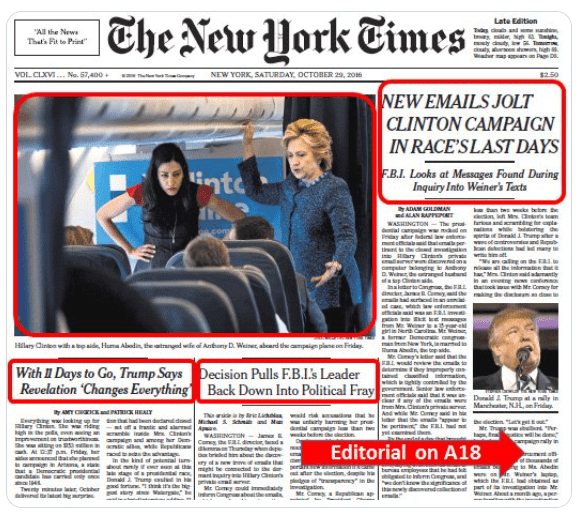
Just two days later, then-FBI director James Comey revealed the bureau had reopened its probe into Clinton’s emails, based on the possible discovery of new communications on a laptop belonging to disgraced New York politico Anthony Weiner. The news jolted the campaign with a particularly strong boost from the New York Times, which devoted two-thirds of its front page to the story — and the notion it was a major blow to Clinton’s prospects.

Untitledff

It was later reported that Comey was motivated to make the unusual announcement about the laptop because he feared leaks from the FBI’s New York field office, which, according to Reuters, had “a faction of investigators based in the office known to be hostile to Hillary Clinton.” Indeed, Giuliani bragged immediately after that he had sources in the FBI, including current agents.

The supposed bombshell — it turned out there was nothing incriminating or particularly new on the laptop — wasn’t the only FBI-related story that boosted T____ in the homestretch of the 2016 campaign. On Oct. 31, citing unnamed “intelligence sources,” the Times reported, “Investigating D____ T____, F.B.I. Sees No Clear Link to Russia.” That article defused a budding scandal about the GOP White House hopeful — at least until after T____’s shock election on Nov. 8, 2016. In the coming days and weeks, the basis of that Times article would melt, but by then the most unlikely POTUS in U.S. history was ensconced in the Oval Office.

There are many reasons for T____s victory, but experts have argued the FBI disclosures were decisive. In 2017, polling guru Nate Silver argued that the Comey probe disclosure cost Clinton as many as 3-4 percentage points and at least 1 percentage point, which would have flipped Pennsylvania, Michigan, and Wisconsin and handed her the Electoral College.

This week’s stunning corruption charges against a top FBI spymaster [whose assignment to the New York office was announced in October 2016] — an agent who by 2018 was known to be working for a Vladimir Putin-tied Russian oligarch — should cause America to rethink everything we think we know about the T____-Russia scandal and how it really happened that T____ won that election.

The government allegations against the former G-man Charles McGonigal (also accused of taking a large foreign payment while still on the FBI payroll) and the outsized American influence of the sanctioned-and-later-indicted Russian billionaire Oleg Deripaska — also tied to U.S. politicians from T____ campaign manager Paul Manafort to Senate GOP leader Mitch McConnell — should make us also look again at what was really up with the FBI in 2016.

How coordinated was the effort in that New York field office to pump up the ultimate nothingburger about Clinton’s emails while pooh-poohing the very real evidence of Russian interference on T____’s behalf, and who were the agents behind it? What was the role, if any, of McGonigal and his international web of intrigue? Was the now-tainted McGonigal a source who told the New York Times that fateful October that Russia was not trying to help Trump win the election — before the U.S. intelligence community determined the exact opposite? If not McGonigal, just who was intentionally misleading America’s most influential news org, and why?

…To be sure, the 2016 FBI leaks weren’t the first time a major news organization has been burned by anonymous law enforcement sources, and regrettably, it probably won’t be the last. Media critics have been talking for years about the Times’ flawed coverage, and how its near certainty that Clinton would win and a desire to show its aggressiveness toward a future president seemed to have skewed its coverage.

It’s not only that America’s so-called paper of record has never apologized for its over-the-top coverage of the Clinton emails or the deeply flawed story about the FBI Trump-Russia probe. It’s that the Times has shown a stunning lack of curiosity about finding out what went wrong….

Last week’s indictment of McGonigal is a classic case of raising more questions than were answered. The evidence presented by prosecutors suggests the FBI counterintelligence expert wasn’t introduced to Deripaska until his waning days with the bureau in 2018, aided by a pair of Russian diplomats. In 2019, after he’d retired, the indictment says McGonigal went to work for the oligarch to help him evade U.S. sanctions and to investigate a rival. But the Times also reported that U.S. counterintelligence — in which McGonigal had been a key player — had tried unsuccessfully to recruit Deripaska as an asset in the years around the 2016 election.

Like the Woody Allen character Zelig, Deripaska — a 55-year-old aluminum magnate who at one time was the richest man in Putin’s Russia — is turning up in the background everywhere in the ongoing corruption of American democracy. The oligarch’s history of multimillion-dollar business dealings with Paul Manafort — T____’s campaign manager in the summer of 2016 — is central to the theory of Russian interference, after it was confirmed that Manafort shared key campaign data with a suspected Russian intelligence agent also connected to Deripaska.

In 2019, Deripaska did manage to get those U.S. sanctions lifted, in a controversial deal backed not only by Team T____ but critically by then-Senate Majority Leader Mitch McConnell. That same year, a Deripaska-linked aluminum company announced it would build a large plant in Kentucky, where McConnell was running for reelection. (It eventually wasn’t built.) This is the same McConnell who, during that critical fall period in 2016, refused to sign a bipartisan statement warning about Russian election interference.

Another coincidence in a scandal that is drowning in so-called coincidences.

It’s becoming clear that the tamping down of the most explosive parts of the Trump-Russia story is the greatest case of gaslighting since the movie [of that name] hit screens in 1944. It’s not just the FBI leaks in New York. We also learned last week — yes, thanks to that same New York Times — about the extraordinary and ethically dubious lengths that T____’s second attorney general, William Barr, and Barr’s handpicked special prosecutor, John Durham, went to to try to prove the FBI was out to sink T____. That’s the exact opposite of what really happened. Indeed, the Times noted the only major criminality turned up in the Durham probe was a potentially explosive new charge of financial impropriety — by D____ T____.

Seven years later, the lack of accountability and justice for the gaslighting of American democracy is appalling. Barr did a remarkable job in blunting the investigation by special counsel Robert Mueller, including squashing his findings about obstruction of justice by the T____ administration. A much-hyped probe by Justice Department inspector general Michael Horowitz into the FBI’s New York office took four long years and failed to find the leakers. And new revelations — including that tip about T____ financial crimes that Italian intelligence passed on to Barr and Durham — continue to surface.

Why does it matter? T____ is no longer president, after all, and America has a lot of other problems, with police brutality and mass shootings currently on the front burner. Yet when it comes to this all-encompassing T____-Russia scandal, the past isn’t even past. The seemingly untouchable 45th president was in New Hampshire and South Carolina this weekend, campaigning to become the 47th. The man that critics call “Moscow Mitch” McConnell could return as majority leader in that same election. And Putin’s obsession with Ukraine — always a focus of his U.S. interference and T____ dealings — has become a war with dire global implications.

More importantly, this never-ending scandal has demolished our trust in so many institutions — an FBI that seems to have corrupted an election, a Justice Department that covered up those deeds, and, yes, a New York Times that enabled several lies instead of exposing them.