Whereof One Can Speak 🇺🇦

Nothing special, one post at a time since 2012

For Those Interested in Interest Rates

If there’s one thing it’s hard to predict, it’s the future. (So, apparently, Yogi Berra once said.)

That didn’t stop Prof. Paul Krugman from writing about the future of interest rates in his New York Times newsletter (I’m leaving out most of his charts):

From a financial point of view, 2022 has, above all, been the year of rising interest rates. True, the Federal Reserve didn’t begin raising the short-term interest rates it controls until March, and its counterparts abroad acted even later. But long-term interest rates, which are what matter most for the real economy, have been rising since the beginning of the year in anticipation of central bank moves.

These rising rates correspond, by definition, to a fall in bond prices, but they have also helped drive down the prices of many other assets, from stocks to cryptocurrencies to, according to early indications, housing.

So what will the Fed do next? How high will rates go? Well, there’s a whole industry of financial analysts dedicated to answering those questions, and I don’t think I have anything useful to add. What I want to talk about instead is what is likely to happen to interest rates in the longer run.

Many commentators have asserted that the era of low interest rates is over. They insist that we’re never going back to the historically low rates that prevailed in late 2019 and early 2020, just before the pandemic — rates that were actually negative in many countries.

But I don’t see that happening. There were fundamental reasons interest rates were so low three years ago. Those fundamentals haven’t changed; if anything, they’ve gotten stronger. So it’s hard to understand why, once the dust from the fight against inflation has settled, we won’t go back to a very-low-rate world.

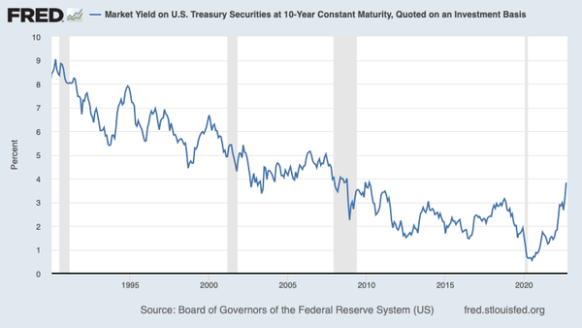
Some background: The low interest rates that prevailed just before the pandemic were the end point of a three-decade downward trend:
krugman041022_2-articleLarge

What do we think caused that trend? Some commentators say that it was artificial, that the Fed kept pushing rates down by printing money. But basic macroeconomics says that this shouldn’t be possible: If you keep rates artificially low for an extended period, the result should be high inflation. And until the price surge of 2021-22, inflation stayed subdued year after year.

A useful concept here, going back more than a century to the work of the Swedish economist Knut Wicksell, is that of the so-called “natural rate of interest”. Wicksell defined the natural rate either as the interest rate that matched saving with investment or as the rate consistent with overall price stability. These definitions are actually consistent with each other: An interest rate that is too low, so that investment spending exceeds the supply of savings, will cause inflationary overheating of the economy.

And the fact that we didn’t see inflationary overheating over the course of a 30-year trend of falling interest rates suggests that the decline wasn’t artificial — that the natural rate must have been falling over that period.

Why might the natural rate have declined? The most likely culprit is a decline in investment demand, driven by a combination of demographic and technological stagnation.

The key insight is that investment spending is driven in large part by growth — growth in the number of workers and in technological progress. A growing labor force needs more office space, more houses, and so on; a stagnant work force only needs to replace structures and equipment as they wear out. Technological progress can also contribute to investment by making it worthwhile to replace outmoded capital goods, and also by making people richer so they can demand more living space, and so on; if technological progress slows down, investment spending tends to fall.

Since the 1990s, both of these drivers of investment lost a lot of their momentum.

Once the last of the baby boomers reached their mid-20s, the number of Americans in their prime working years, which had risen rapidly for decades, flattened out:

This demographic downturn was even stronger in other wealthy countries. The working-age population in Europe has been declining since 2010, and it has fallen in Japan at a fairly rapid clip.

Technological change is harder to pin down, but it’s difficult to escape the sense that major innovations are becoming increasingly rare…. And for what it’s worth, estimates of total factor productivity, a measure meant to capture the economy’s overall technological level, have grown slowly since the mid-2000s:

So is there any reason to expect either demography or technology to be more favorable for investment in, say, 2024 than they were in 2019? I don’t see it.

It’s true that there has been a lot of recent technological progress in green energy, and it’s possible that an energy transition, helped by Joe Biden’s climate policies, will contribute to investment in the years ahead. But that aside, the same factors that kept interest rates low before the pandemic still seem to be in place.

What about inflation? Another old principle in thinking about interest rates is the Fisher effect, which implies that an increase in expected inflation should normally lead to an equal rise in interest rates. And inflation has spiked in the past year and a half.

That spike is, however, probably temporary. There’s a huge amount to say about inflation, but the 30,000-foot view goes like this: During the pandemic slump, governments gave households huge amounts of aid to maintain their incomes in the face of economic lockdowns. This meant that consumer purchasing power remained high despite a temporary reduction in productive capacity, causing a surge in prices — and leading central banks to hike rates to bring inflation back down.

But there doesn’t seem to be much question about whether they will, in fact, control inflation. Certainly, financial markets expect inflation to revert to pre-pandemic norms:

In summary, then, low interest rates weren’t artificial; they were natural. And it’s hard to see anything that will cause the natural rate to rise once the current inflation spike is over. So the era of low interest rates probably isn’t over after all.

Unquote.

Prof. Krugman may be underestimating the effect of progress in green technologies and how much work will be needed in order to implement them. He may be underestimating the effects of the worsening climate crisis. Or advances in artificial intelligence or biotechnology or nuclear fusion. Or the benefits of advanced technologies given to us by visitors from another world. 

But if the recent trend continues, interest rates will go down again. Since interest rates affect both borrowing and saving, and thereby the world’s economy, that’s interesting.

Connecting Global Dots

Josh Marshall of Talking Points Memo looks at the big picture

It’s interesting to step back sometimes and consider … our times. Today we have our ongoing battle over democracy and authoritarianism in the U.S. The UK is in its latest stage of its ongoing national self-immolation. Italy has just elected its first far-right government since Benito Mussolini’s rise to power in the early 1920s. Russia, which has made itself into the international clarion of rightist nationalism, is stumbling through a succession of largely self-inflicted catastrophes in its war of choice in Ukraine.

Let’s go back to the Arab Spring. The Arab Spring unsettles or topples governments across the Arab Middle East. But it triggers long-running civil wars in Syria and Libya. The first especially, but also the second, are the main drivers of the European Union migrant crisis of 2015, in which some 1.3 million refugees/migrants requested asylum in the EU, the most in any single year since World War II. Given the closeness of the vote and the great focus on the migrant crisis in 2015 and 2016, it’s very hard to imagine the UK leaves the European Union without this chain of events … beginning in December 2010.

Less obvious is that you can make a looser but I think still fairly persuasive argument that these events play a key role in the rise of [MAGA-ism] in the United States….The rise of [MAGA-ism] is part of a long progression within the United States. [However, their leader’s] particular platform — to the extent you can call it that — focused on “the wall” and immigrants from Mexico and Central America….

But there’s a somewhat different commonality I am focusing on.

The [reactionary] right is, paradoxically, highly internationalized if not internationalist. There’s a deep confluence and sharing of ideas, imagery and programs between the U.S. and Europe. The narratives of “our out of control migration” and white Christian cultures under threat was a common, interwoven and reinforcing pattern on both sides of the Atlantic….

These are of course only the barest thumbnail outlines of recent history and its relationship to the present…. Why this interests me is that migration flows and their intensity are going to increase over time. The most basic reason is climate. Our potential climate futures range from really bad to truly catastrophic. But anywhere on that spectrum you have lots of people trying to move from places that are less habitable than they used to be or are in the throes of political and economic instability for those same reasons. Telecommunications and transport technology greatly accelerate that process.

A century ago a poor peasant in India or Ecuador may have known in a general way that there were vastly richer societies in Europe and North America. But they couldn’t really know the details and it was close to impossible to get there anyway. Today, almost everyone in the world can see through electronic media how people live in Europe, North America, and other parts of the affluent world and — though it’s hard and often dangerous — it is possible to get there.

What we can draw from this is that the accelerating patterns of global migration which are so central to the politics of the last decade and have helped reshape politics in Europe and North America will almost certainly continue to intensify.

While I Was Away

Here are a few things from the past week or so I wanted to share:

From Paul Krugman at the New York Times:

Wonking Out: The Tax Cut Zombie Attacks Britain

I’ve written a lot over the years about zombie economic ideas — ideas that have failed repeatedly in practice, and should be dead, but somehow are still shambling around, eating policymakers’ brains. The pre-eminent zombie in American economic discourse has long been the belief that cutting taxes on the rich will create an economic miracle.

That belief is still out there: Even as its infrastructure was collapsing to the point that its largest city no longer had running water, Mississippi tried to raise its economic fortunes with … a tax cut….

The important point to understand is that there isn’t a serious debate about the proposition that tax cuts for the rich strongly increase economic growth. The truth is that there is no evidence — none — for that proposition….

Of course, people on the right, raised on the legend of Saint Reagan, believe that his tax cuts did wonders for the U.S. economy. But the data don’t agree [he has charts, etc.]

From Jamelle Bouie, also at the New York Times:

In political writing about the federal judiciary, there is a convention to treat the partisan affiliation of a judge or justice as a mere curiosity, to pretend that it does not matter that much whether a jurist was nominated by Ronald Reagan or Bill Clinton or George W. Bush or Barack Obama so long as he or she can faithfully uphold the law.

The issue with this convention, as we’ve seen in the legal drama over the classified materials found … at Mar-a-Lago, is that it isn’t equipped to deal with the problem of hyperpartisan, ideological judges who are less committed to the rule of law than to their presidential patron….

Thankfully, there is a solution, and it takes only a simple vote of Congress: expand and reorganize the federal court system [well, actually it would only be a partial solution and important votes in Congress are rarely simple].

The practical reason to increase the number of courts and judges is that the country is much larger than it was in 1990, when Congress made its last expansion….

In the 32 years since 1990, the United States has grown from a population of roughly 250 million to a population of over 330 million….. And the federal judiciary is swamped. Last year, the Judicial Conference of the United States, a nonpartisan policymaking body for the federal courts, recommended that Congress create 79 new judgeships across existing district and appeals courts.

Congress, and here I mean Democrats, should go further with a court expansion to rival [Jimmy Carter’s in 1978]…. The goal is simple: to account for growth and to deal with the problem of a cohort of hyperpartisan and ideological judges whose loyalty to [the orange-ish ex-president] may outweigh their commitment to the law.

Would it be a partisan move? Yes. But it is a truth of American politics going back to the early days of the Republic that partisan problems — like the one engineered by Mitch McConnell … and the Federalist Society — demand partisan solutions.

From Charles Pierce for Esquire:

In the End, Climate Change Is the Only Story That Matters

To pretend otherwise is just to build the walls of your sandcastle higher.

While we watch the disembowelment of various lawyers in the employ of a former president* and wrap ourselves in the momentum of the upcoming midterm elections, the climate crisis—its time and tides—waits for no one. Every other story in our politics is a sideshow now. Every other issue, no matter how large it looms in the immediate present, is secondary to the accumulating evidence that the planet itself (or at least large parts of it) may be edging toward uninhabitability….

To stand on the bluffs above the Chukchi Sea [between Siberia and Alaska], looking down at a series of broken and ruined seawalls that have already failed to hold back the power of the ocean, and to consider that there are politicians in this country who are unwilling to do anything about the climate crisis, or who even deny it exists, is to wish they all could come and stand on these bluffs and look out at the relentless, devouring sea.

It probably doesn’t matter, but:

From Verlyn Klinkenborg for the New York Review of Books:

Endless Summer [not a great title]

Brian Wilson’s songs still have the power to astonish on their own terms, from their own time….

I have trouble accepting that Smile—the album he abandoned in 1967—was finally finished in 2004, because I question the continuity of the creative mind that “finished” it nearly forty years after it was begun. My skepticism makes me wonder whether I’m simply clinging to the memory of my own experience of the Beach Boys when I was young. But I don’t think so. They’re the same doubts that apply, say, to Wordsworth’s late revisions to The Prelude.

The joy I experience listening to those early Beach Boys records—through “Good Vibrations” and “Heroes and Villains” and slightly beyond—has nothing to do with nostalgia, with memories of where I was or who I was when I heard them. They don’t evoke for me an idealized California or even my adolescent yearnings. I don’t hear them from [Iowa] or Sacramento. I hear them from now. Wilson’s songs still have the power to astonish on their own terms, from their own time. What makes them so remarkable isn’t just the artistic fulfillment they achieve. It’s the artistic promise they embody. You can feel the explosive, disruptive, but ultimately controlled power of Wilson’s musical imagination—usually in three minutes or less….

Wilson marvels, in one of the documentaries I’ve mentioned, how quickly he wrote the melody of a song like “Caroline, No.” To me, that’s a sign that he’s allowed himself to misunderstand—in wholly conventional terms—what’s most remarkable about his work. It isn’t the melodic line or the speed with which it was written that stuns me now and stunned me then. It’s the shape of the mind in which the intricate shapes of his music entangled and resolved themselves. That mind has only ever been captured in one place: in the music as Brian Wilson recorded it long ago. 

Finally, two conclusions about France:

Louis XIV’s Versailles estate is too damn big. Did any of those 18th century aristocrats walk great distances in their 18th century shoes? The “gardens” are not somewhere to stroll around. They’re somewhere to hike or ride around.

And almost every French waiter was extremely nice, even the one who spilled the orange juice. Aren’t they supposed to be mean and snooty? Or is that only at the more exclusive establishments?

Cable News and the Ways of the World

It’s human nature to want a single explanation for anything that happens. We usually look for the reason, not the reasons. Thus, when the new management at CNN fired John Harwood and Brian Stelter, both of whom have openly criticized the former president (and full-time criminal), the reason that immediately came to mind was a political one. CNN’s new owner, Warner Brothers Discovery, wants the company to be nicer to Republicans.

An article from Vox written a couple weeks ago suggested that’s one reason, but there’s probably another as well:

In [one] version of events, Stelter is the victim of John Malone, the billionaire cable magnate and the most powerful investor in Warner Brothers Discovery Inc., which now owns CNN and the rest of what used to be called Time Warner.

Malone’s politics lean quite right/libertarian…. More to the point: Current and former CNN employees believe Malone’s view of CNN is entirely colored by Fox News. “John Malone doesn’t watch CNN. John Malone only watches CNN via Fox News,” says a CNN employee. “If I watched CNN via Fox News, I would hate CNN too.”

And Stelter, who spent most of the Trump era criticizing the American right’s embrace of disinformation, was already a target of Fox News hosts like Tucker Carlson…. Then, after Stelter’s boss, Jeff Zucker, was pushed out in February, Stelter went after Malone, who had said he wished CNN was more like Fox News because Fox News had “actual journalism.”

Asked about this theory by the New York Times, Malone gave one of the most candid admissions you’ll ever see a public person make in the guise of a denial: “Mr. Malone said he wants “the ‘news’ portion of CNN to be more centrist, but I am not in control or directly involved.” Translation: Yes, this pleases me.

So in this theory, … Malone and his managers — CEO David Zaslav and Chris Licht, the executive Zaslav hired to replace Zucker — will find other CNN journalists they want off the air as well. [In fact, they already have. They fired John Harwood this past week — he called the Republican front-runner a “dishonest demagogue” on his way out the door].

Then again, maybe they’ll need to let go of a lot of people because of theory No. 2:

Warner Brothers Discovery has a heavy debt load, but Zaslav has told investors that won’t matter, in part because he’s going to find $3 billion in savings.

We’ve already seen signs of budget-cutting in the company’s entertainment properties … but there will be many more cuts to come this fall. So Stelter, who reportedly made close to $1 million a year, was an easy cut: His show … was a big deal in media circles … but not a huge draw for normals.

Under Zaslav/Licht, CNN has already made one significant cut: Killing off CNN+, its brand-new streaming service, weeks after it launched … But that may not be anything close to enough to help the parent company hit its numbers. In which case, Stelter’s departure could be the first of many, and we’ll spend less time worrying about CNN’s politics and more time worrying about its ability to provide first-class news coverage.

But there’s another theory. Someone who goes by YS on Twitter and claims to have worked at CNN for 18 years says it’s all about who watches cable news:

Each quarter, the cable operators [like Comcast and AT&T] release their subscriber base. For seven consecutive years, the cable operators have seen subscriber declines… It’s called in the TV biz, “Cord Cutters”.

97% of “Cord Cutters” are under the age of 50. The majority of what is left watching cable are … old people. As demographics for cable TV has changed … the networks remaining with any traction (ESPN, news networks, etc.) have to – HAVE TO – appeal to who is sitting on their couch watching.

In the ratings war, the scorecard is usually based on the A18-49 demographic. But not for news. All advertisers on these networks buy them for A50+. [Aiming for that demographic] MSNBC went left. Fox News went right. CNN tried to play the middle.

But between 2008 and 2016, CNN lost 60% of its 50+ audience. Fox News, saw a 70% increase in the same demographic during the same period (mostly men). Fox News gave the audience what they want, an aggrieved white man perspective…. While the rest of America is out there cutting the cord, Fox News doubled down on old people. And won. 

News networks are not here to defend democracy. There is only one goal and one goal only. Higher CPM’s [i.e. what they can charge advertisers to reach a thousand viewers. On average, advertisers pay $20 to reach 1,000 viewers, which adds up when 100 million people watch the Super Bowl]. CPM is the currency used in TV to reflect the value of the programming.

[CNN’s new boss] was given one edict. Raise CPM’s. That’s it. That’s all he has to do. And he believes [becoming more “centrist”] is how.

Whether there’s one reason or several for CNN’s management to change its programming, the basic fact is that many old people (although not all of us) watch cable TV and will accept a kind of fascism if it comes to that, and the people who call the shots for big corporations tend to be Republicans who have some doubts about democracy and no doubts at all about making money.

Student Loan Forgiveness: Bad Assumptions, Bad Arguments

I went to college when you could do it relatively cheaply. More recently, a close relative took out loans and paid them off. Yet I find myself strangely pleased that President Biden is giving many former students financial assistance. If you happen to disagree (or if you don’t), here are perceptive comments on the matter from two columnists. First, Paul Waldman of The Washington Post. Then Jamelle Bouie of The New York Times.

One can make reasonable arguments against the student loan forgiveness plan President Biden announced this week. But the outright fury of the response in some quarters, and the absurd bad faith and hypocrisy being mobilized against this plan, have been a wonder to behold. And it is revealing fundamental things about the people taxpayers think the government ought to help.

To watch the reaction, you’d think this is the first loan forgiveness program in human history. You’d also think it’s absolutely vital to determine whether every last recipient will be morally deserving of this assistance, and whether any good people anywhere might fail to qualify for it. The more you examine these arguments — not only from Republicans but also journalists and a few Democrats — the weirder they seem.

At the most basic level, loan forgiveness isn’t novel or even unusual. Our bankruptcy system allows people to discharge loans every day — yet perversely, the law makes it extraordinarily difficult to get released from student loan debt even if you’re bankrupt. Some well-known people have used the bankruptcy system to eliminate their debts [including a former president, six times].

The government, furthermore, bails out people, companies and industries all the time when it decides that doing so is worthwhile. In the Great Recession we bailed out banks, insurers and auto companies. D____ T____ handed out tens of billions of dollars to farmers hit by his pointless trade war. Pandemic relief distributed hundreds of billions of dollars in forgivable Paycheck Protection Program loans to businesses.

Some of those forgiven loans — remember, taxpayer money, from truck drivers and waitresses — even went to the same Republican members of Congress who now rail against forgiving student debt, as the White House eagerly pointed out. If you’re a struggling blue-collar worker, are you mad that Rep. Marjorie Taylor Greene (R-Ga.) had $183,000 in loans forgiven, or that Rep. Markwayne Mullin (R-Okla.) had $1.4 million forgiven, or that Rep. Matt Gaetz (R-Fla.) had $482,000 forgiven?

If not, why does student loan forgiveness make you mad?

This leads to one of the most bizarre arguments against this program: Sure, it helps some people, but what about people it doesn’t help? What about people who never went to college, or who already paid off their loans? Why should they chip in to help these other people?

That argument could be raised against almost every government program in existence. This is the nature of paying taxes and having a government: Your money goes to all kinds of things that don’t benefit you directly or that you don’t like. You pay to maintain national parks you might not visit, and to find cures for diseases you’ll never contract. You support schools even if you don’t have kids. You build roads in states you don’t live in. You support wheat farmers even if you’re on a gluten-free diet.

How many people complaining about loan forgiveness have campaigned against the mortgage interest deduction? It costs taxpayers tens of billions of dollars every year, and its recipients — homeowners who itemize their deductions — are disproportionately wealthy. Where are all the cries of “How does this help people who rent, or people who already paid off their mortgages???”

The flip side of that argument is one we’re also hearing, that some people who will get this assistance might not truly need it. Journalists are searching for supposedly undeserving recipients, no matter how small their numbers. What if there’s an engineering major who just graduated and hasn’t gotten a job yet, but next year she’ll be working at Google? My God, are we going to forgive her loans when in 10 years she could be a billionaire?

The answer to that question is, who cares? Seriously. As a taxpayer (and as someone who, yes, took out student loans and paid them off), I don’t mind if some people get relief who might do fine without it, because tens of millions of lives could be transformed by this policy. The question is how much good the program as a whole does, not whether it helps someone somewhere who doesn’t really need it. The overwhelming majority of recipients will be middle class and because it gives extra to Pell Grant recipients, people from poor families get the most help.

Finally, some people warn that the program could worsen inflation, because it will put money into the economy. The truth is that the effect on inflation will likely be minuscule, but you could raise the same objection to literally anything the government spends money on.

For instance, earlier this summer, the House passed an $839 billion military spending bill for the 2023 fiscal year — that’s one year, not over a decade. Will pumping that much money into the economy be inflationary? And if so, should we just stop funding the military?

The fact that this question probably sounds ridiculous to you is revealing: Nobody ever worries about the inflationary effect of military spending, because people make that kind of objection only to policies they don’t like.

And that’s what’s at the heart of the objections to Biden’s loan forgiveness: Most of those making them are perfectly happy to have the government help some people, just not these people. And if that’s your argument against student loan forgiveness, you haven’t shown why the program is bad; all you’ve done is reveal yourself.

Unquote. Now from Mr. Bouie’s newsletter (no link available):

The Republican response to President Biden’s student loan forgiveness program is to try to turn the issue into a culture war…. Republicans would say that they are simply speaking up for those Americans who won’t benefit from the program. But they’re working under faulty assumptions.

First, a few details on the program itself. Under the plan, Biden will direct the federal government to forgive up to $20,000 in federal student loans for recipients of Pell Grants (which are awarded to students from low-income families), and up to $10,000 in loans for other eligible borrowers. It is restricted to individuals with incomes of up to $125,000 a year and households with incomes of up to $250,000 a year.

If every single recipient earned $124,999, it would lend credence to the Republican argument that this is some kind of war on working-class and blue-collar Americans. But they don’t. In fact, the biggest beneficiaries of Biden’s policy are exactly the people Republicans claim to represent with their rhetoric. As my newsroom colleague Jim Tankersley notes, “the people eligible for debt relief are disproportionately young and Black. And they are concentrated in the middle band of Americans by income, defined as households earning between $51,000 and $82,000 a year.”

If you want to haul freight for a living, you’ll need a commercial driver’s license, which means you’ll need training, which means you’ll need school. This schooling can cost thousands of dollars, and students can pay their tuition with federal student loans. So, too, can people who need training to work as medical technicians or home care workers or physical therapists or restaurant workers, among many other trades and professions.

Millions of people with blue-collar jobs owe thousands of dollars in federal student loans, and they may not have the income needed to pay them off. Biden’s plan helps them as much or more than a graduate of a four-year college with debt on the ledger. It also helps the millions of Americans who took out loans, attended college, but for one reason or another could not complete their degrees and are in the worst of all financial worlds as a result.

Like the “welfare queen,” the lazy, profligate and irresponsible student loan borrower of Republican rhetoric is a myth. And the point of the myth, as I said earlier, is to spread cultural resentment.

The fact of the matter is the Republican Party does not have anything to offer the millions of working- and middle-class Americans who labor under the burden of student debt. For all the talk of “populism,” the party is still hostile to the social safety net, opposed to raising the minimum wage, hostile to unions and worker power and virtually every economic policy intervention that isn’t tax cuts and upward redistribution from the many to the most fortunate few.

To debate the reality of student debt relief is to make that more than clear to the public at large. Republicans, then, are trying to make this a debate over culture, to try to reduce issues of class to a question of aesthetics, with traditional blue-collar workers on one side and the image of an ungrateful and unproductive young person on the other. And they’re hoping, as always, that you won’t notice.

Unquote. 

That should be the Republican Party’s epitaph: THEY HOPED YOU WOULDN’T NOTICE.