Whereof One Can Speak 🇺🇦

Nothing special, one post at a time since 2012

A Big Story Fox “News” Won’t Cover

Really good liars never admit they’re lying. From CNN:

Fox News continues to be exposed like never before.

In legal filings made public Tuesday as part of Dominion Voting Systems’ $1.6 billion defamation lawsuit against the right-wing channel, a trove of private text messages, emails, and deposition transcripts offered a new look at how the sausage is made behind the scenes at the channel — and it is ugly. 

The filings expose the face of the network, Tucker Carlson, as a fraud. They show that Rupert Murdoch rejected conspiracy theories about Dominion, despite allowing them to be promoted on his network. And they show the contempt that hosts like Sean Hannity have for some of their colleagues who tried to tell the truth about what actually transpired in the 2020 election.

► Carlson “passionately” hates [the former president]: In a number of private text messages, Carlson was harshly critical of T____…. Carlson [wrote] that T____’s post-election behavior was “disgusting”…. In another text message, two days before the January 6 attack, Carlson said, “We are very, very close to being able to ignore T____ most nights. I truly can’t wait.” Carlson added of T____, “I hate him passionately.” The Fox host said of the Trump presidency, “… We’re all pretending we’ve got a lot to show for it, because admitting what a disaster it’s been [the last four years] is too tough to digest. But come on. There isn’t really an upside to T____.”

â–şMurdoch rejected conspiracies: In his January deposition, Murdoch was repeatedly asked about various electronic voting conspiracy theories — and he rejected all of them. “You’ve never believed that Dominion was involved in an effort to delegitimize and destroy votes for D____ T____, correct?” a Dominion lawyer asked at one point. “… No, I’ve never seen it,” Murdoch replied….

► Hannity and Doocy mocked Fox’s journalists: In a series of November 2020 text messages, Hannity and Steve Doocy attacked the reporting from their colleagues on the so-called “straight news” side of the network. “‘News’ destroyed us,” Hannity complained. “Every day,” Doocy replied. “You don’t piss off the base,” Hannity said. “They don’t care. They are JOURNALISTS,” Doocy texted back. Hannity said he has “warned” people at the network “for years” and there is “NOTHING we can do to fix it.”

► Fox D.C. chief decried “existential crisis” at network: More than a month after the 2020 election, then-Fox News DC Managing Editor Bill Sammon decried the network’s coverage of false election claims in private messages to a colleague, fearing it had become an “existential crisis” for the right-wing channel. “It’s remarkable how weak ratings make good journalists do bad things,” Sammon wrote then-political editor Chris Stirewalt. Stirewalt replied, “It’s a real mess.”

Greg Sargent of The Washington Post comments:

[The] fear that viewers might see telling the truth about D____ T____’s loss as betrayal was widespread inside the network…. [Fox insiders] fumed that candor about 2020 was driving the audience away, prompting viewers to defect to competitors who offered a more comforting cocoon. On the air, some of those personalities kept doling out what they privately admitted were lies.

[This scandal] points to an even bigger story: The right wing media’s long war on the truth. For decades, conservative media outlets have expressly sought to build and capture an audience that would accept only their version of events, and would be cordoned off to place them beyond the reach of mainstream news sources entirely.

“Right wing media have been engaged in a 70-year project to ensure that their audiences only trust conservative news outlets,” Nicole Hemmer, who tells this story in “Messengers of the Right”, her excellent history of conservative media, told me. “They’ve worked to discredit other sources of more-objective information, so that their audiences are unwilling to trust outlets more rooted in reality”….

Hemmer traces the genesis of this broader ideological project to the late 1940s and early 1950s. At the time, she tells me, leading figures on the right made a concerted decision to “create their own media outlets” in the form of periodicals such as Human Events, while spreading “the message that all non-conservative media are deeply biased”.

This intensified during the presidency of Richard M. Nixon, who turned Vice President Spiro Agnew loose to make snarling speeches attacking the television networks…. The influence of right-wing media intensified in the late 1980s with the explosion of talk radio. This capture of conservative audiences was aided, Hemmer notes, by the success of Rush Limbaugh and others who made the message about biased mainstream news “entertaining and profitable.”

Enter Fox News, which was founded in the mid-1990s and attained itscommanding heights in the right-wing information ecosystem in the early 2000s. 

But now the audience’s captivity to an alternate version of events is blowing back on Fox News. Over the years Fox News’s audience has rebelled over other things, such as Hannity’s championing of immigration reform, which incited a backlash from his viewers. Nothing, however, has compared to the current scandal. 

Will there be any repercussions? There should be. Democratic politicians shouldn’t appear on their programs. People giving press conferences shouldn’t answer questions from their “reporters”. Cable TV operators should either drop Fox “News” or make people pay a lot to watch. Businesses and government facilities, including military bases, shouldn’t let Fox run in waiting rooms, offices, etc. Fox management should be ostracized. And there should be more defamation lawsuits.

I’ve read that Fox isn’t telling its viewers about any of this (no surprise). But I hope other right-wing outlets are spreading the news. Don’t watch Fox! They don’t really believe the election was stolen! Or that vaccinations are terribly dangerous! Watch us and visit our site instead! We’re on your side! We promise not to upset you by telling you the truth about anything!
It Used To Be the Blue and the Gray; Now It’s Blue and Red

One of the most moronic members of Congress was in the news recently when she proposed a “national divorce”. Red and blue states would go their separate ways. She’d have us remain one country, but the national government would have much less authority than it does now.

American politics being what it is these days, many of us, probably most of us, have thought it would be a good idea if those other states — the crazy ones — went off and formed their own damn country. Unfortunately, this would be a very difficult thing to do.

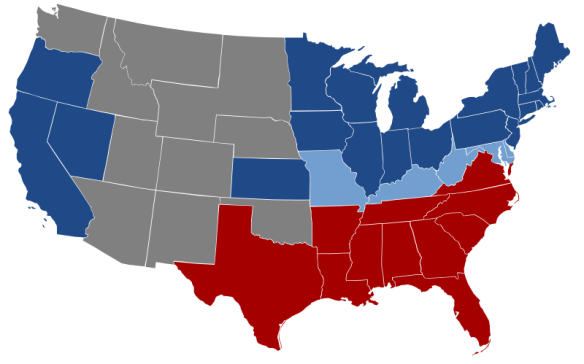
Back in 1861, the country was geographically divided between the North and South. The South  had slavery, its “peculiar institution”, and the North didn’t. But the division wasn’t that clearcut. There were five “border states” (Missouri, Kentucky, West Virginia, Maryland and Delaware, moving from west to east) that permitted slavery but didn’t secede from the Union. They’re the light blue ones below (the gray areas were relatively unsettled “territories” that hadn’t yet become states).

US_map_1864_Civil_War_divisions.svg

President Lincoln’s Emancipation Proclamation was only intended to end slavery in the eleven states that had seceded. It wasn’t until the 13th Amendment to the Constitution was ratified in 1865 that slavery was abolished everywhere. But geography made it relatively easy for the southern states to try to leave.

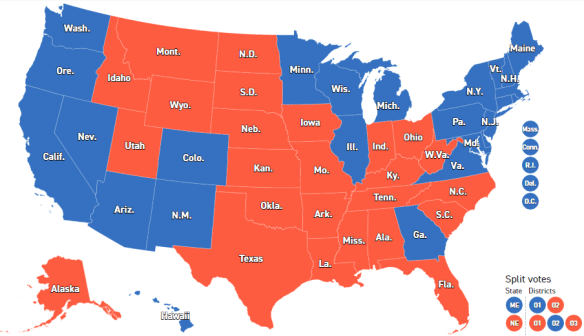
Dividing America by red and blue states is more complicated today. This map shows the results of the 2020 presidential election. The blue states voted for the Democratic winner; the red ones for the Republican loser. The red states are connected; the blue ones aren’t. And look at Georgia all by itself. (That’s where the Republican moron who proposes a national divorce was voted into Congress. Based on this election, she’d want to relocate.)

Untitled This way of portraying an election makes sense in terms of our obsolete Electoral College, since it requires each state to hold its own separate presidential election. In almost every state, a candidate gets all of that states “electoral votes” if they beat their opponent by one vote in that state’s election.
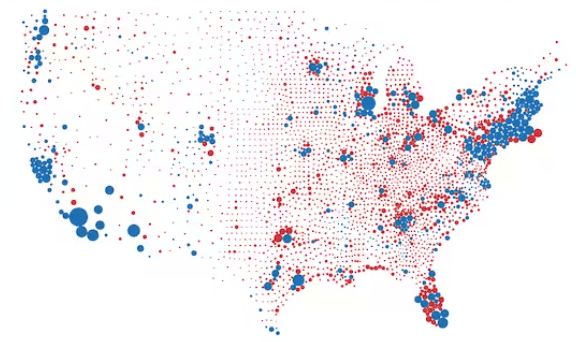
But a state-level map hides something important about American politics. After the 2004 election, the editors of a Seattle alternative paper called “The Stranger” wrote about our Urban Archipelago:

Look at our famously blue West Coast. But for the cities—Seattle, Portland, San Francisco, Los Angeles, and San Diego—the West Coast would be a deep, dark red. The same is true for other nominally blue states. Illinois is almost entirely red—Chicago turns the state blue. Michigan is almost entirely red—Detroit, Lansing, Kalamazoo turn it blue. And on and on. What tips these states into the blue column? Their urban areas do, their big, populous counties….

Liberals, progressives, and Democrats do not live in a country that stretches from the Atlantic to the Pacific, from Canada to Mexico. We live on a chain of islands. We are citizens of the Urban Archipelago, the United Cities of America. We live on islands of sanity, liberalism, and compassion—New York City, Chicago, Philadelphia, Seattle, St. Louis, Minneapolis, San Francisco, and on and on.

And we live on islands in red states too—a fact obscured by that state-by-state map. Denver and Boulder are our islands in Colorado; Austin is our island in Texas; Las Vegas is our island in Nevada; Miami and Fort Lauderdale are our islands in Florida. Citizens of the Urban Archipelago reject heartland “values” like xenophobia, sexism, racism, and homophobia, as well as the more intolerant strains of Christianity that have taken root in this country….

For Democrats, it’s the cities, stupid—not the rural areas, not the prickly, hateful “heartland,” but the sane, sensible cities—including the cities trapped in the heartland.

This map shows the 2020 election by county instead of state. The blue dots are the Urban Archipelago, the United Cities of America. (The map also shows how Biden managed to win by 7.5 million votes, unlike state-level maps that ignore how many people are in those states.)

Untitled

Of course, not everybody in Los Angeles County or Miami-Dade voted for Democrats. But on top of all its other problems, a “national divorce” by state would strand millions of Democratic city dwellers in red Republican states free to become even more reactionary and dangerous to live in.

Even though un-uniting the United States is unlikely, thinking about the possibility helps us understand our country’s political geography. According to a 2019 paper by Will Wilkinson of the Niskanen Center, it’s all about cities and population density. The title of the paper is “The Density Divide: Urbanization, Polarization and the Populist Backlash”. Here’s his summary of his findings:

We’ve failed to fully grasp that urbanization is a relentless, glacial social force that transforms entire societies and, in the process, generates cultural and political polarization by segregating populations along the lines of the traits that make individuals more or less responsive to the incentives that draw people to the city. I explore three such traits — ethnicity, ideology-correlated aspects of personality, and level of educational achievement — and their intricate web of relationships. The upshot is that, over the course of millions of moves over many decades, high density areas have become economically thriving, multicultural havens while whiter, lower density places are facing stagnation and decline as their populations have become increasingly uniform in terms of socially conservative personality, aversion to diversity, and lower levels of education. This self-segregation of the population, I argue, created the polarized economic and cultural conditions that led to populist backlash [note: and the election of You Know Who in 2016].

Because the story of urbanization just is the story of a strengthening relationship between density, human capital and economic productivity, it’s also the story of relative small town and rural decline. The same process that has filtered better-educated, more temperamentally liberal whites out of lower density places has left those places with less vibrant economies, but also with more place-bound, ethnocentric populations.

It’s no shock that leavers leave and stayers stay. What’s surprising is that, if you’re white…,  the personality traits that make you more or less inclined to leave or stay — that make you more or less magnetized to the rising attractive force of the city — also predict how socially conservative or liberal you’ll tend to be, and which political party you’ll tend to support.

So the pull of urbanization has segregated us geographically on those traits, and it has done it so thoroughly that Democratic vote share now rises, and Republican vote share drops, in a remarkably linear fashion as population density rises. The relationship between density and party affiliation is, with few exceptions, similar everywhere — in “red states” and “blue states,” in sprawling metro regions and bucolic small towns — and majorities tend to flip at the density typical of a big city’s outer suburbs. I call this partisan polarization on population density the “density divide.”

When populations segregate geographically on traits relevant to ideology and party affiliation, political polarization is sure to follow. The increasing concentration of the economy in big cities, which is both a cause and effect of urbanization, amplifies this polarization. Rising prosperity reliably produces a liberalizing, tolerant, positive-sum mood. Material insecurity, in contrast, tends to elicit a grim, zero-sum, us-or-them mindset. Because the sunshine of prosperity has become increasingly focused on urban populations, lower density white populations — which, thanks to the sorting logic of urbanization, are already more conservative and ethnocentric — have been left with objectively darkening prospects and a mounting sense of anxiety that is, at once, economic and ethno-cultural.

This combination of conditions created a political opportunity [a certain orange demagogue]  managed to exploit. Because urbanization is reshaping societies everywhere around the world, it has created similar conditions, and similarly illiberal strongman leaders, in other countries as well. If we’re going to be able to do anything about the acrimony of polarization and the peril of ethno-nationalist populism, we’re going to have to get the story straight. This cross-disciplinary account of the social and psychological forces behind the density divide is my preliminary attempt to put us, finally, on the right track.

The Rot and Greed Inside Fox “News”

Fox “News” is in the news because a lawsuit revealed what the company’s leaders think of their viewers, i.e. they prefer comforting lies to truth and if Fox doesn’t feed them enough comforting lies, they’ll change the channel and Fox won’t make as much money.

Brian Stelter explains (behind the Atlantic’s paywall):

The basic story of Fox News and the 2020 election is well understood. Fox’s relatively small news operation covered the vote count accurately; this coverage infuriated President D____ T____, the MAGA base, and Fox’s opinion stars; some viewers temporarily flipped to further-right outlets, such as Newsmax; and Fox panicked.

But thanks to Dominion Voting Systems, which is pursuing a $1.6 billion defamation lawsuit against Fox, we now know that the network’s sense of crisis was even more intense than it appeared from outside. With the case careening toward trial, a court filing [last week] revealed some of what Dominion found during the discovery process, including eye-popping messages from Sean Hannity, Tucker Carlson, and Fox’s senior management. “Getting creamed by CNN!” Fox’s owner, Rupert Murdoch, wrote to its top executive after seeing the overnight ratings on November 8. “Guess our viewers don’t want to watch it.”

He was right. Some of Fox’s top shows began broadcasting a better story, one that its viewers did want to watch: a conspiracy-laden tale about crooked Democrats stealing an election. Dominion is arguing that Fox knew full well that [the] voter-fraud allegations were bunk, but promoted the lies anyway.

Whether or not Dominion prevails in court, and many experts believe it will, the lawsuit is already forcing an ethical reckoning over Fox’s disrespect of its audience. Hour after hour, day after day, Fox stars kept signaling to viewers that T____ might still win the election not because they thought he would, but because they were worried about their ratings. And we all witnessed the consequences on January 6….

On November 12, 2020, nearly a week after Joe Biden clinched the presidency, … Hannity pretended that the outcome was still in doubt. He said the election was not fair. He cited “outstanding votes that have yet to be counted” and “more reports of dead people voting from beyond the grave.” And, crucially, he talked at length about Dominion….

The Fox News correspondent Jacqui Heinrich … had the audacity to tweet the truth. She wrote that “top election infrastructure officials”—including some in [the current] administration—had issued a statement saying “there is no evidence that any voting system deleted or lost votes, changed votes, or was in any way compromised.”

… Carlson flagged Heinrich’s tweet and told Hannity, “Please get her fired.” Why? Because her minor Twitter fact-check of an out-of-control president was exactly the sort of thing that Fox’s fan base could not stand to see.

“It needs to stop immediately, like tonight,” Carlson wrote. “It’s measurably hurting the company. The stock price is down. Not a joke.”

Hannity replied and said he had already sent the accurate and thus offending tweet to Fox News Media CEO Suzanne Scott.

“Sean texted me,” Scott wrote to two colleagues…. Scott was bothered too. She worried that reporters at other outlets would notice Heinrich’s tweet: “She has serious nerve doing this and if this gets picked up, viewers are going to be further disgusted”….

The new legal filing by Dominion is such a showstopper [because] we can read exactly what the leaders and stars of Fox News really think. This is my biggest takeaway: In the days after Biden won the election, while T____ tried to start the steal by shouting “Stop the Steal,” the most powerful people at Fox News were not concerned about [informing their audience or] the health of U.S. democracy. They were concerned about Fox’s brand and their own bottom line.

Stelter has talked to people at Fox:

A senior staffer at Fox railed against the network’s journalists and math wizards who had called Arizona for Biden, calling them “arrogant fucks”.

[A] former morning-show producer told me, “We were deathly afraid of our audience leaving, deathly afraid of pissing them off.”

A veteran staffer [said] “I feel like Fox is being held hostage by its audience”…

Sources at Fox [have] told me to think of it not as a network per se, but as a profit machine. They feared doing anything that would disrupt the machine. 

Jay Rosen, a journalism professor at New York University, also describes Fox “News” as a “machine”:

The latest filing by Dominion Voting Systems in its defamation suit against Fox nails something critics have long argued for. Fox is not a news organization. It’s something else. But what is this thing? I will try to answer that.

The Dominion suit establishes that Fox stars (like Tucker Carlson) and executives (like CEO Suzanne Scott) were fearful and enraged when some of their own people blundered into delivering a true and accurate report about the 2020 election. Think about that. When its own talent reported the facts truthfully, the result was a company crisis….

If Fox is not a news organization … and it is not “opinion” either (because the Dominion filing shows the hosts are frightened to share their real opinions) then what is it, exactly? Some common answers: It’s entertainment. It’s propaganda. No, it’s just ratings.

[It’s] the commercial arm of a political movement that has taken control of the Republican Party. The product is resentment news. Current ways to resent. Success in that market makes for political power. [It’s] a kind of machine.

By “machine” I mean to evoke both the manufacture of politicized grievance for fun and profit, and the kind of machine through which Richard Daley rose to power in mid 20th century. A machine in the sense of the Cook County Democratic Machine. Again: not a news organization.

Dominion’s filings describe a time when the audience took charge of the resentment machine. Power traded hands for a bit. Viewer backlash from a correct call in Arizona felt ruinous. Stars with shows and executives nominally in charge of Fox saw how weak their positions were.

Fox has to accept that its powers are limited. The Fox audience can veto events that in the rest of the world unquestionably occurred. You’re not a news organization if your audience’s refusal to accept what happened prevents [you from telling them] what happened.

Both the Republican Party and Murdoch’s fear-and-loathing machine know they cannot control the core audience for commercialized resentment and white nationalism, which will turn on anyone who interferes in the free exercise of its many hatreds.

We are faced with a vicious circle. There is an audience for right-wing fake news. Fox cultivates that audience by giving it fake news. That makes the audience want more fake news. So that’s what Fox gives them. We might think that Fox’s audience will shrink when they realize they’re being lied to and otherwise manipulated. But since they get their news from Fox “News”, they’ll probably never hear about it and won’t believe it if they do.

The Good News About Social Security

Democrats created Social Security in 1937 over the usual Republican opposition. People with jobs put money in while they work and take money out (usually more than they put in) when they retire. The program has been in the news lately because President Biden pointed out that at least one leading Republican had suggested Social Security and all other government programs should cease to exist every year unless the president and Congress agreed to renew them in some form or other (he seems to have backed away from that position after more people heard about it).

Since Social Security and its finances are a big deal, it helps to know the truth. Josh Marshall of Talking Points Memo explains:

Political reporters remain way behind when it comes to seeing through the flimflam of Republicans’ schemes to cut or dismantle Social Security. [Too often,] press accounts of the financing of the program [aare] trapped in Republican talking points. In X number of years, we hear again and again, Social Security will become “insolvent.”

But this isn’t true. At best, it’s a totally misleading way to describe how the federal government pays for things.

Social Security and Medicare are funded (almost entirely) by a payroll tax of approximately 15% on wage and salary income up to a statutory cap, which currently stands at $160,200. That tax is split between the employer and the employee. It funds the two programs. A couple generations ago, Congress increased the tax to build up a surplus to pay for the benefits of the Baby Boom generation. That’s the “trust fund.” Social Security “lent” that extra money to the rest of the federal government, i.e., it purchased government bonds. Eventually the Trust Fund will run out of bonds to cash in. The current estimate is that it will happen in the mid-2030s. This is when Social Security supposedly becomes “insolvent.”

But that’s a meaningless term. The federal government has to pay its promised benefits. If they can’t all be paid out of payroll taxes, the remainder can and will be paid out of general revenues. This was actually the assumption about what would eventually happen back when the program was founded almost a century ago. (Look it up.)

This doesn’t mean it’s a non-issue. It means there will be a funding gap and that’s a budgetary issue to be resolved. It’s not “insolvent.” That’s just scare talk. Now, how can the funding gap be resolved? You could just pay the remainder out of general revenue (the general tax base of income, corporate, capital gains and other taxes that are not tied to any specific program). But there’s another more straightforward approach: just rejigger the payroll tax.

You could simply raise the payroll rate. But that’s a bad idea….Payroll taxes are really regressive. You’re paying about 7.5% on the first dollar you make up to $160,200. No deductions or anything. Every dollar. Most economists would say you’re actually also paying the employer side too because that’s money that goes to the cost of employing people that would otherwise go to the employee. So there’s a good argument that low- and middle-income workers are paying a flat tax of 15% on every dollar they make. It makes no sense to raise that rate. The simpler and more equitable solution is just to raise the cap.

It gets raised every year by a calculus tied to cost of living and related measures… But I mean raise it to a higher level, beyond the annual increase. There are various ways to do this. You can just raise the number from $160k to say $200k or $250k. Or, perhaps more equitably, you could leave the cap at $160k and have it kick in again starting at $500k. That way you put most of the burden on very high income earners.

Obviously there are a limitless number of ways you can do this. The point is that there are really basic budgetary changes that solve the problem — the problem being that there is a larger share of retirees to younger workers. (Another way to help with this problem is to welcome more working-age immigrants.)

Of course, you could just start cutting benefits — as Republicans want to do. But that’s a values question more than an economics one. Who should carry the burden of this shortfall, seniors on fixed incomes or the people getting rewarded most in the current economy? Income inequality is a key part of this equation on every front, both as a matter of equity and adjusting Social Security finances and because rising income inequality has itself weakened Social Security financing. As more income has been pushed into the higher tax brackets, more income has been removed from the Social Security tax base.

The global point is that there’s no “insolvency” or “bankruptcy.” That makes the whole thing sound like some looming crisis, which it’s not.

For example, Senators Elizabeth Warren and Bernie Sanders have proposed changes that would keep Social Security fully funded for 75 years (and increase benefits).

More from Mr. Marshall:

Since we’re talking about whether Social Security survives for future generations, we should start with understanding the various ways the program’s foes propose to limit or get rid of it. Since Social Security is one of America’s most popular government programs, virtually no one says they want to get rid of Social Security…. Plans to cut it or phase it out entirely are almost all framed as ways to “improve it” or “save” it….

For years, the Republican policy of choice was converting Social Security into a 401k-like system of private accounts. This was billed as a way to avoid the program’s inevitable “bankruptcy” and make it “better”…. This is what President Bush tried and failed to do in 2004 and 2005. There’s nothing wrong with a 401k….But it’s not Social Security. [A] 401k places the risk on the individual rather than socializing the risk, which is the heart of what social insurance [like] Social Security is….

The other approach Republicans look toward is to leave the structure of the program more or less as it is and just reduce the benefits. There are three different ways benefit cuts are usually proposed…

The first is simply to increase the age of eligibility [since] people live longer than they did when the program was first created… Regardless, it’s still a cut. Fewer years of eligibility means fewer total dollars you receive. It also means needing to work longer [note: which is fine for people in Congress but not so great if you work in construction or some other physically taxing job].

The second approach is to change the formula that determines the annual increases that allow security benefits to keep up with the cost of living… There is actually some real debate about whether the current cost of living formula is the most “accurate” way to calculate cost of living and purchasing power. It’s highly, highly technical, but the technical issues are mostly beside the point… It’s still a cut from the current formula. A beneficiary in 2060 will get a smaller check than they would have with the current system…

The third broad category is what’s called “means testing”. You save money by seeing how much people really need the money when they retire. Advocates of this approach point out that Bill Gates doesn’t need his Social Security check….In practice, of course, [means testing would have] to apply to a lot more people than  Bill Gates… Otherwise you’re not saving any money….

This very broad overview leaves out a lot of detail, and not just technicalities. Social Security supports a lot of people across the age spectrum [including the disabled], not just retirees. Because my mother died when I was a child, my father (or whoever had been my legal guardian) received Social Security checks to support the costs of raising me until I turned 18….

No one is going to argue with “making Social Security better”. But it’s hard to see how cutting benefits make it better….The only way you can make the argument that cuts make Social Security “better” is if you start with the claim that it’s currently “going bankrupt.” But it’s not.

And one last thing:

Despite the fact that Republicans have been demanding cuts and a phase-out for years and despite the fact they will continue to do so after the current burst of media attention abates, they are now demanding that President Biden not say what their policy is….Indeed, what’s especially weird is how many Republicans can’t help restating their demand for cuts [such as increasing the age of eligibility and means testing] even while denying their demand for cuts….

What To Do About Right-Wing Rural Voters (and Others)

“Can Anything Be Done To Assuage Rural Rage?” That was the title of Paul Krugman’s NY Times column on Thursday. He described the problem but wasn’t sure how to solve it. On Friday, Brian Beutler made a suggestion in his Big Tent newsletter. First, some of Krugman:

Rural resentment has become a central fact of American politics — in particular, a pillar of support for the rise of right-wing extremism. As the Republican Party has moved ever further into MAGAland, it has lost votes among educated suburban voters; but this has been offset by a drastic rightward shift in rural areas… But is this shift permanent? Can anything be done to assuage rural rage?

The answer will depend on two things: whether it’s possible to improve rural lives and restore rural communities, and whether the voters in these communities will give politicians credit for any improvements that do take place.

Katherine Cramer, the author of The Politics of Resentment … attributes rural resentment to perceptions that rural areas are ignored by policymakers, don’t get their fair share of resources and are disrespected by “city folks”.

As it happens, all three perceptions are largely wrong….

The truth is that ever since the New Deal rural America has received special treatment from policymakers. It’s not just farm subsidies, which [in 2020] accounted for around 40 percent of total farm income. Rural America also benefits from special programs that support housing, utilities and business in general.

In terms of resources, major federal programs disproportionately benefit rural areas, in part because such areas have a disproportionate number of seniors receiving Social Security and Medicare. But even means-tested programs — programs that Republicans often disparage as “welfare” — tilt rural. Notably, at this point rural Americans are more likely than urban Americans to be on Medicaid and receive food stamps.

And because rural America is poorer than urban America, it pays much less per person in federal taxes, so in practice major metropolitan areas hugely subsidize the countryside. These subsidies don’t just support incomes; they support economies: Government and the so-called health care and social assistance sector each employ more people in rural America than agriculture, and what do you think pays for those jobs?

What about rural perceptions of being disrespected? Well, many people have negative views about people with different lifestyles; that’s human nature. There is, however, an unwritten rule in American politics that it’s OK for politicians to seek rural votes by insulting big cities and their residents, but it would be unforgivable for urban politicians to return the favor. “I have to go to New York City soon,” tweeted J.D. Vance during his senatorial campaign. “I have heard it’s disgusting and violent there.” Can you imagine, say, Chuck Schumer saying something similar about rural Ohio, even as a joke?

So the ostensible justifications for rural resentment don’t withstand scrutiny — but that doesn’t mean things are fine. A changing economy has increasingly favored metropolitan areas with large college-educated work forces over small towns. The rural working-age population has been declining, leaving seniors behind. Rural men in their prime working years are much more likely than their metropolitan counterparts to not be working. Rural woes are real.

Ironically, however, the policy agenda of the party most rural voters support would make things even worse, slashing the safety-net programs these voters depend on….

But can they also have a positive agenda for rural renewal? As The Washington Post’s Greg Sargent recently pointed out, the infrastructure spending bills enacted under President Biden, while primarily intended to address climate change, will also create large numbers of blue-collar jobs in rural areas and small cities. They are, in practice, a form of the “place-based industrial policy” some economists have urged to fight America’s growing geographic disparities….

But even if these policies improve rural fortunes, will Democrats get any credit?

Prof. Krugman is skeptical. Brian Beutler is too. But he has a suggestion:

By certain measures, we’re living through a brighter morning in America than the younger half of the population has ever experienced. Not by all measures. [But] unemployment has never been lower. The inflation crisis you heard so much about wasn’t imaginary, but it was more than offset for most workers by higher wages, and in any case, it appears to have ended months ago. A greater percentage of Americans have health insurance than ever before. And the economy is poised for huge investments in domestic manufacturing, infrastructure, and clean energy. 

Plug it all into some of the tidier theories of American politics, and you’d expect us to be living through an era of calm and good feeling, a fallow season for demagogues who fan mass grievances for personal enrichment and political gain.

And yet…. Right-wing madness doesn’t seem to have receded, at least as a temptation for Republican politicians….The reality of our strong economy has not defined perceptions of it, which have tended to resemble doom-laced political reporting and outright propaganda, rather than raw data gathered by government agencies and other researchers. A huge percentage of Americans believes that the country is in the midst of a recession. Inflation remained a major, stated concern for voters long after prices had stabilized….

The prevailing orthodoxy continues to hold that the best way to head off a MAGA takeover runs through the pocketbooks of Republican voters, or by conceding to their cultural grievances….

What if elections were instead about the things that most disgust voters about Republicans? The things that just cost Republicans so dearly in Arizona, Michigan, Pennsylvania and elsewhere? What if the best way to defeat the fascist threat isn’t with a bottom-up approach of deradicalization-through-industrial-policy, but a top-down approach of exposing and revolting against the GOP’s corrupt, medieval politics? Or at least, why not try both?

… In a world where concerted messaging can persuade most people that a good economy is actually bad, and where issue salience is often a function of passing propaganda campaigns and media fixations, it’s … strange to assume that Republican-coded cultural issues are the only ones that might preoccupy voters ahead of an election. Especially after 2022. I think we have enough experience by now to understand what MAGA really is, and how to make Republican politicians regret clothing themselves in it.

Back in 2015 and 2016 the centrist political establishment … were at pains to explain the effect D____ T____ had on his rallygoers—the way they’d thrill to his attacks on Mexicans and Muslims and others—as an artifact of their “economic anxiety.” Journalists needed a way to explain what everyone was seeing without appearing biased against Republicans. Conservatives wanted to paper over the pathologies of the GOP base for brand-management purposes. Progressives wanted to go to bat for the salutary effects of egalitarian economic policy.

I had this gag at the time that admittedly got a bit out of hand, where a T____ supporter, rich or poor, would do something capital-D Deplorable on camera, and I’d say he was simply anxious about wage competition from low-skilled immigrants or whatever. Point is, it was clear even then that the appeal was the fascism itself… Voters don’t dislike Democrats for principally economic reasons. They prefer Republicans because they are swamped with right-wing rhetoric and ideas and lies that they find appealing or presume to be true, and the best way to disrupt that dynamic is to alter the informational stew with new ingredients.

The principal reason to build a more egalitarian polity is that you think it’s important for people to lead fulfilling and secure lives….. If you want people to embrace the promise of liberal democracy, you have to persuade them of its inherent virtues, not fatten their wallets and hope they can be made to believe the extra cash came from liberalism. If you want voters to abandon politicians who are corrupt, dishonest, menacing, you have to convince them that their corruption and dishonesty and menace outweighs anything else about them that might seem appealing. You have to put real effort into making their fundamental faithlessness a liability for them. And we know voters will respond to that effort, because they just did [in the 2022 election].