On the Bright Side, ACA-Wise

There is only one sure thing when it comes to predicting what President Donnie will do. He’ll always do what he thinks will serve his interests. It might not actually serve his interests, but he will believe it does. Otherwise he wouldn’t do it. That’s because he doesn’t have an altruistic gene or self-sacrificing neural pathway in his body. Not one. He is 100% self-centered and selfish. 

The possibly good news is that Donnie has promised not to cut Medicare and Medicaid (and Social Security):

trump-msg

Plus, there’s this:

…T***p told the Wall Street Journal he would consider keeping two of [the ACA’s] most popular provisions — one that allows adult children to stay on their parents’ health insurance plans, and another that would forbid insurance companies from refusing to cover “pre-existing conditions.”

“I like those very much,” the newspaper quoted Trump as saying [on Nov. 11th].

Furthermore, although he has parroted the standard Republican line about quickly repealing the Affordable Care Act, he’s said it should immediately be replaced with something “terrific”. In his case, of course, “terrific” usually means either expensive or fraudulent, but let’s assume he wants the ACA replacement to be popular. It’s true that he’s so mendacious, ignorant and/or stupid that he recently said it will take about a week to design and approve a terrific replacement, but put that aside too. Perhaps he sees an opportunity to feed his narcissism by doing something that will make most of America admire him (as unlikely as that will ever be). 

It shouldn’t have been a surprise, therefore, that Donnie told “The Washington Post” yesterday that he will shortly unveil a plan that offers “insurance for everybody”!

(By the way, before I forget, whoever is responsible for childishly defacing that picture up there from Donnie’s Twitter account is going to be in big, big trouble on January 20th.)

Of course, given that the President-elect’s entire career outside reality TV has been based on telling suckers what they want to hear, his promises are less than worthless. But at least we know that protecting Medicare and Medicaid; limiting the ruthlessness of insurance companies; and making sure we all have health insurance are ideas he’s heard of.

There are a few other reasons for a tiny bit of extremely cautious optimism:

(1) Most of us don’t want the ACA repealed and nobody wants to lose what they already have, so there has been a huge negative response to the Republican “plans”, with websites like Faces of the ACA , articles like “Without Obamacare, I’ll Get Sicker, Faster, Until I Die” and “Here’s What One Cancer Survivor Wants You To Know About Obamacare” and constant reminders that it’s “Time to Turn Up the Heat: Senate Staffers Are Complaining About the Avalanche of Angry Calls”. The anti-ACA repeal movement is also getting support (some of it lukewarm) from unlikely sources, including Republican governors, hospital administrators, insurance companies and the American Medical Association. 

(2) The House of Representatives almost always follows its leader, the odious Paul Ryan, but the Senate is much less predictable. Even in the House, the most reactionary Republicans sometimes vote against their leader because a proposed piece of legislation doesn’t harm enough people. In fact, recent history shows that Republicans find it much easier to agree on what they’re against than on what they’re for. On top of that, nobody knows how  Pres. Donnie will react to legislation that doesn’t obviously satisfy his greed or narcissism. For a helpful summary of the procedural hurdles Congressional Republicans are up against, see “Everything Republicans Will Have To Do To Actually Repeal and Replace Obamacare” (subtitle: “It Won’t Be Easy”). 

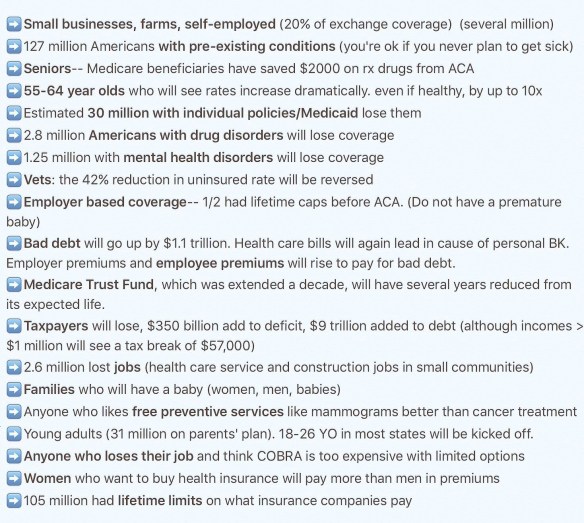
(3) It’s been reported that there is more opposition to “Obamacare” than to the Affordable Care Act. The more people learn what the ACA actually does, the more they like it. So, once President Obama becomes a fond memory, and despite well-funded Republican efforts to confuse the issue, it’s possible that support for the ACA will increase. Andy Slavitt, the acting administrator of the Centers for Medicare and Medicaid Services, prepared a list of everyone who will be negatively affected by repeal of the ACA (without, of course, a terrific replacement):
c2k_w0xwqaad8d4

And let’s not forget this bit of good news:

c2esrmzusaadfg9-1

Will spreading the good news about the ACA and bad news about its repeal have an effect on the right-wing ideologues in Congress and the orange person in the White House? We don’t know, but it’s worth a try.

One last thought for now. One of the phrases that comes up in arguments about our healthcare system is “socialized medicine”. It’s used to attack the idea that the government should control or bear responsibility for healthcare. When you think about it, however, it’s clear that healthcare does have a very strong social aspect. If we don’t want poor people dying in the streets or dread diseases spreading through the population, we need society, including the government, to make sure people get medical treatment. This is why people who arrive at emergency rooms at the edge of death get medical treatment, even if they don’t have a health insurance card or a suitcase full of cash.

The idea that healthcare is a social good fits nicely with the standard Democratic view that “we are all in this together”. Most of us don’t want to live in a dog eat dog world. 

Republicans, however, lean toward the “every man for himself” or “not my brother’s keeper” model. That’s not all bad. Almost everyone puts themselves, their family and their friends ahead of strangers. But in the Republicans’ case, that fundamental attitude easily translates into less for the poor and sick and more for the rich and healthy. That’s the underlying message behind Paul Ryan’s recent statement that he favors “high risk pools” for people with “pre-existing conditions”. He was answering a question from a cancer patient whose life was saved by the ACA:

So we, obviously, want to have a system where they can get affordable coverage without going bankrupt because they get sick. But, we can do that without destroying the rest of the healthcare system for everybody else. That’s the point I’m trying to make. What we should have done was fix what was broken in health care without breaking what was working in healthcare, and that’s what, unfortunately, Obamacare did. So, by financing state high-risk pools to guarantee people get affordable coverage when they have a pre-existing condition, like yourself, what you’re doing is, you’re dramatically lowering the price of insurance for everybody else [PoliticsUSA].

Doing this won’t work, of course, unless those unlucky sick people are wealthy enough to pay sky-high premiums, the government (meaning the rest of us) pays their bills or they simply give up, drop out of the insurance market and take their chances. That’s how “high risk pools”, also known as “insurance ghettos”, have always worked, i.e. failed, in the past.

A closing comment from the PoliticsUSA site:

… Ryan thinks cancer patients and other pre-existing conditions are ruining healthcare for everyone else…The true evil in [Ryan’s] plan is that by separating out the high-risk patients from everyone else, Ryan … can keep costs down by underfunding the pool for people who need healthcare the most…

That’s the attitude we’re up against. The news isn’t all bad, but it’s not going to be easy.

The Best Short Summary of the Affordable Care Act (ACA) Situation You’ll Find

In a blog post called “There Will Be No Obamacare Replacement”, Paul Krugman quotes himself from seven years ago. What he says deserves to be quoted at length and shared widely.

Quote:

“You may be surprised at the evident panic now seizing Republicans, who finally — thanks to [FBI Director] James Comey and [evil dictator] Vladimir Putin — are in a position to do what they always wanted, and kill Obamacare. How can it be that they’re not ready with a replacement plan?

That is, you may be surprised if you spent the entire Obama era paying no attention to the substantive policy issues — which is a pretty good description of the Republicans, now that you think about it.

From the beginning, those of us who did think it through realized that anything like universal coverage could only be achieved in one of two ways: single payer, which was not going to be politically possible, or a three-legged stool of regulation, mandates, and subsidies. Here’s how I put it exactly 7 years ago:

Start with the proposition that we don’t want our fellow citizens denied coverage because of preexisting conditions — which is a very popular position, so much so that even conservatives generally share it, or at least pretend to.

So why not just impose community rating — no discrimination based on medical history?

Well, the answer, backed up by lots of real-world experience, is that this leads to an adverse-selection death spiral: healthy people choose to go uninsured until they get sick, leading to a poor risk pool, leading to high premiums, leading even more healthy people dropping out.

So you have to back community rating up with an individual mandate: people must be required to purchase insurance even if they don’t currently think they need it.

But what if they can’t afford insurance? Well, you have to have subsidies that cover part of premiums for lower-income Americans.

In short, you end up with the health care bill that’s about to get enacted. There’s hardly anything arbitrary about the structure: once the decision was made to rely on private insurers rather than a single-payer system — and look, single-payer wasn’t going to happen — it had to be more or less what we’re getting. It wasn’t about ideology, or greediness, it was about making the thing work.

[Still quoting the professor here] It’s actually amazing how thoroughly the right turned a blind eye to this logic, and some — maybe even a majority — are still in denial. But this is as ironclad a policy argument as I’ve ever seen; and it means that you can’t tamper with the basic structure without throwing tens of millions of people out of coverage. You can’t even scale back the spending very much — Obamacare is somewhat underfunded as is.

Will they decide to go ahead anyway, and risk opening the eyes of working-class voters to the way they’ve been scammed? I have no idea….”

End Quote.

The Affordable Care Act really was the “conservative” approach to universal health insurance, a variation on the plan signed into law by the Republican Governor of Massachusetts, Mitt Romney. But the Republican Party decided to oppose everything President Obama did. That meant they had to oppose the ACA too. Now they’re stuck trying to replace a major law they should have been in favor of all along. 

Almost final word from Prof. Krugman:

…if Republicans do end up paying a big political price for their willful policy ignorance, it couldn’t happen to more deserving people.

I’d change that last sentence to read “pay a big political price for playing extremely partisan politics with the health and well-being of the American people”, but the part about the “more deserving people” is perfect.

Capitalism and Inequality

Quote: “Since 1974, the top 1% and the bottom 50% have swapped their relative shares of the national income… Unless we radically transform our capitalist system, which will require building a movement capable of challenging and overcoming the power of those who own and direct our economic processes, working people in the United States face the likelihood of an ever-worsening future.”

mhl's avatarReports from the Economic Front

Defenders of capitalism in the United States often choose not to use that term when naming our system, preferring instead the phrase “market system.”  Market system sounds so much better, evoking notions of fair and mutually beneficial trades, equality, and so on.  The use of that term draws attention away from the actual workings of our system.

In brief, capitalism is a system structured by the private ownership of productive assets and driven by the actions of those who seek to maximize the private profits of the owners.  Such an understanding immediately raises questions about how some people and not others come to own productive wealth and the broader social consequences of their pursuit of profit.

Those are important questions because it is increasingly apparent that while capitalism continues to produce substantial benefits for the largest asset owners, those benefits have increasingly been secured through the promotion of policies –…

View original post 760 more words

The Devastating Transformation of Work in the US

Quote: “Corporate profits and income inequality have grown in large part because US firms have successfully taken advantage of the weak state of unions and labor organizing … to transform work relations. Increasingly, workers, regardless of their educational level, find themselves forced to take jobs with few if any benefits and no long-term or ongoing relationship with their employer.”

mhl's avatarReports from the Economic Front

Two of the best-known labor economists in the US,  Lawrence F. Katz and Alan B. Krueger, recently published a study of the rise of so-called alternative work arrangements.

Here is what they found:

The percentage of workers engaged in alternative work arrangements – defined as temporary help agency workers, on-call workers, contract workers, and independent contractors or freelancers – rose from 10.1 percent [of all employed workers] in February 2005 to 15.8 percent in late 2015.

That is a huge jump, especially since the percentage of workers with alternative work arrangements barely budged over the period February 1995 to February 2005; it was only 9.3 in 1995.

But their most startling finding is the following:

A striking implication of these estimates is that all of the net employment growth in the U.S. economy from 2005 to 2015 appears to have occurred in alternative work arrangements. Total employment according to the…

View original post 883 more words

Organizing for the Future

A review at the London Review of Books caught my eye because the two books discussed both have the word “Postcapitalism” in their titles. Who doesn’t want to know what’s coming next?

The review didn’t convince me that anyone knows. Two possibilities are mentioned: Full Automation and Universal Basic Income. Presumably, “Full Automation” refers to automating as much as possible. More robots and smarter software should lead to fewer people having jobs. That might lead to everyone being guaranteed a basic income. Or it could lead to mass sterilization, with only lottery winners and good-looking people being allowed to reproduce.

What I found more interesting were some remarks about “austerity”, the recently popular attempt to stimulate world economies by reducing government spending:

In both books, the critical fronts are a total opposition to austerity and neoliberalism, and a focus on the possible consequences of increased automation, including the creation of a ‘surplus population’. The ‘real austerity project’, Mason argues, is ‘to drive down wages and living standards in the West for decades, until they meet those of the middle class in China and India on the way up’. As a result, ‘the next generation will be poorer than this one; the old economic model is broken and cannot revive growth.’ Those places which, in their different ways, have managed to insulate themselves – authoritarian China, Russia or Iran, residually social democratic northern Europe – will not be exempt: ‘By 2060, countries such as Sweden will have the levels of inequality currently seen in the USA.’

Further down in the article, there’s some practical discussion:

What the historical labour movement did, in Srnicek and Williams’s eyes, was set itself goals and demands – for pensions, social security, fewer working hours – and fight for them inside and outside the workplace. What they are really proposing … is that a new set of demands be agreed and doggedly insisted on, in the manner of the old left.

But how could enough of us agree and doggedly insist on a new set of demands? Maybe the authors of the books being reviewed have an answer, but the only way I can see that happening is through the creation of a mass movement like the labor movement of the 19th and 20th centuries. 

In his very good book The Age of Acquisition: The Life and Death of American Resistance to Organized Wealth and Power, Steve Fraser describes how organized labor contributed to the general welfare after the New Deal and World War 2:

…the labor movement of those years of uproar created – more than any other institution, public or private – a standard of living envied everywhere. In 1945, 40 percent of American families lived below the poverty line… By 1970, only 10 percent lived in poverty… Not only did the economy grow at an annual average of 4 percent during the postwar era, but that growth favored the poor more than the wealthy…it was the organized labor movement that compelled broad sectors of American industry still unwilling to engage in the new mechanisms of collective bargaining to nonetheless match the standards of living (wages, hours, vacations, holidays, pensions, health care and more) that unions were winning for their members….

An “American standard of living” and the forms of industrial democracy that made it possible … shattered the old order [196].

Perhaps globalization means that a race to the economic middle (or even the bottom) cannot be stopped. But it was organized labor and other progressive organizations that demanded and achieved progress in the past. I think it will have to be organized human beings, whether or not they have traditional jobs, who demand and achieve progress in the future.