Mysteries

I did something I usually don’t do, which is look at one of those articles about rural or suburban voters in the Midwest who voted for Txxxx and will do it again (“Txxxx supporters still support Txxxx!”). Everything he said was about how he’s doing personally. His farm is doing well. The pandemic is mostly far away. He expressed no concern about anybody else and made inane excuses for the president (e.g. it’s so unfair that the news media report all this bad news — they’re purposefully ignoring the good things (?) the president does).

Fortunately, however, the thrust of the article was that Txxxx will do worse in Iowa than four years ago and possibly lose the state.

Along with the mystery of why anyone would vote for such a terrible person and president, there’s the mystery of why the stock market is doing so well. Paul Krugman helps answer that question and warns of darker times ahead:

On Tuesday, the S&P 500 stock index hit a record high. The next day, Apple became the first U.S. company in history to be valued at more than $2 trillion. Dxxxx Txxxx is, of course, touting the stock market as proof that the economy has recovered from the coronavirus; too bad about those 173,000 dead Americans, but as he says, “It is what it is.”

But the economy probably doesn’t feel so great to the millions of workers who still haven’t gotten their jobs back and who have just seen their unemployment benefits slashed. The $600 a week supplemental benefit enacted in March has expired, and Txxxx’s purported replacement is basically a sick joke.

Even before the aid cutoff, the number of parents reporting that they were having trouble giving their children enough to eat was rising rapidly. That number will surely soar in the next few weeks. And we’re also about to see a huge wave of evictions, both because families are no longer getting the money they need to pay rent and because a temporary ban on evictions, like supplemental unemployment benefits, has just expired.

But how can there be such a disconnect between rising stocks and growing misery? Wall Street types, who do love their letter games, are talking about a “K-shaped recovery”: rising stock valuations and individual wealth at the top, falling incomes and deepening pain at the bottom. But that’s a description, not an explanation. What’s going on?

The first thing to note is that the real economy, as opposed to the financial markets, is still in terrible shape. The Federal Reserve Bank of New York’s weekly economic index suggests that the economy, although off its low point a few months ago, is still more deeply depressed than it was at any point during the recession that followed the 2008 financial crisis.

And this time around, job losses are concentrated among lower-paid workers — that is, precisely those Americans without the financial resources to ride out bad times.

What about stocks? The truths is that stock prices have never been closely tied to the state of the economy. As an old economists’ joke has it, the market has predicted nine of the last five recessions.

Stocks do get hit by financial crises, like the disruptions that followed the fall of Lehman Brothers in September 2008 and the brief freeze in credit markets back in March. Otherwise, stock prices are pretty disconnected from things like jobs or even G.D.P. [the Gross Domestic Product] [although the market does quickly, sometimes violently respond to the latest earnings reports].

And these days, the disconnect is even greater than usual.

For the recent rise in the market has been largely driven by a small number of technology giants. And the market values of these companies have very little to do with their current profits, let alone the state of the economy in general. . . .

Take the example of Apple, with its $2 trillion valuation. Apple has a price-earnings ratio — the ratio of its market valuation to its profits — of about 33. [The historical P.E. ratio for the stock market is around 15.] As long as they expect Apple to be profitable years from now, they barely care what will happen to the U.S. economy over the next few quarters.

Furthermore, the profits people expect Apple to make years from now loom especially large because, after all, where else are they going to put their money? Yields on U.S. government bonds, for example, are well below the expected rate of inflation.

And Apple’s valuation is actually less extreme than the valuations of other tech giants, like Amazon or Netflix. . . .

[Prof. Krugman left out another well-known factor helping the stock market (a factor he understands very well). That’s FOMO (fear of missing out). When stocks go up, it’s natural that people want to own stocks. The stock market is, among other things, a giant casino. When some gamblers are having a great time, other gamblers want to join in the fun.]

Unfortunately, ordinary Americans get very little of their income from capital gains, and can’t live on rosy projections about their future prospects. Telling your landlord not to worry about your current inability to pay rent, because you’ll surely have a great job five years from now, will get you nowhere — or, more accurately, will get you kicked out of your apartment and put on the street.

So here’s the current state of America: Unemployment is still extremely high, largely because Txxxx and his allies first refused to take the coronavirus seriously, then pushed for an early reopening in a nation that met none of the conditions for resuming business as usual — and even now refuse to get firmly behind basic protective strategies like widespread mask requirements.

Despite this epic failure, the unemployed were kept afloat for months by federal aid, which helped avert both humanitarian and economic catastrophe. But now the aid has been cut off, with Txxxx and allies as unserious about the looming economic disaster as they were about the looming epidemiological disaster.

So everything suggests that even if the pandemic subsides — which is by no means guaranteed — we’re about to see a huge surge in national misery.

Oh, and stocks are up. . . . 
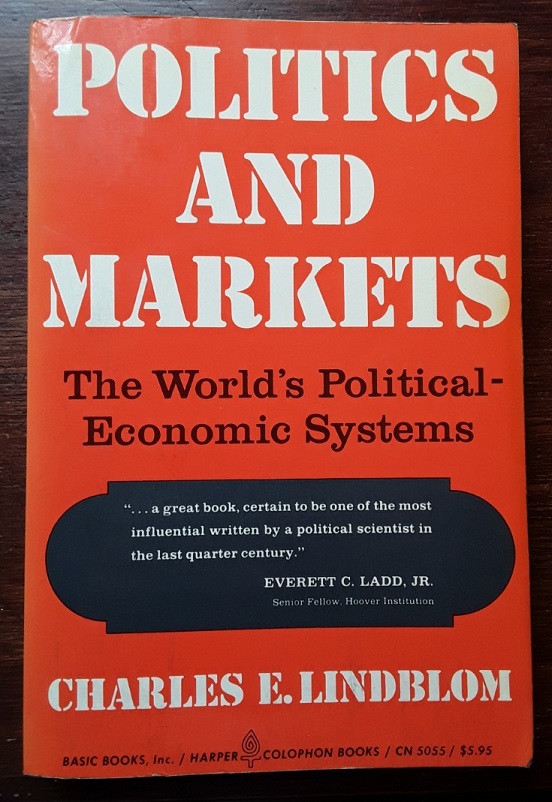
Politics and Markets One More Time

Around 40 years ago, I bought a book called Politics and Markets: The World’s Political-Economic Systems. It was written by Yale professor Charles Lindblom. I read about half of it before putting it aside. I don’t know why I stopped reading, because I thought it was excellent and intended to finish it. Instead, I treated the book like a kind of talisman. For some time, I kept it on my desk at work. It was there so long that someone asked me if I was still reading “that book”. I suppose I didn’t have the mental energy to finish it, but having it around was nice. Maybe it reminded me of my aborted attempt at an academic career.

thumbnail_20200807_142201

A few days ago, I thought I might go around the house and find books I’ve always thought about reading but never did. An obvious candidate was a biography of Ralph Waldo Emerson called Emerson: The Mind on Fire. Just like Politics and Markets, I read about half of it years ago and have often thought of finishing it. Unlike Politics and Markets, however, Emerson still had a decades-old bookmark showing where I stopped reading (it wasn’t even at the start of a chapter).

I’m now reading Politics and Markets again. I was immediately impressed.

This is how the 1977 edition above begins:

Relentlessly accumulating evidence suggests that human life on the planet is headed for a catastrophe. Indeed, several disasters are possible, and if we avert one, we will be caught by another. At present rates of population growth, another century will put 40 billion people on Earth, too many to feed. If industrial production grows at present rates during the next century, resource requirements will multiply by a thousand. And energy emission, some scientists say, will over a longer period of time raise Earths’ temperature to a level unsuitable for human habitation. All this assumes that a nuclear catastrophe does not spare us the long anguish of degeneration.

However fearful one may be that the fallible and dilatory intelligence of the human species will somehow either end human life or reduce it to unbearable squalor, the decline of the human condition is not inevitable. It is for us to decide whether we will continue to reproduce at disastrous rates, plunder the planet of resources, or burn ourselves from the face of the earth through either thermal pollution or a few quick blasts. The world is man’s doing, not something done to him.

Assuming that men and women wish to give some thought to their futures, what are the fundamental politico-economic mechanisms they can employ in order to maintain — indeed greatly enlarge — the humane qualities of life on Earth? That is the question of this book. Some will doubt that political and economic mechanisms matter. They will say that man’s future hinges on a moral regeneration. Or science and technology. Or inner awareness. Or a new form of family or other small-group association. Or organic foods — the list is open to nominations. This book is for those who believe that politics and economics will turn out to matter.

Well, some good news is that world population isn’t climbing as fast as people expected in 1977. It was 4.2 billion back then. Now it’s 7.8 billion, but the rate of increase is going down. It’s projected that there will be 10 billion of us by 2077, not 40 billion. And since the fertility rate is expected to keep dropping, world population may actually decline in the next century (even without the help of killer viruses, nuclear wars, giant meteors, etc.).

Along with population, resource requirements continue to grow, although some experts believe that we won’t run out of the things we need, since as resources become scare, they’ll become more expensive and we’ll find substitutes (I don’t know what the substitute for oxygen or water would be).

The bad news, of course, is that the “energy emission” that “some scientists” were worried about in 1977 is now out of control. If you want a scary update, see Bill McKibben’s article “130 Degrees” at the New York Review of Books site:

What [the 10 to 15% drop in emissions during the pandemic] seems to indicate is that most of the momentum destroying our Earth is hardwired into the systems that run it. Only by attacking those systems—ripping out the fossil-fueled guts and replacing them with renewable energy, even as we make them far more efficient—can we push emissions down to where we stand a chance.

As for “nuclear catastrophe”, it’s easy to think that the danger subsided with the end of the Cold War. That’s not the message from “The New Nuclear Threat”, an article by Jessica Matthews in the same issue of The New York Review of Books (I’ve subscribed for a long time — the subscription is almost worth the price):

In part because of effective deterrence, fear of their destructiveness, and a growing taboo against their use, and in part because of dumb luck, nearly a century has passed without nuclear weapons being used again in conflict. . . . But we are not safer today—quite the reverse. . . . A second nuclear arms race has begun—one that could be more dangerous than the first. . . .

The single step from which profound policy change could flow, domestically and internationally, would be formal endorsement by the five original nuclear powers—the US, Russia, the UK, France, and China—of the Reagan-Gorbachev principle, jointly articulated by the two leaders at their 1985 summit. It states simply, “a nuclear war cannot be won and must never be fought.” International adoption would simultaneously indicate the nuclear powers’ recognition of the rising dangers of nuclear conflict and the need to move toward nuclear forces around the world that are structured for deterrence, not war fighting. . . .  Eventually, these eleven words could underlie the next generation of arms control negotiations, strengthen the global nonproliferation regime, and help short-circuit a second nuclear arms race.

I don’t know if Prof. Lindblom’s old book might help with any of this. I’ll let you know if I finish it.

A Comment, a Column, and Carnage

“There isn’t any iceberg. There was an iceberg but it’s in a totally different ocean. The iceberg is in this ocean but it will melt very soon. There is an iceberg but we didn’t hit the iceberg. We hit the iceberg, but the damage will be repaired very shortly. The iceberg is a Chinese iceberg. We are taking on water but every passenger who wants a lifeboat can get a lifeboat, and they are beautiful lifeboats. Look, passengers need to ask nicely for the lifeboats if they want them. We don’t have any lifeboats, we’re not lifeboat distributors. Passengers should have planned for icebergs and brought their own lifeboats. I really don’t think we need that many lifeboats and they’re supposed to be our lifeboats, not the passenger’s lifeboats. The lifeboats were left on shore by the last captain of this ship. Nobody could have foreseen this iceberg.”

Someone calling themselves “Citizen” submitted that comment after reading Paul Krugman’s latest column in The New York Times. Krugman wrote:

“I don’t know about you, but I’m feeling more and more as if we’re all trapped on the Titanic — except that this time around the captain is a madman who insists on steering straight for the iceberg. And his crew is too cowardly to contradict him, let alone mutiny to save the passengers.

A month ago it was still possible to hope that the push by Dxxxx Txxxx and the Txxxxist governors of Sunbelt states to relax social distancing and reopen businesses like restaurants and bars — even though we met none of the criteria for doing so safely — wouldn’t have completely catastrophic results.

At this point, however, it’s clear that everything the experts warned was likely to happen, is happening. Daily new cases of Covid-19 are running two and a half times as high as in early June, and rising fast. Hospitals in early-reopening states are under terrible pressure. National death totals are still declining thanks to falling fatalities in the Northeast, but they’re rising in the Sunbelt, and the worst is surely yet to come.

A normal president and a normal political party would be horrified by this turn of events. They would realize that they made a bad call and that it was time for a major course correction; they would start taking warnings from health experts seriously.

But Txxxx, who began his presidency with a lurid, fact-challenged rant about “American carnage,” [is] doubling down on his rejection of expertise, this week demanding full reopening of schools in defiance of existing guidelines……

Until early 2020, Txxxx led a charmed political life. All his recent predecessors had to deal with some kind of external challenge during their first three years…..But Trump inherited a nation at peace and in the middle of a long economic expansion that continued, with no visible change in the trend, after he took office.

Then came Covid-19. Another president might have seen the pandemic as a crisis to be dealt with. But that thought never seems to have crossed Txxxx’s mind. Instead, he has spent the past five months trying to will us back to where we were in February, when he was sitting on top of a moving train and pretending that he was driving it.”

Unquote.

After hearing Txxxx speak at his inauguration, former president George W. Bush remarked, “Well, that was some weird shit”. When — not if — Joe Biden becomes president in January, Txxxx’s story about American carnage will have come true.

No More Bad Bailouts

An opinion piece from The Boston Globe describes a policy a sensible government would adopt:

Twice in a dozen years, Congress has undertaken enormous bailouts to rescue companies and individuals in the economy. In 2008, the federal government drafted legislation on the fly that bailed out the big financial institutions, but left many homeowners drowning with underwater mortgages. Amid popular outcry, Congress then promised to end bailouts forever with the passage of the Dodd-Frank Wall Street Reform Act in 2010.

Less than a decade later, Congress has authorized an even more enormous bailout. This time, the legislative process has been even more complicated. Congress once again scrambled, drafting legislation to address both the public health and economic emergencies stemming from COVID-19. So far it has rushed through five separate relief bills in a matter of months because each successive bill was insufficient to address not only the public health crisis but also the economic crisis. Congress will now likely take up a sixth bill in late July [assuming Sen. Turtle Face, the Kentucky Republican, agrees], in part to deal with the imminent expiration of expanded unemployment insurance benefits.

Once again, the rescue legislation has been a bonanza for lobbyists, financial institutions, and big businesses, which have been able to get access to financing relatively swiftly and with few conditions. Once again, the public is left wondering where all the money went. And once again, workers and Main Street businesses have been relegated to second-class status. Small businesses have struggled to get limited rescue funds under the Paycheck Protection Act. Even with trillions of dollars going out the door, 40 million Americans remain out of work. The public health crisis continues, as testing remains woefully limited and incidence of the virus is growing in many parts of the country. Communities of color have been hit especially hard, setting back efforts to expand equality and opportunity.

This ad hoc approach to responding to economic crises is inefficient at best and malpractice at worst. Emergency response and disaster management professionals do not “wing it” every time there is a forest fire or a hurricane. They prepare in advance, developing policies and procedures so they can react swiftly and effectively. When Congress starts thinking about a response only after an economic crisis starts, it’s no surprise that the response isn’t very effective.

Policymakers should take a page from the disaster response playbook. Economic crises are emergencies, and just like with a fire or a hurricane, many aspects of a response can be anticipated — unemployment, income shocks, and liquidity constraints. What we need, therefore, is a standing set of procedures and policies — an emergency economic resilience and stabilization law that can be activated when a crisis hits.

The benefits of this approach are significant. Congress could respond to economic emergencies more quickly because it wouldn’t need to reinvent the wheel every time there is a crisis. Executive branch agencies would also be able to anticipate the administrative capacities needed to implement the program. And individuals and businesses would have a good sense of what happens during a crisis, reducing fear and uncertainty.

Because the standing law would address the major foreseeable problems, Congress could focus its attention on the unique causes of the specific downturn. In the case of COVID-19, for example, Congress would have been able to spend much of the spring focused on the public health aspect of the crisis, such as facilitating production of tests and establishing a contact tracing system.

A standing program would also reshape the political dynamics around rescue legislation. In the fog of an economic crisis, lobbyists see a bonanza: a chance to stuff goodies for their clients into must-pass legislation. Members of Congress who simply want good governance can end up using their limited political capital fighting off such bad policies or ensuring that uncontroversial provisions make it into the final bill rather than advancing the best policies.

While Congress would be free to change the economic resilience program even in the midst of a crisis, the fact that a program already exists would require members to explain any divergences. There would likely be fewer concerns about lobbying, favoritism, and corruption because the rules would be written without anyone knowing which particular companies need help—or which lobbied hardest. So what might such a program look like? We think it should have four parts.

First, it would end no-strings-attached bailouts by providing a restructuring process for large or publicly traded companies. The companies would have the option to get funding from the US government, but their shareholders would be wiped out. Their debt would be converted into equity — meaning the company would now be owned by its lenders and by the federal government, which would get a preferred equity stake. Alternatively, companies would still have the option to pursue a traditional restructuring in bankruptcy, but without federal aid.

Second, there would be a program for smaller businesses to cover payroll and operating expenses to prevent mass layoffs and closures on Main Street. The small business program would be akin to what Congress attempted with the Paycheck Protection Program, but with direct payroll subsidies for employers to maintain payroll and cover operating expenses, rather than operating through banks as third-party intermediaries.

Third, there would be reforms to the financial system infrastructure so that every person or business could get an account to which emergency government payments could immediately be credited. That would make it possible for people and businesses to get direct payments, like checks, much more quickly than they have in this crisis.

Finally, the program would include “automatic stabilizers,” a wonky term for policies that are automatically triggered based on data, rather than relying on repeated and recurrent congressional action. In the event of an economic crisis like the crash in 2008 or COVID-19 this past spring, funding for state and local governments, for example, would automatically kick in and would continue until the economy has bounced back.

A standing economic resilience program like this one is possible for a simple reason. We can predict many of the policy responses that are needed in a crisis. While every crisis undoubtedly has its own unique trigger and features, the next time won’t be very different. Rather than live through another round of ad hoc bailouts for the wealthy and powerful and suffering for everyone else, Congress should get prepared, so our country’s response to the next crisis can be quicker, fairer, and more effective.

Unquote.

This week the government was forced to identify some of the “small businesses” that received stimulus money. They included top law firms, the Secretary of the Treasury’s family business, several chains with wealthy private-equity investors, twenty-two tenants of an office building owned by the president, Kanye West’s company, the Ayn Rand Institute and the Archdiocese of New York. 

It would be cynical to say a sensible policy like this would never, ever happen in a country like ours.

(It would probably never happen in a country like ours.)

The Economy, the Virus and Us

Annie Lowery of The Atlantic says that economists have four major concerns regarding the US economy.

(1) The household fiscal cliff:  Government stimulus payments have kept the economy in fairly good shape this spring, despite massive unemployment. However, the stimulus is supposed to end a month from now. Republicans don’t favor renewing it. That will mean  “millions of families just keeping their head above water will sink”. Consumer spending will plummet.

(2) The great business die-off:  “This steep decline in consumer spending will hasten mass business failure… An estimated 100,000 small companies have shut permanently. On top of that, numerous businesses—airlines, restaurants, live-events businesses, hotels, private schools, oil and gas companies—face severe and stubborn slumps….Economists expect that 42 percent of people recently let go will not return to their former employers.

(3) The state and local budget shortfall:  Every state except Vermont is required to balance its budget, but “sales taxes, real-estate-transfer taxes, income taxes, fines and fees—they are all collapsing, leaving local governments with a budget gap expected to total $1 trillion next year. Without help from Washington, this will necessarily mean massive service cuts and job losses: namely, an estimated 5.3 million job losses.

(4) The lingering health crisis:  “The catastrophe of the American government’s management of the … pandemic …  has led to the unnecessary deaths of tens of thousands of people…. The country is reopening with the disease still spreading and maiming and killing, as several states experience a dramatic surge in caseloads. Never getting the pandemic under control means never unleashing the economy…. Ending the pandemic would have been the single best thing the federal government could have done to preserve the country’s wealth, health, and economic functioning. The Txxxx administration, in its hubris, obstinacy, and incompetence, failed to do it.”

“Congress could extend unemployment insurance, offer new help to flailing businesses, send monthly cash grants to poor families, offer fiscal relief to the states, and implement a nationwide test-and-trace program.” Or things may get a lot worse.

From Stat News:

The “respiratory” virus that causes Covid-19 made some patients nauseous. It left others unable to smell. In some, it caused acute kidney injury….The Centers for Disease Control and Prevention constantly scrambled to update its list [of symptoms] in an effort to help clinicians identify likely cases.

[But] in late January, … scientists in China identified one of the two receptors by which the coronavirus, SARS-CoV-2, enters cells. It was the same gateway, called the ACE2 receptor, that the original SARS virus used. Studies going back some two decades had mapped the body’s ACE2 receptors, showing that they’re in cells that line the insides of blood vessels — in what are called vascular endothelial cells — in cells of the kidney’s tubules, in the gastrointestinal tract, and even in the testes.

Given that, it’s not clear why the new coronavirus’ ability to wreak havoc from head to toe came as a surprise to clinicians. Since “ACE2 is also the receptor for SARS, its expression in other organs and cell types has been well-known”….

The assumption that infection would first and foremost cause respiratory symptoms was misplaced. In the week before they were diagnosed, Covid-19 patients were 27 times more likely than people who tested negative for the virus to have lost their sense of smell. They were only 2.6 times more likely to have fever or chills, 2.2 times more likely to have trouble breathing or to be coughing, and twice as likely to have muscle aches. For months, government guidelines kept people not experiencing such typical signs of a respiratory infection from getting tested.

Faced with a disease the world had never seen before, physicians are learning as they go. By following the trail of ACE2 receptors, they are more and more prepared to look for, and treat, consequences of SARS-CoV-2 infection well beyond the obvious.