Bottom Up, Not Top Down

One party wants more people to vote, while the other party wants fewer. One party helps people at the economic bottom, while the other helps those at the top. It’s almost as if we should support one party, not the other!

From The New York Times, “Biden Bets on the Poor” (and the middle):

To jump-start the ailing economy, President Biden is turning to the lowest-paid workers in America, and to the people who are currently unable to work at all.

Mr. Biden’s $1.9 trillion economic relief package, which cleared the Senate on Saturday and [will] be headed for the president’s signature in a matter of days, would overwhelmingly help low earners and the middle class, with little direct aid for the high earners who have largely kept their jobs and padded their savings over the past year.

For the president, the plan is more than just a stimulus proposal. It is a declaration of his economic policy — one that captures the principle Democrats and liberal economists have espoused over the past decade: that the best way to stoke faster economic growth is from the bottom up.

Mr. Biden’s decision to take that approach in his first major economic legislation is in stark contrast to [the former occupant of the White House and unindicted co-conspirator], whose initial effort in Congress was a tax-cut package in 2017 that largely benefited corporations and wealthier Americans.

The “American Rescue Plan” advanced by Mr. Biden includes more generous direct benefits for low-income Americans than the rounds of stimulus passed last year . . . It is more focused on people than on businesses and is expected to help women and minorities in particular, because they have taken an outsize hit in the pandemic recession.

Researchers predict it could become one of the most effective laws to fight poverty in a generation. Columbia University’s Center on Poverty and Social Policy estimates that the plan’s provisions, including a generous expansion of tax credits for low-income Americans with children, would reduce the poverty rate by more than a quarter for adults and cut the child poverty rate in half.

. . . The new legislation contains provisions intended to attack the virus itself, including money for Covid testing and vaccine distribution.

But it also includes elements of longstanding Democratic priorities that will apply widely to lower-income Americans whether they are hurting financially from the pandemic or not. In addition to the tax credits, the bill increases subsidies for child care, broadens eligibility under the Affordable Care Act, and expands food stamps, rental assistance and unemployment benefits, among other provisions. . . .

Mr. Biden’s economic team is betting that a mix of $1,400 checks to individuals, more generous jobless aid and other safety-net benefits in the plan will help power a rapid increase in economic growth by aiming money at people who need help right now to pay their bills, buy groceries and stave off eviction or foreclosure — as opposed to higher earners who would be more likely to save the money.

Many economists predict that the increase in consumer spending would spur more hiring and business production, helping to lift the economy to its fastest annual growth rate since the mid-1980s. . . .

What [some] call wasteful, untargeted or counterproductive spending in Mr. Biden’s bill are, in the eyes of Mr. Biden and his allies, the key ingredients for a roaring recovery once widespread vaccine distribution restores a sense of normalcy across the nation.

“Focusing on marginalized workers,” said Janelle Jones, the chief economist at the Labor Department, “is really the way to make sure we are lifting all boats” . . .

High earners and large companies show little sign of needing government help today. On the whole, the pandemic recession and recovery have made them richer. Workers earning higher wages and those able to work remotely are far less likely to have been thrown off the job, and they have stockpiled savings in the recovery. Companies like Amazon have gained market share as consumer habits have shifted.

But at the bottom end of the income spectrum — and in particular, among Black and Latino families — millions of Americans are still feeling the deep pain of the recession. The economy remains nearly 10 million jobs short of its prepandemic peak, with women of all races and men of color struggling the most to regain employment. The unemployment rate for Black men remains above 10 percent.

Data from the Census Household Pulse survey, . . . shows that the lingering economic distress of the crisis is concentrated among low earners and those who remain out of work. Nearly half of households earning below $35,000 a year reported falling behind on housing payments. One quarter reported not having enough food.

Mr. Biden’s plan would shower those households with government assistance. Elizabeth Pancotti, the policy director at Employ America, . . . has calculated the benefits for several different hypothetical hard-hit Americans under the bill.

For a working single mother of a 3-year-old who earns the federal minimum wage — just under $16,000 a year — the bill would provide as much as $4,775 in direct benefits, Ms. Pancotti estimates. For a family of four with one working parent and one who remains unemployed because of child care constraints, the benefits could total $12,460.

The Tax Policy Center in Washington estimates that the direct payments and expanded tax credits in the bill would, by themselves, increase after-tax income this year by more than 20 percent for an average household in the lowest quintile of income earners in the United States. It previously had forecast that Mr. Trump’s tax cuts would raise that same group’s income by less than 1 percent in the first year.

“It is as far away as you can get from regressive, supply-side economics,” said Senator Michael Bennet, Democrat of Colorado, a longtime champion of an expanded child tax credit to fight poverty. “This is progressive economics that puts money in the hands of working people who will spend that money” . . . .

That Time the Chinese Communists Used a Few Words to Make Themselves Look Good

The Chinese Communist Party (CCP) doesn’t get as much publicity as it should. The people who run China’s government do horrible things. Prof. Perry Link is an expert on China and explains one way the party easily manipulated the rest of the world using the power of propaganda: 

Does the CCP’s Department of Propaganda (later renamed the Department of Publicity) lie? [Author and dissident] Su Xiaokang gently told me that the question is naïve. The CCP system, he explained, has an entirely different way of measuring the value of statements. Truth and falsity are incidental. A statement is valuable if its “social effects” are “good,” and the effects count as good if they support the power interests of the CCP. (For politically innocuous matters like weather reports or basketball scores, support of the party does not apply, but avoidance of harm to the party still does.) Hence a “good” statement might be true, half-true, or untrue—that is beside the point.

A tendency toward including truth does become relevant when someone judges that a statement will influence people more effectively if a bit of verisimilitude is supplied. But truth is never the first criterion, and in that sense neither is lying. American democracy’s headache with a president who lies is a fundamentally different problem from China’s living under the CCP’s propaganda apparatus, whose roots date from the 1940s and whose experts by now are very good at what they do.

Readers of the Western press, whether aware of it or not, have seen examples of that expertise. In the run-up to the 2008 Beijing Olympics, the international wing of the Xinhua News Agency instituted frequent use of the phrase “lifted from poverty.” This was what “China” (meaning the CCP) had done for hundreds of millions of Chinese people. The world’s media—The New York Times, The Wall Street Journal, Reuters, Al Jazeera, Kyodo News, the BBC, and many others—picked up the phrase, as did Western politicians on both the left and the right. The World Bank used it in official reports. Those words were, in short, highly successful in achieving the intended effect: the world came to believe that the CCP was doing great good.

A more transparent account of what it had done, beginning in the 1980s and 1990s, is that it released its controls on the Chinese people so that, for the first time in decades, they could make money for themselves; hundreds of millions responded by working long hours at low wages without the protection of labor unions, workers’ compensation insurance, a free press, or independent courts; and, yes, they made great amounts of money, escaping poverty for themselves and simultaneously catapulting the CCP elite, who still rode high above them, to truly spectacular wealth.

In short, the word “lifted” [requires] analysis of who lifted whom. That question did not normally occur to people around the world who read the words “China lifted.” The grammar of such sentences, combined with the formula China = CCP, left no need for a question. Was this word-engineering deliberate? Anyone who doubts that it was should note that CCP media used the “China lifted” phrase in publications in English, French, German, and other foreign languages but not in Chinese-language media at home. That made good sense. What would happen if the CCP started telling the Chinese people that “we lifted you”? The people would know better. Both sides know better. To make such an assertion might generate unfortunate “social effects,” such as a greater number of demonstrations, strikes, sit-ins, roadblocks, and other examples of what the Ministry of Public Security labels “masses incidents” and counts in the tens of thousands per year.

Statistics for a Sunday Afternoon

Over the past 20 years, the US economy has grown at an annual rate of 1.9%. Goldman Sachs predicts a rate of 7% for 2021 (Washington Post).

The provision in President Biden’s Covid relief bill to send almost all families monthly checks of up to $300 per child would move close to 10 million children above the poverty line, cutting child poverty nearly in half (Los Angeles Times).

Asked to describe what happened during the assault on the Capitol, 58% of [the unindicted co-conspirator’s] voters call it “mostly an Antifa-inspired attack that only involved a few of [his] supporters” (USA Today).

We’ve had almost 500,000 confirmed Covid deaths in the US. To include that many names, the Vietnam Veterans Memorial would have to be 87 feet tall (Washington Post).

hith-vietnam-vets-memorial-2 (1)

The number of atoms in your body is roughly 1028 — that’s a 1 followed by 28 zeros (New York Times). There are around 1,000 different species of bacteria living on your skin (Nature).

Texans in the Cold: A Few Completely Random Thoughts

Houston is the “energy capital of the world.” It is home to 4,600 energy-related firms, according to the Greater Houston Partnership. We have the expertise in our own backyard to ensure energy reliability for the state. However, Texas’s leaders have chosen to prioritize profit over people. When there are no regulations requiring power plants to winterize, and the generous tax abatements they receive don’t have those requirements, it creates an incentive not to do so for once-in-a-decade storms. The added cost of preparing a plant for extreme weather would cause the price of electricity provided to be higher, thus making the responsible plant operator unable to compete in a market where these costs are often skipped. — Heather Golden, “Failing Government, Freezing Texans”, The Bulwark

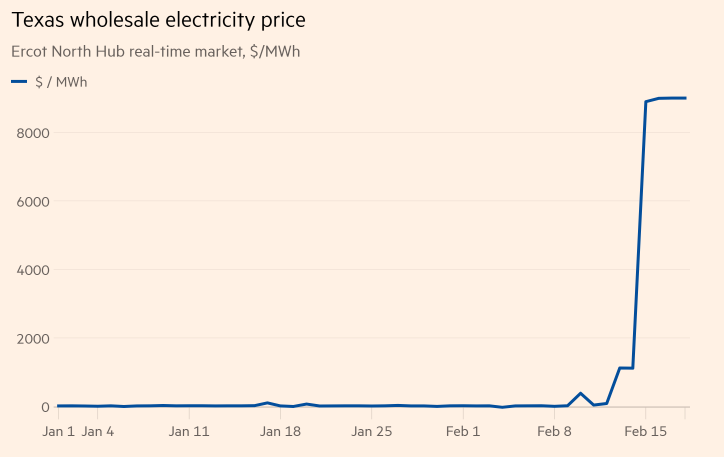
When a deep freeze shut down half the power generation capacity in Texas this week, the wholesale price of electricity exploded 10,000 per cent, with the financial consequences now being felt all the way from individual households to huge European energy companies. Astronomical bills face customers who opted for floating-rate contracts tied to wholesale prices in the state’s freewheeling electric market.

The wholesale power price was at the maximum allowable $9,000 a megawatt hour for five days from last Sunday. For a household, that translates to a $9 a kilowatt-hour electricity rate, compared with a typical cost of 12 cents.

EuqxyxkXYAA6ix6

In Burleson, a suburb of Fort Worth, Valerie Williams has been charged more than $6,000 by her electricity retailer Griddy to power her 1,400 sq ft home over the past few days. As the storm approached, Griddy told its customers to switch to more typical fixed-rate plans from other providers, but not everyone did, since there was little indication of just how extreme prices would become.

Griddy was charging her credit card multiple times a day, Williams said. She struggled to find a new provider during the crisis before finally identifying one that would switch her service on Friday. “I’m guessing it will be close to $7,000 by the time we get moved,” she said of her bill. . . .

On Friday, the city council in Denton, Texas, met to approve emergency borrowing to cover $300m the city-owned utility would pay Ercot this week — more than quadruple its purchases in full-year 2020. — “Freeze Sends Prices Soaring: Grid Operator Ercot Requires Billions in Payments”, Financial Times

The idea behind Texas energy policy was that a deregulated market didn’t require any oversight to protect the system from crisis, because profit-maximizing utilities would build in robust excess capacity to take advantage of possible price spikes. But they didn’t, even though the price spike has been incredible. — Paul Krugman

Yes, there are numerous places where Smith deplores the impact of government, and specifically the effects of intrusive regulation on trade . . . . But overall the view of Smith as anti-government seriously mistakes him. . . .He was quite clear that markets — and indeed society as a whole — are generally sustained by trust and confidence, and that for these and other things they rely on external institutions, notably of law and government, for their viability. By contrast, if merchants are left entirely to their own devices, the result is corrosive. He robustly asserts that “People of the same trade seldom meet together, even for merriment and diversion, but the conversation ends in a conspiracy against the public, or in some contrivance to raise prices”. No one who has read Smith closely can rationally believe he is an out-and-out free-marketeer. — Jesse Norman, Adam Smith: Father of Economics

The divide in our politics isn’t between proponents of big vs. small government. It’s between those trying to use government to help people and those who just want to troll the other side. When we elect responsible people, we end pandemics. When we don’t, people freeze to death. — Rep. Tom Malinowski (D-NJ)

American Politics Today: A Case Study

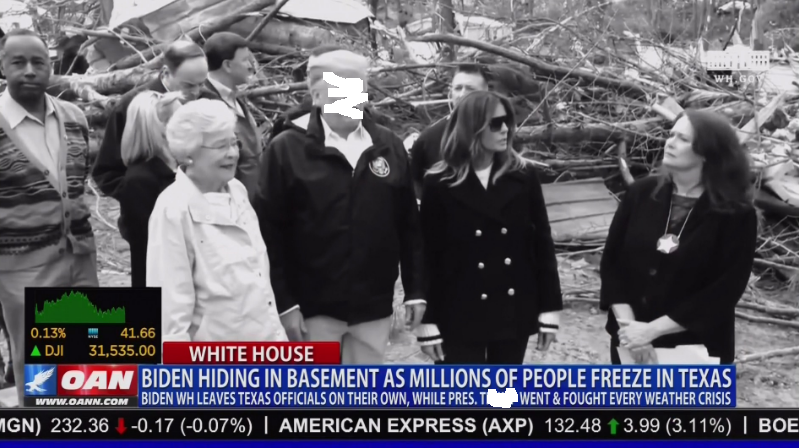
One America News Network (OAN, not OANN) is where you go for “news” when you think Fox has become way too liberal. Somebody posted this screenshot today:

Untitled

Yes, we all remember how the former president “went and fought every weather crisis”, like that time after Hurricane Maria when he personally launched paper towels — or was it toilet paper? — to a roomful of Puerto Ricans and then decided to delay millions of dollars in financial aid.

So why is that cowardly weakling Joe Biden “hiding in his basement”? Biden may have immediately declared a state of emergency in Texas and authorized the federal government to send generators and other supplies, and and he may have spoken to Gov. Abbott yesterday:

President Joseph R. Biden, Jr. spoke this evening with Texas Governor Greg Abbott about the severe winter weather situation facing central and southern parts of the United States, including Texas. [He] conveyed his support to the people of Texas [and] reiterated that the federal government will continue to work hand-in-hand with state and local authorities in Texas to bring relief and address the critical needs of the families affected. He also shared his intentions to instruct additional federal agencies to look into any immediate steps that could be taken to support Texans at this time. The President also expressed that his administration was at the ready should the State of Texas or any other impacted region need additional federal disaster support or assistance as severe storms move across the US.

But what has Biden done for Texas lately? Damn liberals.

Meanwhile, Paul Krugman of The New York Times tells what occurred after the disaster struck:

For a while, the politics surrounding the power outages that have spread across Texas looked fairly normal. True, the state’s leaders pursued reckless policies that set the stage for catastrophe, then tried to evade responsibility. But while their behavior was reprehensible, it was reprehensible in ways we’ve seen many times over the years.

However, that changed around a day after the severity of the disaster became apparent. Republican politicians and right-wing media, not content with run-of-the-mill blame-shifting, coalesced around a malicious falsehood instead — the claim that wind and solar power caused the collapse of the Texas power grid, and that radical environmentalists are somehow responsible for the fact that millions of people were freezing in the dark, even though conservative Republicans have run the state for a generation.

This wasn’t normal political malfeasance. It’s the energy-policy equivalent of claiming that the Jan. 6 insurrection was a false-flag Antifa operation — raw denial of reality, not just to escape accountability, but to demonize one’s opponents. . . . 

Like many states, Texas has a partly deregulated electricity market, but deregulation has gone further there than elsewhere. In particular, unlike other states, Texas chose not to provide power companies with incentives to install reserve capacity to deal with possible emergencies. This made power cheaper in normal times, but left the system vulnerable when things went wrong.

Texas authorities also ignored warnings about the risks associated with extreme cold. After a 2011 cold snap left millions of Texans in the dark, the Federal Energy Regulatory Commission urged the state to winterize its power plants with insulation, heat pipes and other measures. But Texas, which has deliberately cut its power grid off from the rest of the country precisely to exempt itself from federal regulation, only partially implemented the recommendations.

And the deep freeze came.

While Texas’s Republican governor was blaming wind power, other state officials admitted that power plants and pipelines that deliver natural gas were the main source of the problem. (Besides which, wind turbines operate in places like Norway and Greenland all winter without breaking down.)

The Washington Post describes what actually happened this week:

Wind accounts for just 10 percent of the power in Texas generated during the winter. And the loss of power to the grid caused by shutdowns of thermal power plants, primarily those relying on natural gas, dwarfed the dent caused by frozen wind turbines, by a factor of five or six.

As the cold hit, demand for electricity soared past the mark that ERCOT [the Electric Reliability Council of Texas] had figured would be the maximum needed. But at a moment when the world is awash in surplus natural gas, much of it from Texas wells, the state’s power-generating operators were unable to turn that gas into electricity to meet that demand.

In the single-digit temperatures, pipelines froze up because there was some moisture in the gas. Pumps slowed. Diesel engines to power the pumps refused to start. One power plant after another went offline. Even a reactor at one of the state’s two nuclear plants went dark, hobbled by frozen equipment.

Krugman (who knows the answer) asks, therefore, “Why, then, the all-out effort to falsely place the blame on wind power?”

The incentives are obvious. Attacking wind power is a way for both elected officials and free-market ideologues to dodge responsibility for botched deregulation; it’s a way to please fossil fuel interests, which give the vast bulk of their political contributions to Republicans; and since progressives tend to favor renewable energy, it’s a way to own the libs. And it all dovetails with climate change denial.

But why do they think they can get away with such an obvious lie? The answer, surely, is that those peddling the lie know that they’re operating in a post-truth political landscape. When two-thirds of Republicans believe that Antifa was involved in the assault on the Capitol, selling the base a bogus narrative about the Texas electricity disaster is practically child’s play.

Greg Sargent of the Post concludes:

No doubt many Republicans expressing outrage at the failures producing this disaster — and calling for accountability and reform — are sincere in their intentions, though we’ll see how long those demands persist.

But it’s painfully obvious that in an important larger sense, many aspects of their reaction to the Texas calamity do indeed demonstrate the future they want.

It’s a future in which the default response to large public problems will be to increasingly retreat from real policy debates into an alternate information universe, while doubling down on scorched-earth distraction politics and counter-majoritarian tactics to insulate themselves from accountability. . . .

The thing is that Abbott knows renewable energy isn’t to blame. Elsewhere, he has admitted that natural gas and coal failures played a key role. Yet the lure of retreating into the Fox News universe — and spewing nonsense he knows will resonate there — is irresistible.

When a politician’s fundamental purposes in public life are to pursue power and maintain the economic and cultural status quo, it’s easy to lie with a clear conscience. As Gen. Sherman once said:

The lust for Power in political minds is the strongest passion of Life, and impels Ambitious Men to deeds of infamy.