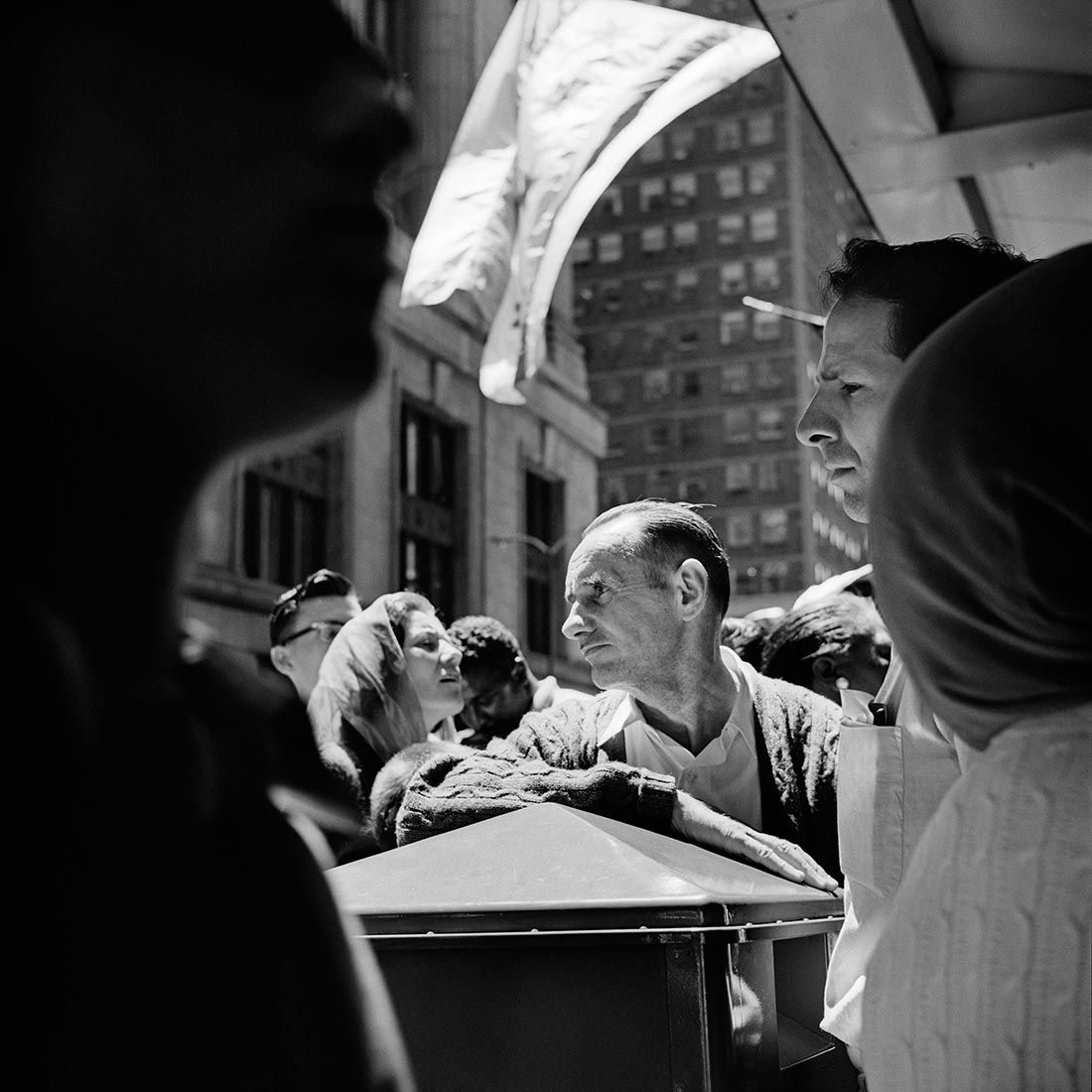
A Paragraph About Memory

There was a review in the New York Times this weekend of the third volume of Karl Ove Knausgaard’s six-volume, autobiographical novel My Struggle. I especially liked this paragraph from the reviewer Rivka Galchen:

In and out of the book, Knausgaard repeatedly claims to have a weak memory, a claim one might argue the book belies, but I believe him. Knausgaard forgets most everything (which is very different from everything) the way we all forget most everything, and he might forget even a little bit more than the rest of us. His grandfather tells him a story about having once joined a rescue mission for a plane that crashed in nearby mountains. No one survived, the grandfather says, but he remembers seeing the captain’s head: “His hair was perfect! Combed back. Not a strand out of place.” It’s a kind of gruesome metonymy for memory itself: So much life gone, and this one head in the snow is what remains in the mind’s eye. The past returns to us like light almost entirely obscured by a heavy, dark screen in which memory has made a few pinholes; we see very little, really, yet we look upon it as if at the starry vault of the heavens.

But why are bad memories often more powerful than good ones? I wonder if Knausgaard has anything to say about that.

(Thanks to linuxgal of Terminal Cruise for motivating me to remember reading the paragraph about memory. According to Professor Rosenberg, of course, it was just a matter of electricity flowing in and out (see previous post).)

In a Way, It All Turned Out For The Best (Wolf of Wall Street Edition)

Even for Netflix customers, curiosity sometimes wins out and it’s worth $1.28 to rent a DVD from one of those big vending machines at the grocery store. That’s how we ended up watching The Wolf of Wall Street the other night, instead of waiting to see how long a “Very long wait” would be. Unfortunately, the minority of critics who said The Wolf of Wall Street is a bad movie were right.

Maybe it was a good idea for Martin Scorsese to use the story of these crooked stock brokers if he wanted to make another Goodfellas. But he ended up with a movie that is ridiculously long (3 hours) and repetitious. It isn’t funny or suspenseful. It’s merely excessive. Since I never cared about the characters, I should have given up, like I did with Scorsese’s Shutter Island. But since I’ve seen almost all of his movies (all the way back to 1967’s Who’s That Knocking At My Door), I kept watching (in three installments), partly out of respect and partly to see if it would get better. It didn’t. It was just more of the same.  

If you’re open to watching a movie about terrible people who look like they’re having a wonderful time, consider watching Goodfellas again. But not The Wolf of Wall Street.

Needing to return the DVD to the store in order to avoid being charged another $1.28, I figured I’d use the trip to buy some more milk. The wait at the express lane wasn’t too long, but the best part of the transaction was when the clerk handed me the receipt and announced that I had just saved $1.40 on my purchase. Simply by using my A&P customer card. 

But wait! That meant my rental of The Wolf of Wall Street and subsequent visit to the store had returned a profit of over 9%! Not bad at all!

Of course, there was the time spent traveling to the store, the cost of gasoline and three hours of weak entertainment that could have been better spent. But if you put all that on one side, and balance it with the curiosity I satisfied, the knowledge I gained and that 12 cent profit, it all turned out pretty darn well. 

Plus, if I convince just one of you to skip The Wolf of Wall Street, our collective life on Earth will be a little bit better (“saving the world since 2012”). Unless you could have made a profit.

Nebraska in Black, White and Gray

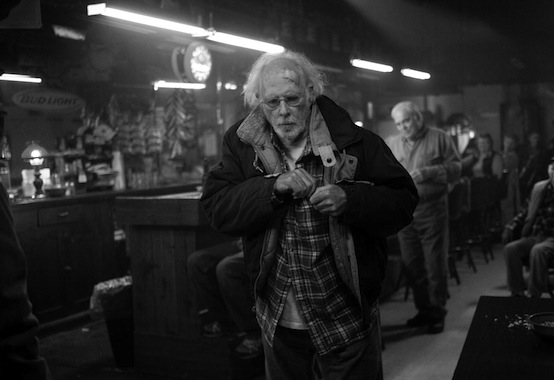
Since I recently expressed great disappointment with Gravity, one of the movies nominated for Best Picture last year, it’s only fair that I express great appreciation for one of the others: Nebraska. That’s the one in which Bruce Dern plays a cantankerous, confused old man who thinks he’s won a million dollars from an outfit that’s pushing magazine subscriptions.

It’s an old-fashioned picture, beautifully filmed in black and white, with some wonderful performances, especially by Dern (a healthy 77-year old runner in real life) and June Squibb as his extremely outspoken wife. Their performances were both nominated for Oscars, as were the screenplay, directing and cinematography. 

I had a little problem with the premise of the movie — hadn’t Dern’s character ever gotten one of those “We are authorized to award you one million dollars!” notices in the mail before? And when his wife and sons try to convince him he hasn’t really won anything, don’t they point out the very big “if” in the small print?

Putting that quibble aside, Nebraska is the most consistently enjoyable movie I’ve seen in months. I don’t know how a young person would respond to it (a lot of old people, plus black and white?), but the characters and relationships in the movie resonated with me. My parents didn’t age gracefully, I had an uncle who wouldn’t stay put, and I’m wondering what kind of old man I’m turning into. Contented, grumpy, quiet, outspoken, wise, befuddled? Probably all of the above.

NEBRASKA

How Can You Miss Me If I Won’t Go Away?

My urge to save the world one post at a time waxes and wanes. Lately, it’s waned.

Its waning could be a response to the daffodils blooming:

For oft, when on my couch I lie
In vacant or in pensive mood,
They flash upon that inward eye
Which is the bliss of solitude;
And then my heart with pleasure fills,
And dances with the daffodils.

                               — William Wordsworth

But did you know that Seasonal Affective Disorder (SAD) strikes some of us in the spring or early summer, not in the dark days of winter?

April is the cruellest month, breeding
Lilacs out of the dead land, mixing
Memory and desire, stirring
Dull roots with spring rain.
Winter kept us warm, covering
Earth in forgetful snow, feeding
A little life with dried tubers.

                               — T. S. Eliot

Life in itself 
Is nothing 
An empty cup, a flight of uncarpeted stairs, 
It is not enough that yearly, down this hill, 
April 
Comes like an idiot, babbling and strewing flowers.

                              — Edna St. Vincent Millay

But first, these messages:

Gravity was nominated for seven Oscars and 97% of the critics on Rotten Tomatoes liked it, but it’s not a good movie. They spent millions and millions making it look great but seem to have thrown the script together over a long weekend. One miraculous escape after another eats away at the suspense. And that capsule should have landed on a giant heap of corn.

it’s a simple fact of arithmetic that one person’s vote hardly ever matters. How many elections are decided by one vote? Since voting makes no sense from a practical perspective, we need to stop thinking of voting in practical terms. Instead, we should view voting as a democratic ritual. Ritual behavior doesn’t have to be practical. If everyone in this country – at least those of us who don’t have to wait in line for hours to vote – treated voting as a symbolic celebration of democracy, something that every citizen just does as a matter of course, we in the majority (those of us who favor less military spending, for example) could make a difference. Accepting that voting is impractical but doing it anyway would be a very practical thing to do.

Glenn Greenwald is one of the journalists selected by Edward Snowden to receive those secret National Security Agency files. Greenwald now has a website called The Intercept. The site includes links to “top secret” documents. For example, there’s a set of slides from the UK’s Government Communications Headquarters (GCHQ) called “The Art of Deception: Training for Online Covert Operations”. It suggests ways to discredit people or organizations by applying “The 4 D’s: Deny / Disrupt / Degrade / Deceive” (apparently, the NSA and GCHQ don’t merely listen; they also manipulate). There are also some light-hearted internal blog posts, like this one from the NSA regarding SIGINT (Signals Intelligence):

So, SIGINT is downright cool! As much as we complain about our “Big Data Problem”, collection/processing issues, dismal infrastructure/outdated browsers/OS’s, our ability to pull bits out of random places of the Internet, bring them back to the mother-base to evaluate and build intelligence off of is just plain awesome!

In conclusion, please don’t expect too much from Gravity, remember to vote, and visit The Intercept. As for everything else, I’ve got nothing (as of now anyway).

Farndale Daffodil Field

Vivian Maier, Street Photographer

Vivian Maier arrived in New York in 1951. She later moved to Chicago and worked as a nanny. In her spare time, she took more than 100,000 photographs. But she didn’t share them with anyone. In 2007, when she was 81 and living in poverty, an auction house sold thousands of her prints and negatives for $400. Since then, her work has been exhibited in the United States and Europe, she’s been the subject of a book and now there’s a documentary, Finding Vivian Maier. Of course, there are websites too, including this one, which has lots of information about her and a wonderful selection of her work. She took this picture of herself in 1953. She died in 2009.  

vv 029A few more from vivianmaier.com:

1963. Chicago, IL

Chicago, IL

Undated