The Thin Red Line by James Jones

James Jones enlisted in the army in 1939. He witnessed the attack on Pearl Harbor, which was the basis for his first novel From Here to Eternity. The Thin Red Line is a kind of sequel to From Here to Eternity, since it’s based on his experiences as an infantryman on Guadalcanal, the Pacific island the Allies invaded nine months after Pearl Harbor.

The novel is 500 pages long, but engrossing and fast-moving. If I were a military recruiter, I would not recommend this book to prospective soldiers. 7,100 members of the Allied forces, mostly Americans, died on Guadalcanal, and 31,000 Japanese. It’s hard to believe that the men who survived lived through it. In addition to the actual fighting, there was heat, exhaustion, lack of food and water (especially water), lack of sleep and malaria.

It’s hard to follow the battle scenes sometimes, since the geography is confusing, and it’s sometimes hard to remember which character is which, since there are so many of them, but that’s o.k. Combat is said to be confusing. Jones does a great job expressing the inner thoughts of his characters, almost all of whom would rather be anywhere else. Among these recurring thoughts are fear of dying, fear of cowardice, the pleasure and relief that comes from killing instead of being killed, the numbness that results from extended combat, and the love and hatred of one’s fellow soldiers.

One minor complaint: for some reason, 90% of the characters have single-syllable last names. Maybe it was common practice to use shortened last names in the Army, but it’s distracting to see a bunch of characters named Stein, Band, Whyte, Blane, Gore and Culp (the officers); Welsh, Culn, Grove, Keck, Spain, Stack, Storm, Beck, Field, Fox, Potts, Thorne and Wick (sergeants); Fife, Jenks and Queen (corporals); and Bead, Cash, Dale, Doll, Earl, Fronk, Hoff, Land, Marl and Park (privates first class).

Jones describes some relatively pleasant moments for his characters, but they are rare. Much more common are descriptions like these:

“Digging. Their neverending, universal digging. Sweating and panting with exhaustion, digging. Like last night. And almost every night in the world. And sometimes two or three times in the day. A place to lay your head. Three by three by seven, slit trench. Only the very lucky ever inherited another outfit’s holes. Nobody ever dug the round deep foxholes here because there weren’t any tanks. Here the home was the slit trench.”  

“As they crawled, suddenly, for no real reason, he found himself remembering that young, foolish, innocent, gullible Corporal Fife, that total stranger, who once had stood forth in the dawn on Hill 209 and had stretched out his arms willing to be killed for mankind, and the love of mankind. Well, fuck mankind, that bunch of ‘honorable’ animals. Piss and shit on them. That was what they deserved.”

No wonder these guys dreamed about getting wounded, just seriously enough to get the hell off that island.
Class Warfare Is a Fact – Part 3

After some discussion in the comments on Part 2 of what has turned into a brief series, I thought it would be a good idea to post the concluding paragraphs of the underlying paper by Emmanuel Saez (winner of the John Bates Clark Medal, periodically awarded to an outstanding young economist).

Here are his conclusions (my emphasis added):

“Interestingly, the income composition pattern at the very top has
changed considerably over the century. The share of wage and salary income
has increased sharply from the 1920s to the present, and especially since the
1970s. Therefore, a significant fraction of the surge in top incomes since 1970
is due to an explosion of top wages and salaries. Indeed, estimates based
purely on wages and salaries show that the share of total wages and salaries
earned by the top 1 percent wage income earners has jumped from 5.1
percent in 1970 to 12.4 percent in 2007.

(Footnote:  this dramatic increase in top wage incomes has not been mitigated by an increase in mobility at the top of the wage distribution.As Wojciech Kopczuk, myself, and JaeSong have shown in a separate paper,the probability of staying in the top 1 percent wage income group from one year to the next has remained remarkably stable since the 1970s.)

Evidence based on the wealth distribution is consistent with those
facts. Estimates of wealth concentration, measured by the share of total
wealth accruing to top 1 percent wealth holders, constructed by Wojciech
Kopczuk and myself from estate tax returns for the 1916-2000 period in the
United States show a precipitous decline in the first part of the century with
only fairly modest increases in recent decades. The evidence suggests that
top incomes earners today are not “rentiers” deriving their incomes from past
wealth but rather are “working rich,” highly paid employees or new
entrepreneurs who have not yet accumulated fortunes comparable to those
accumulated during the Gilded Age. Such a pattern might not last for very
long. The drastic cuts of the federal tax on large estates could certainly
accelerate the path toward the reconstitution of the great wealth concentration
that existed in the U.S. economy before the Great Depression.
The labor market has been creating much more inequality over the
last thirty years, with the very top earners capturing a large fraction of
macroeconomic productivity gains.

A number of factors may help explain this increase in inequality, not only underlying technological changes but also the retreat of institutions developed during the New Deal and World War II – such as progressive tax policies, powerful unions, corporate provision of health and retirement benefits, and changing social norms regarding pay inequality. We need to decide as a society whether this increase in income inequality is efficient and acceptable and, if not, what mix of institutional and tax reforms should be developed to counter it.

End quote.

By the way, the latest column by Paul Krugman (winner of the Nobel Prize in economics and one of the most astute op-ed columnists writing today) is called “Rich Man’s Recovery”:

“Whatever is causing the growing concentration of income at the top, the effect of that concentration is to undermine all the values that define America. Year by year, we’re diverging from our ideals. Inherited privilege is crowding out equality of opportunity; the power of money is crowding out effective democracy.

So what can be done? For the moment, the kind of transformation that took place under the New Deal — a transformation that created a middle-class society, not just through government programs, but by greatly increasing workers’ bargaining power — seems politically out of reach. But that doesn’t mean we should give up on smaller steps, initiatives that do at least a bit to level the playing field.”

End quote.

This isn’t a war in the usual sense, but the fact remains that the people in this country who have the most money are using their high incomes and wealth to manipulate the political system and other levers of power in order to increase their advantages still more. It’s not a shooting war, but it’s an assault on America as a prosperous and democratic nation.

——————————————————————————————————————-

Professor Saez’s relatively short paper:

http://elsa.berkeley.edu/~saez/saez-UStopincomes-2012.pdf

Professor Krugman’s most recent column:

http://www.nytimes.com/2013/09/13/opinion/krugman-rich-mans-recovery.html?hp

Class Warfare Is a Fact – Part 2

Paul Krugman makes the important point that the substantial gains in income for the richest Americans has been concentrated in a very small group. It’s not the top 10% or the top 5% or even the top 1% that has prospered the most — it’s the top tenth of 1% and the top hundredth of 1% who have substantially increased their share of the national income:

Of the gains made by the top 10 percent [since 1979], almost none went to the 90-95 group; in fact, the great bulk went to the top 1 percent. The bulk of the gains of the top 1, in turn, went to the top 0.1; and the bulk of those gains went to the top 0.01. We really are talking about the flourishing of a tiny elite.

In other words, income has only increased for the top 5.0% since 1979, and more than half of that increase went to the top 0.1%. It’s as if the bottom 95.0% of Americans haven’t received a raise in 30 years.

http://krugman.blogs.nytimes.com/2013/09/12/good-times-at-the-top/

Class Warfare Is a Fact

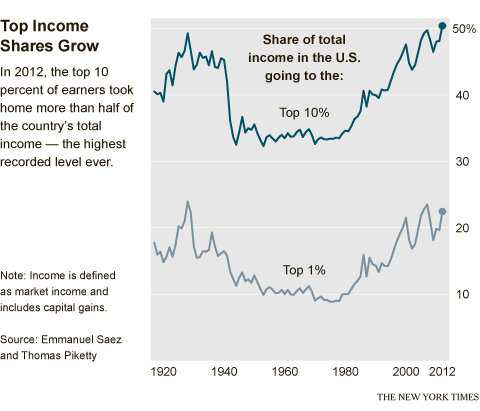
An updated study by economist Emanuel Saez of U.C. Berkeley shows that the the top 1% of earners in the United States received more than 20% of the country’s total income in 2012, while the top 10% of earners received more than half of the country’s income. The share of income going to the wealthiest Americans is now at or near the highest levels on record since the government began keeping the relevant statistics and the federal income tax was created in 1913.

What’s even more remarkable, perhaps, is that the income of the top 1% went up nearly 20% in 2012, while the income of the remaining 99% rose only 1%. Since 2009, the wealthiest 1% have taken 95% of the income gains in our supposedly classless society.

We should remember these statistics when we hear Republican politicians, who pretend to be friends of the middle class, claim that lower taxes for the wealthy benefit everyone. It’s past time to raise taxes on the rich, invest in America’s infrastructure and start creating decent jobs again. Otherwise we’re going to continue to get economically screwed.

Note the year 1980 in this chart, when class warrior and demagogue supreme Ronald Reagan was elected President:

10economix-sub-wealth-blog480

http://takingnote.blogs.nytimes.com/2013/09/11/the-rich-got-richer/

Good News Is Breaking Out All Over

It often seems like the world is going to hell. But clearly there is good news too, like what might be happening with the chemical weapons in Syria.

Here’s another piece of good news: medical researchers are getting closer to understanding the mutations that result in people getting cancer. As the article below says, we already know that smoking causes mutations leading to lung cancer and ultraviolet light causes mutations that cause skin cancer. Now scientists are beginning to figure out which mutations lead to other kinds of cancer: 

Out of the 30 cancer types, 25 had signatures [or patterns] arising from age-related mutational processes. Another signature, caused by defects in repairing DNA due to mutations in the breast cancer susceptibility genes BRCA1 and 2, was found in breast, ovarian and pancreatic cancers.

One of the interesting findings mentioned in the article is that a certain family of enzymes is linked to more than half of the cancer types studied:

These enzymes, known as APOBECs, can be activated in response to viral infections. It may be that the resulting signatures [that cause cancer] are collateral damage on the human genome caused by the enzymes’ actions to protect cells from viruses.

When I was growing up, my mother wouldn’t say the word “cancer”. It was like “Voldemort”, a word that must not be spoken. As our knowledge grows, “cancer” should eventually become as rare as the world “polio” is today.

http://www.sanger.ac.uk/about/press/2013/130814.html

In completely unrelated and less important news, the Japanese are now accepting the fact that a foreigner will break the single season home record of their great national hero, Sadaharu Oh. During his career in Japanese baseball, Oh hit 863 home runs, 149 more than Babe Ruth hit in America. As the New York Times explains:

A few foreign players in Japan’s top league have threatened to surpass Oh’s hallowed mark of home runs in a single season, 55. And each time, opposing pitchers refused to throw pitches anywhere near the strike zone in a blatant effort to protect Oh’s record.

Yesterday, Wladimir Balentien, a native of Curacao, playing for the Tokyo Yakult Swallows, tied Oh’s record of 55 home runs in a season. He has 21 games left and opposing pitchers are throwing pitches he can hit.

So the people of Japan have taken another step toward welcoming the participation of foreigners in Japanese society. Good news is breaking out all over.

http://www.nytimes.com/2013/09/06/sports/baseball/deference-to-a-revered-record-by-sadaharu-oh-in-japan-is-going-going.html