A Republican Admits the Terrible Truth

Mitt Romney was the Republican candidate for president in 2012. Barack Obama beat him. The election wasn’t very close. Six years later, Romney was elected to the Senate. After one term, Romney has decided not to seek re-election. The Atlantic has an excerpt from an upcoming biography of the Utah senator. Here’s what New York Times columnist Jamelle Bouie’s wrote about it in his newsletter:

Reading the recent excerpt from McKay Coppins’s forthcoming biography of Mitt Romney of Utah, I was struck by the depth of the senator’s contempt and disdain for much of the Republican Party, including many of his colleagues in the Senate.

He condemned their vanity, their venality, their cowardice. “Every time he publicly criticized [the Orange Menace], it seemed,” Coppins writes, “some Republican senator would smarmily sidle up to him in private and express solidarity.” Romney made note of the “rank cynicism” of his Republican colleagues and their almost total refusal to stand up for anything that might harm their future electoral prospects. He saved his harshest words, however, for those Republican senators who would do or say anything for political power and influence.

What bothered Romney most about [Senator Josh] Hawley and his cohort was the oily disingenuousness. “They know better!” he told me. “Josh Hawley is one of the smartest people in the Senate, if not the smartest, and Ted Cruz could give him a run for his money.” They were too smart, Romney believed, to actually think that [the loser] had won the 2020 election. Hawley and Cruz “were making a calculation,” Romney told me, “that put politics above the interests of liberal democracy and the Constitution.”

As for the latest crop of Republicans, Romney had this to say: “I don’t know that I can disrespect someone more than [Senator] J.D. Vance.”

Bouie says Romney’s words are “surprisingly harsh and unsparing for someone who is still an active participant in American political life”.

Yet they’re totally deserved. Bouie had more to say in his Times column:

“A very large portion of my party,” Senator Mitt Romney of Utah tells McKay Coppins, “really doesn’t believe in the Constitution”….

If Romney was using “the Constitution” as a rhetorical stand-in for “American democracy,” then he’s obviously right. Faced with a conflict between partisan loyalty and ideological ambition on one hand and basic principles of self-government and political equality on the other, much of the Republican Party has jettisoned any commitment to America’s democratic values in favor of narrow self-interest.

The most glaring instance of this, of course, is [the] attempt to overturn the results of the 2020 presidential election, which was backed by prominent figures in the Republican Party, humored by much of the Republican establishment and affirmed, in the wake of an insurrectionary attack on the Capitol by supporters of the former president, by a large number of House and Senate Republican lawmakers who voted to question the results.

Other examples of the Republican Party’s contempt for democratic principles include the efforts of Republican-led state legislatures to write political majorities out of legislative representation with extreme partisan gerrymanders; the efforts of those same legislatures to raise new barriers to voting in order to disadvantage their political opponents; and the embrace of exotic legal claims, like the “independent state legislature theory,” meant to justify outright power grabs.

In just the past few months, we’ve seen Tennessee Republicans expel rival lawmakers from the State Legislature for violating decorum by showing their support for an anti-gun protest on the chamber floor, Florida Republicans suspend a duly elected official from office because of a policy disagreement, Ohio Republicans try to limit the ability of Ohio voters to amend the State Constitution by majority vote, Wisconsin Republicans float the possibility that they might try to nullify the election of a State Supreme Court justice who disagrees with their agenda and Alabama Republicans fight for their wholly imaginary right to discriminate against Black voters in the state by denying them the opportunity to elect another representative to Congress.

It is very clear that given the power and the opportunity, a large portion of Republican lawmakers would turn the state against their political opponents: to disenfranchise them, to diminish their electoral influence, to limit or even neuter the ability of their representatives to exercise their political authority.

So again, to the extent that “the Constitution” stands in for “American democracy,” Romney is right to say that much of his party just doesn’t believe in it. But if Romney means the literal Constitution itself — the actual words on the page — then his assessment of his fellow Republicans isn’t as straightforward as it seems.

At times, Republicans seem fixated on the Constitution. When pushed to defend America’s democratic institutions, they respond that the Constitution established “a republic, not a democracy” [although, according to the English language, a republic is a kind of democracy]. When pushed to defend the claim that state legislatures have plenary authority over the structure of federal congressional elections and the selection of presidential electors, Republicans jump to a literal reading of the relevant parts of Article I and Article II to try to disarm critics. When asked to consider gun regulation, Republicans home in on specific words in the Second Amendment — “the right of the people to keep and bear Arms, shall not be infringed” — to dismiss calls for reform.

[The leader of the Republican Party] tried to subvert American democracy, yes, but his attempt rested on the mechanisms of the Electoral College, which is to say, relied on a fairly literal reading of the Constitution. Both he and his allies took seriously the fact that our Constitution doesn’t require anything like a majority of the people to choose a president. Attacks on representation and personal freedom — the hyper-gerrymandering of legislatures to preserve and perpetuate minority rule and the attempts to limit or restrict the bodily autonomy of women and other Americans — have operated within the lines drawn by the Constitution, unimpeded or even facilitated by its rules for structuring our political system.

Republicans, in other words, do seem to believe in the Constitution, but only insofar as it can be wielded as a weapon against American democracy — that is, the larger set of ideas, intuitions, expectations and values that shape and define political life in the United States as much as particular rules and institutions.

Because it splits sovereignty between national and subnational units, because it guarantees some political rights and not others, because it was designed in a moment of some reaction against burgeoning democratic forces, the Constitution is a surprisingly malleable document, when it comes to the shaping of American political life. At different points in time, political systems of various levels of participation and popular legitimacy (or lack thereof) have existed, comfortably, under its roof.

Part of the long fight to expand the scope of American democracy has been an ideological struggle to align the Constitution with values that the constitutional system doesn’t necessarily need to function. To give one example among many, when a Black American like George T. Downing insisted to President Andrew Johnson that “the fathers of the Revolution intended freedom for every American, that they should be protected in their rights as citizens, and be equal before the law,” he was engaged in this struggle.

Americans like to imagine that the story of the United States is the story of ever greater alignment between our Constitution and our democratic values — the “more perfect union” of the Constitution’s preamble. But the unfortunate truth, as we’re beginning to see with the authoritarian turn in the Republican Party, is that our constitutional system doesn’t necessarily need democracy, as we understand it, to actually work.
Why the Weather Has Become So Weird

It’s the difference between a linear and a non-linear system. Andrew Dessler, Professor of Atmospheric Sciences at Texas A&M, explains:

If you’re struggling to understand why the impacts of climate change suddenly seem so awful, it’s time we discuss a key scientific term: non-linearity.

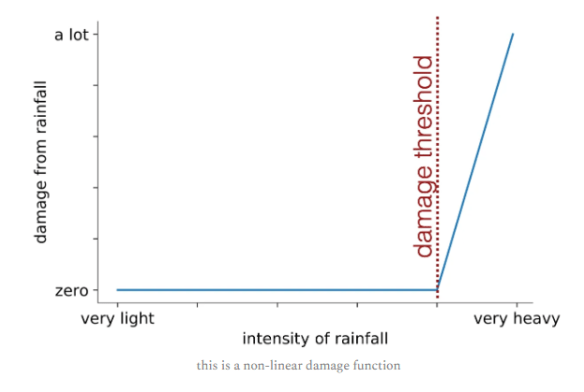
In a linear system, changes occur in a straight line. If climate impacts were linear, each 0.1°C increase in temperature would produce the same increment of damage. In this world, things slowly get worse over decades until, later this century, the accumulations of slow impacts becomes truly terrible.

But impacts of climate change are different — they are non-linear. In a rain event, for example, the first few inches of rain typically produce no damage because existing infrastructure (e.g., storm drains) were designed to handle that much rain.

As rainfall continues to intensify, however, it eventually exceeds the capacity of the storm runoff infrastructure and the neighborhood floods. You go from zero damage if the water stops half an inch below the front door of your house to tens of thousands of dollars of damage if the water rises one additional inch and flows into your house.

Untitled

Thus, the correct mental model is not one of impacts slowly getting worse over decades. Rather, the correct way to understand climate change is that things are fine until they’re not, at which point they’re really terrible. And the system can go from “fine” to “terrible” in the blink of an eye.

The key to this is recognizing the thresholds that exist in the systems around us. For example, when engineers of the 20th century designed the infrastructure that we live with today (bridges, dams, storm runoff systems), they designed it for the range of climate conditions that existed at the time, adding in a small margin for unforeseen weather extremities. But not too much of a margin — they wanted to keep costs down.

This range and margin together define the design limits of the built world. If we still had the climate of the 20th century, we’d be fine. But the relentless warming of our planet has taken us to the edge and beyond these 20th-century design limits.

The speed of us passing limits is mind bending. People who are affected are often shocked and we frequently see people bemoaning the fact that some impact never happened before — this is the calling card of non-linear effects.

So when we see all of the climate impacts of the last few years suddenly appearing, it shouldn’t surprise us. The very rapid warming we are experiencing is pushing us past many thresholds in our human and natural systems.

Note that these damages are not uniformly distributed. When the globe warms from 1.1C to 1.2C, most people are unaffected. But, for a minority of people, this will drive the climate system past important thresholds, resulting in enormous damages and suffering for them. It could be a rainfall event that, intensified by warming, crosses a threshold and floods a city. Or it could be a heatwave that, powered by increasing temperatures, becomes intense enough to wipe out entire crops. Whatever the scenario, for those people it is awful.

When the Earth warms the next 0.1C, an entirely new group of thresholds will be passed, bringing great harms to entirely different groups of people. Many of them will not expect it, having been lulled into complacency by the fact that they hadn’t been negatively impacted by warming up to then. Is that you?

Let’s hope not, but the reality is that someone, somewhere, will inevitably face climate disaster in the near future. Therefore, it’s crucial to discard the notion of climate change as a distant, linear threat and acknowledge that all of us are in the non-linear firing line.

One More Answer to a Frequently Asked Question

You’ve probably never heard a discussion or seen an article about Biden voters. What makes them tick? Why do they support such a person? You have, however, heard lots of discussion and seen too many articles about the people who support the other guy. What are they thinking? What are they like? How can they support an individual who’s so obviously corrupt, egotistical, incompetent, and so on? You’ve probably asked yourself the same question.

There’s a simple explanation for why one group of voters is endlessly analyzed and the other isn’t. Biden voters aren’t mysterious to the people who run the news media. The other guy’s voters are. Weird is interesting.

Journalist Tom Nichols (who goes by @RadioFreeTom) offers an explanation I hadn’t heard before:

I wrote a whole book on why democracies become illiberal, but something about America after [the other guy’s] indictment really strikes me. Yes, MAGA world is about resentment and ignorance and displaced anger and all that. But it’s also a time that seems to me incredibly…juvenile.

[Him] hawking t-shirts with his mug shot is like some hair band selling posters of their guy getting busted for drugs or waggling his junk onstage or something. It’s beyond unserious. It’s child-like, the political version of Oppositional Defiance Disorder. And yet it’ll sell.

In the book, I argue that peace and affluence have been a big part of America’s slide: Life’s good and people don’t grasp that ghastly decisions can have disastrous effects – including on them. Because other adults make sure the nation functions even when the voters go nuts.

But maybe peace and affluence, in addition to making people bored out of their skulls, also prevents them developing into adults who make democracy possible. This is the world, as I wrote in the book, in which Huxley wins, not Orwell. (I am stealing Neil Postman’s point here.)

I suppose you could call all this *decadence*, but it’s not even gloriously decadent in that grandiose, Weimar, “Cabaret” kind of decadence. It’s just people putting on costumes and hats and being violent and then crying in front of judges when it all goes horribly wrong.

Childishness doesn’t make voters less dangerous to democracy. But even if [he] is defeated (again), this is a serious level of social dysfunction. You can’t sustain a superpower when nearly half of its citizens are mired in eternal petulant childhood.

And millions of our oldest citizens, people my age – [his] most reliable voting bloc – who should be our wisest among us, are the ones most like angry, irrational toddlers (much like [their leader] himself). This is incomprehensible to me, especially as I get older.

In another weird role-switch, these right-wingers are now like the dilettantish countercultural activists of the 60s: well-off would-be revolutionaries who really have no idea what they’re doing and merely want to act on ill-defined, self-actualizing, self-centered emotion.

Adults, however, know that there were people who came before us, and people who will come after us, and that “the moment” is not supreme. We have a civic inheritance, a trust, to hold and to protect, and then to pass on. This used to be central to the American idea. No longer.

All we can do is hope that the generations coming up can learn to embrace civic adulthood. I’m (mildly) optimistic – if we get past these next few elections. But how weird that so many adults now worship – and emulate – a choleric 77 year old toddler.

They Give Themselves Permission

Right-wingers love to claim the left is trying to “destroy America”. Joe Biden, a long-time politician who isn’t a radical in any way whatsoever, is accused of the same. (They also sometimes call him a “communist” — at least they know enough about communism to know they’re against it.)

David Roberts, who operates a newsletter/podcast about clean energy and politics called Volts, explains what they’re doing:

In his book The School for Dictators, Ignazio Silone famously called fascism “a counter-revolution against a revolution that never took place”. There is much wisdom there.

A core feature of reactionary (I’ll use that term rather than “fascist” because people love to pointlessly debate semantics) movements is an inversion of power. They cast the weak as looming threats and status-quo powers as the trembling victims.

This is a familiar move … in every reactionary movement. You see it in the US when they talk about gay or trans people imposing themselves on everyone, forcing their lifestyle down our throats. Or when they talk about how white people face more racism.

Or, on a grander scale, when they talk about how social justice warriors have taken over every institution in the the US, ruthlessly imposing their woke worldview.

It’s self-evidently ridiculous, but why do they do it so consistently?

The point is to justify their own escalating violence and lawlessness. They hate difference, they hate the status quo being challenged, they hate the existence of Others in their midst, so they need to convince one another that it’s ok to cast off norms and let the violence [or criminality or immorality] out.

This is why the only mode of moral argumentation you ever see from a reactionary is whataboutism. The point of “they did it first” (for whatever “it,” censorship or voter fraud or whatever) is not that “it” is bad and no one should do it, but that it’s ok for us to do it too.

It’s not even really a moral argument. It’s just a permission structure — they did it, so we can’t be held accountable for doing it too.

So when they create this mythology about Democratic voter fraud, the point is not “voter fraud is bad,” the point is, “it’s ok for us to do it too” [which explains why the people found to have voted twice or somewhere they don’t live are almost always Republicans].

The long-running narrative about left bias in the media is not about “bias is bad”, it’s about, “it’s ok for us to make full-on propaganda”. The point about violent rioting urban lefties is not “violence is bad”, it’s “it’s ok for us to be violent”.

The clichĂ© goes “every conservative accusation is a confession,” and that’s kind of true, but it’s more accurate to say every accusation is permission — permission for the right to do in reality what it has worked itself up to believe the left is doing.

Oh I forgot to mention the classic example we’re living through: endlessly accusing the left of censorship to justify banning books and rewriting history.

It’s all a counter-revolution against a revolution that never took place — a way of defending and reinforcing status quo hierarchies by exaggerating the power and efficacy of the marginalized and vulnerable, the outsiders trying to reform the status quo in an egalitarian direction.

I was thinking about this the other day listening to the @IfBooksPod episode on Jonah Goldberg’s “Liberal Fascism”. Goldberg desperately wanted to be taken seriously as an intellectual, but literally the only thing he could think to do is the World Biggest What About. It’s “we’re rubber, you’re glue” puffed up to hundreds of pages. It’s just how their brains work. It’s never “people should be good”. It’s always, “you can’t call us shitty because you’re shitty too”.

And that is the most primal and formative feature of reactionary psychology: the belief that everyone is selfish, everyone is out for themselves, it’s a zero-sum world in which tribes compete for dominance, and all the progressive talk about universalist values is just a clever con.

They have to believe that. Their worldview has no room for people of good will trying earnestly to do good for humanity. They need for all the Others they hate to be sinister and powerful and right on the verge of taking over and destroying everything.

They need it because it gives them permission to indulge their base instincts. “We have to do this violence/censorship/lawbreaking, it’s the only way to stop the gays/immigrants/professors from destroying our way of life”. Every time it’s the same.

A friend reminded me that I forgot the most perfect example for this thread: all the “Flight 93 election” stuff! If you’re not familiar, this is the right-wing idea that US culture has been hijacked by the left and is headed for some grim end, so anything the right does to regain control is justified, even if it crashes the plane. The danger from the left is so severe, so immediate, that even blowing everything up is better than the alternative. Again, the point is always to create that permission structure.

“You prosecute us for real crimes, we’ll prosecute you for fake crimes!” Sigh.

Unquote.

Mr. Roberts then provides a few recent examples of this phenomenon:

Untitled

Untitled

Untitled

Untitled

In case you haven’t heard, some of the worst House Republicans are pushing to impeach Biden. On what grounds? They don’t know yet, but there must be something, either real or imaginary.

The Song of the South

What is it that makes the American South so special? A journalist named Hamilton Nolan answers that and other questions at How Things Work, where he writes about labor, politics and power.

Since the Covid pandemic struck in 2020, more than two million people have migrated to the six fastest growing states in the South, bringing with them $100 billion in new income. This population shift is held up by Southern governors as proof of the success of their policies—and as a herald of an ongoing shift in the balance of economic power that is bound to continue due to the South’s inherent advantages. What spurred this grand relocation? Traditional wisdom will tell you that it was the more relaxed and open posture of Southern states like Florida during the Covid pandemic, along with the perpetual allures of warmer weather, lower taxes, and more affordable housing prices.

In reality, though, this current sloshing of America towards its drain is not the start of anything new at all. It is spurred not by any new economic paradigm, nor by any Texan or Floridian governor’s new ideas about unleashing the power of free enterprise under the nation’s sunniest skies. It is, instead, a normal reaction to a … rise in the appeal of something that the South has been offering for more than 200 years. Politicians will tell you that the South is attractive because it offers greater freedom. Actually, it offers cannibalism: it is willing to kill and eat its own to fuel a marginal improvement in your lifestyle. Don’t let this deal pass you by!

Ron Desantis is running (unsuccessfully) for president on the premise that he can do for America what he has done for Florida in the past three years. One way to look at his record during those crucial Covid years is: he kept stuff open and got rid of pandemic restrictions, which caused the Florida economy to flourish. Another, more accurate way to look at it is: he kept stuff open and got rid of pandemic restrictions because he fundamentally does not care whether his citizens live or die, as long as his state could get a temporary economic boost that he could use for self-promotional purposes. In this, Desantis was the perfect combination of the classic Southern socioeconomic strategy with a global pandemic.

Ever since being forced to give up formal slavery at gunpoint, the South has pursued a formula of attraction only one step removed from it. The region’s offer to businesses and wealthy people in the rest of America is, and has always been, this: “Come to the South. Do whatever you want. We won’t regulate you. We won’t tax you. We’ll crush any unions that dare to come here. We’ll provide a pool of dirt-cheap labor for you. Because we don’t tax you, our public services will be awful. Our public schools will be inadequate. But don’t worry, because we will build graceful private schools for the people with money, and we will build private country clubs and gated communities to shield you from the poverty, and racist cops to police the borders of the neighborhoods, and you can live here in a private island of bliss. The inadequacy of our public services and our outright racial oppression guarantee that that cheap labor force will continue forever. You can profit from that cheap labor force without ever having to interact with the people who compose it, except as various forms of servants. The oppression, sequestered away from you and walled off from impacting your life except to enhance it, is what makes the system work.”

That’s it. That’s the South’s sales pitch. It is the poorest and most backwards region of America by traditional socioeconomic measurements, but it’s great place to be when you exclude all of the poor people from your measurements. Which they do, because “not caring about all the poor people” is the key to the South’s ability to imagine itself as a place with a political system that works. This is the slavery mentality dragged cleanly into the present day, modified just enough to fit the letter of the law.

In the plantation era, the South was great, as long as you were a plantation owner. If you add all the slaves (and poor whites) into the calculation… ugh, you mess up the numbers. Despite the fact that the South’s failure to industrialize properly due to slavery was one of the things that lost it the Civil War, the region remains stubbornly addicted to cheap labor today. It is, at heart, an inferiority complex. The South’s leaders don’t really believe that they have anything to offer to lure people in other than a work force that will show up for rock bottom wages. If the South really believed in itself, it would be busily investing in public education and health care and a strong social safety net and all the other things that build a healthy and thriving society that ultimately attracts people and businesses. Instead, they do the opposite—because empowering the existing residents of the South would undermine its cheap labor pool.

When you see Southern governors doing seemingly irrational things like rejecting federal government Medicaid funding for their state’s residents, you must understand that the people who would be helped by that funding simply do not count in the minds of those states’ leaders. Their states are modern plantations, and they calculate the success of their governance based on the living standards of the plantation owners, not the workers. Even worse, doing things that help the workers live better could harm the project of maintaining a maximally desperate labor pool. The South doesn’t want their entire population to be healthy and well-educated. They want white people and business owners to be healthy, thanks to private doctors, and well-educated, due to private schools, and to have access to a limitless low-wage work force that, thanks to the failure of the state to invest in their welfare, has no choice but to acquiesce to being exploited. The more desperate they are, the better.

When you see Texas Republicans eliminate laws that grant workers water breaks, that is not some momentary outbreak of callousness; that is the point. …

Embracing the South’s toxic sales pitch pollutes the soul. “I am moving to Florida because the total lack of public health measures is nice and easy for me, as a rich person, even though I know it will cost a calculable number of Floridians their lives.” You are a bad person. “I am moving to Texas to save on my personal income taxes, even though I know that the cost of that is poor schools and oppression for vast swaths of this state’s neediest residents.” You are a bad person. “I am relocating my company’s factory to South Carolina because labor costs there are lower, even though I know that those low wages are a result of systematic oppression and union-busting designed to keep millions of poor people powerless over their own lives.” You are a bad person.

The bliss of ignorance is a critical part of this whole process. Move only between your air conditioned home on a golf course and your air conditioned office and your kids’ private school and the nice strip malls around your nice neighborhood and don’t ask any questions of the people who build the houses and serve the food and fill the factories and it is possible to cling to the illusion that this whole system works. But as soon as you begin to think about the aggregate welfare of everyone in the South—as soon as you place an equal value on the lives of the poor—it becomes devastatingly clear that all the nice enticements that tempted you down here require you to stand, at all times, on the necks of your fellow citizens. If you know that and continue to tolerate it, the South has poisoned you.

Unquote.

“The South has poisoned you”. It’s also how the South has poisoned American politics since the 18th century.