More Budget Baloney From a Leading Political Party

Republican Congressman Paul Ryan, chairman of the House Budget Committee, issued his proposed federal budget yesterday. The Republican majority on the Budget Committee is expected to approve it. Fortunately, even if the full House of Representatives approves it, the Senate won’t.

Nevertheless, Ryan’s budget is worth knowing about. It will influence the budget Congress eventually agrees on and it offers yet another clear statement of the Republican Party’s insane priorities. 

In brief, the Ryan budget calls for a big tax cut on high incomes, a lot more spending on the military, and a lot less spending on programs like Medicare and food stamps. In addition, Ryan would repeal the Affordable Care Act, even though there are now some 10 million people who have health insurance because of that law (via private insurance or Medicaid).

Ryan claims his budget will eliminate the federal deficit in ten years, despite the tax cuts and increased military spending, because he makes stuff up.

One part of the Republican budget document deals with Social Security. I plan to write more about that in a future post, but for now, consider this amazing sentence from page 66: 

Any value in the balances in the Social Security Trust Fund is derived from dubious government accounting. 

The Treasury Department says the government bonds in the Social Security Trust Fund were worth almost three trillion (not billion, but trillion) dollars at the end of December and were paying the Trust Fund an average interest rate of 3.6%. But, according to the authors of the Republican budget document, those bonds are basically worthless. They’re an accounting fiction. Such is the financial insight demonstrated by Congressman Ryan and his Republican colleagues as they go about planning our economic future. 

Republicans on Supreme Court Make Plutocracy Official

In their latest effort to make America’s status as an oligarchy (sub-class plutocracy) official, the five Republicans on the Supreme Court have now decided that wealthy people will be able to give as much money as they want to political parties and groups of candidates. According to the New York Times, the Republicans ruled that:

Overall limits of $48,600 by individuals every two years for contributions to all federal candidates violated the First Amendment, as did separate aggregate limits on contributions to political party committees, currently $74,600.

So, rich people will now be able to give millions of dollars every two years to the political party of their choice, without going to the trouble of setting up supposedly independent political action committees. In addition, rich people will now be able to give millions of dollars directly to candidates every two years, so long as they don’t give any candidate more than $2600 for a single election.

The $2600-per-election limit wasn’t killed off today, but it will be eliminated as soon as the Republican justices gets their chance. That’s because the Republicans on the Court claim, in the Chief Justice’s words, that “there is no right in our democracy more basic than the right to participate in electing our political leaders.” And by “participate”, of course, the Court means “use one’s financial resources to elect and influence as many politicians as possible”.

It’s now official, therefore, that the most basic right in our democracy is no longer the right to vote, a right that should belong to rich and poor alike. Now the most basic right is to “participate”. Anatole France once pointed out that “in its majestic equality, the law forbids rich and poor alike to sleep under bridges, beg in the streets, and steal loaves of bread.” In the same way, the law in the United States now allows rich and poor alike to give millions of dollars to the candidates of their choice and buy as much political advertising as possible, all in the name of freedom of speech.

Treat money as speech, discourage low-income voters from voting (as Republican politicians are doing in every state they control), and do whatever possible to encourage financial inequality (let’s get rid of the death tax!). It’s an amazingly clear agenda. Replace government of the people with government of the few and make sure the few are the rich!

The Man Who Saved the Union: Ulysses Grant in War and Peace by H. W. Brands

Ulysses S. Grant has been called “the most underrated American in history”. But he wasn’t underrated by his contemporaries. His achievements during the Civil War made him a national hero. He was elected President twice and probably would have been elected a third time if he’d chosen to run. He was celebrated around the world as the greatest living American. His death was mourned throughout the nation, even in the South. Eulogists compared him to Washington and Lincoln.

Yet he is mostly known today (if he is known at all) as a drunk, a relatively competent general, a terrible President and the occupant of Grant’s Tomb. It isn’t clear why his historical reputation suffered. One theory is that his enemies were better writers than his supporters.

In recent years, however, Grant’s reputation has improved, partly as the result of two biographies: Grant, by Jean Edward Smith, and this book, The Man Who Saved the Union, by H. W. Brands. It’s hard to know how accurate any biography is, but Brands’ book suggests that Grant was a true American hero. Aside from Lincoln, he was the person most responsible for winning the Civil War. As President, he was the person most responsible for unifying the North and South. 

The strongest impression I got from reading The Man Who Saved the Union, especially from reading Grant’s own words (which Brands frequently quotes), is that Grant was an extremely decent and sensible man. He seems to have always chosen the honorable course over the expedient one, for example, by using the power of the federal government to protect the rights of the freed slaves, over violent opposition in the South, and by seeking a peaceful solution to the conflict with the American Indians in the West. 

As you would expect, Brands’ book loses some momentum when it gets to Grant’s post-war career. Still, it’s a wonderful, highly-readable biography of someone who was beloved in his own time and deserves to be appreciated in ours.

Giordano Bruno: Philosopher / Heretic by Ingrid D. Rowland

Giordano Bruno was a 16th century Italian priest and free-thinker. At the age of 28, he left the monastery where he’d lived for 11 years because he was about to be indicted for questioning the divinity of Jesus and owning the banned writings of Erasmus. He then wandered around Europe for 25 years, studying, writing, teaching and trailing controversy wherever he went.

Bruno had a lot of radical opinions. He is best known today for his belief that the Sun is merely one among an infinite number of stars, all of which are circled by their own inhabited planets. He reasoned that God wouldn’t have created anything less than an infinite universe full of other worlds and people. He also believed that everyone, sinners or not, would eventually receive God’s grace (God’s free and unmerited favor).

In 1592, although it’s unclear why, he returned to Italy. He must have thought the Inquisition would no longer be interested in him. Unfortunately, he soon got into trouble with a local dignitary, who had Bruno arrested as a blasphemer and a heretic. The religious authorities in Venice imprisoned and investigated him for a year before transferring him to Rome, where he was imprisoned and interrogated for another seven years.

Bruno cooperated with the Inquisition to some extent, but questioned the Inquisition’s authority and ultimately refused to recant all his beliefs. He was burned at the stake in 1600. Almost three centuries later, over the objections of the Vatican, the city government erected an impressive statue of Bruno in the square where he was executed. 

Bruno, being the person he was and living the life he did, deserves a better biography than this. The author’s descriptions of Bruno’s life and thought are clear enough, but she goes off on tangents way too often. As soon as you think you’re finally going to learn more about Bruno, you get observations on architecture, church history or the life of someone Bruno met in his travels.

Vivian Maier, Street Photographer

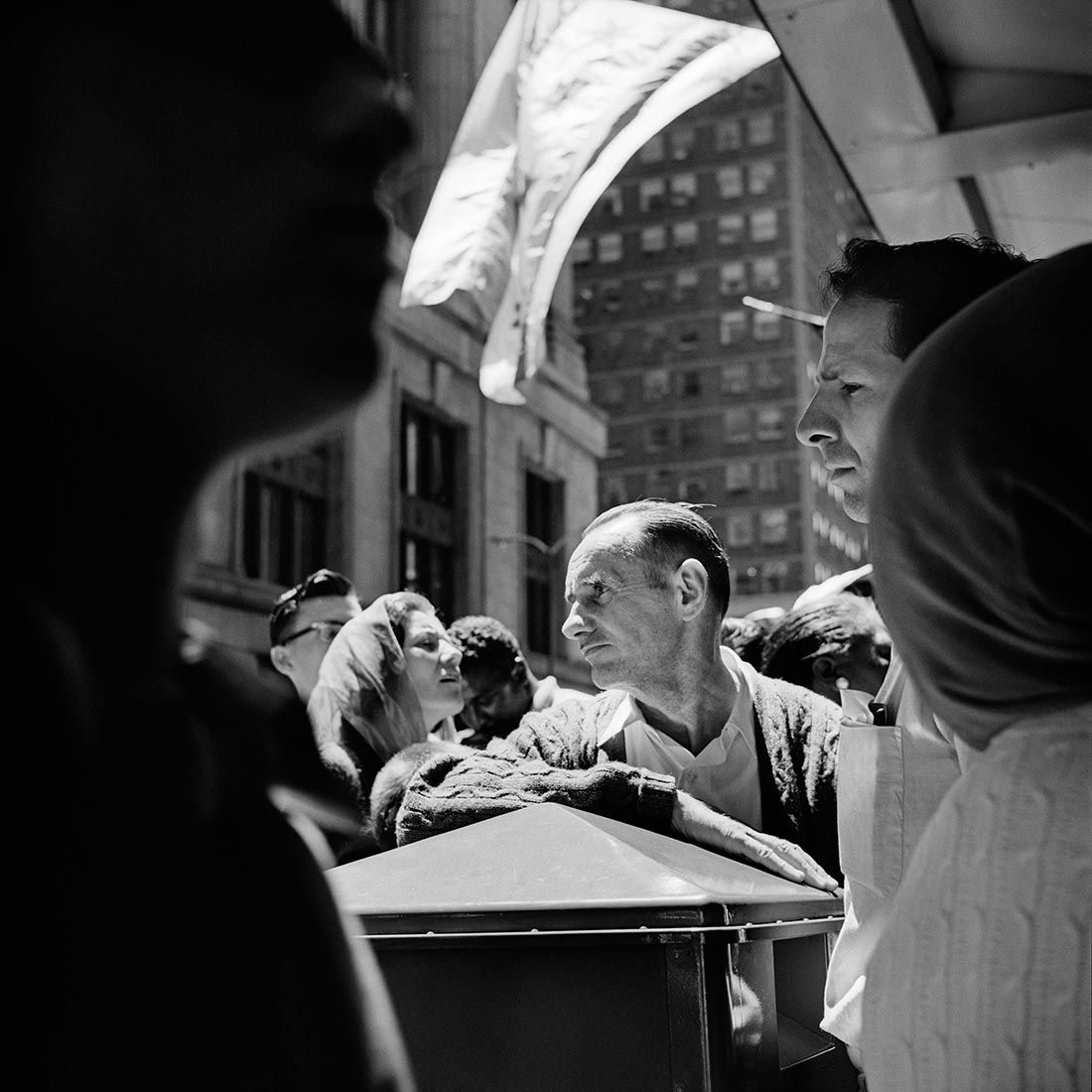
Vivian Maier arrived in New York in 1951. She later moved to Chicago and worked as a nanny. In her spare time, she took more than 100,000 photographs. But she didn’t share them with anyone. In 2007, when she was 81 and living in poverty, an auction house sold thousands of her prints and negatives for $400. Since then, her work has been exhibited in the United States and Europe, she’s been the subject of a book and now there’s a documentary, Finding Vivian Maier. Of course, there are websites too, including this one, which has lots of information about her and a wonderful selection of her work. She took this picture of herself in 1953. She died in 2009.  

vv 029A few more from vivianmaier.com:

1963. Chicago, IL

Chicago, IL

Undated