Cutting the Cord (the Saga Continues)

A couple days ago, I went to the Comcast website to ask about eliminating our cable television service (the two online chats that resulted are recorded in an earlier post).

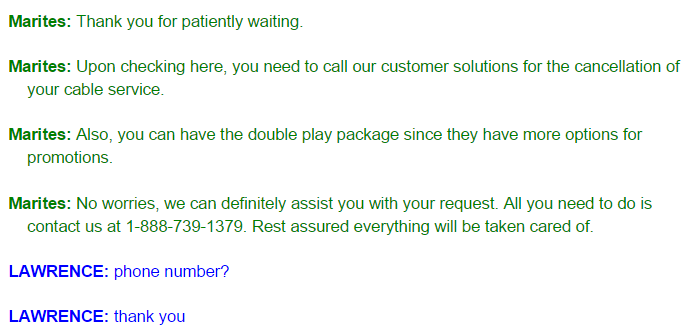
The two “analysts” with whom I chatted, Kaye and Marites, said the same thing: If I wanted to save money by canceling cable TV while keeping our phone and internet service (as part of a so-called “Double Play” package), I’d simply need to get in touch with some other Comcast employee:

com 111

Having gathered my strength for almost 48 hours, I called 888-739-1379 today.

As the pessimistic (i.e. realistic) part of my mind expected, it wasn’t quite as easy as Kaye or Marites promised. In fact, Matthew explained that it would not be possible to get a “Double Play” discount by speaking to him or anyone else on the phone.

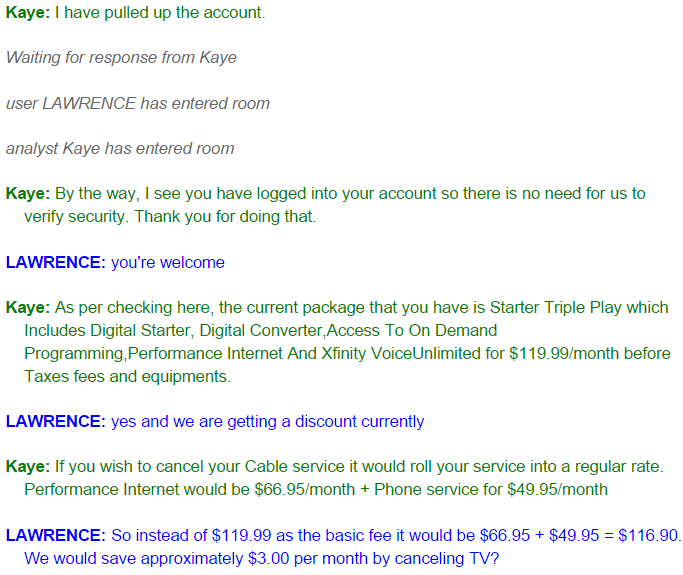
According to Matthew, my only option would be to visit the Comcast website, because, in his words (and the words of Marites too!): “they have more options for promotions”. Unfortunately, the best Matthew could do was offer me the “standard” arrangement for phone and Internet service. That would reduce my basic bill by – to quote from that earlier chat with Kaye – hardly anything at all:

com 444

It never occurred to me before that one of the benefits of a huge monopolistic corporation providing support to its customers by phone and also by website is that (1) employees who answer the phone can tell customers to use the website and (2) employees who chat on the website can tell customers to use the phone.

It really is an elegant solution to the Customer Service Problem.

Next stop: Investigate getting phone service from one of the smaller companies that do that these days, as preparation for finally cutting the cable television cord. 

By the way, I know I should tell Comcast I want to cancel everything in order to get a better deal, but I’d prefer to end our relationship completely (even though Verizon isn’t a wonderful alternative). And I know that when the time comes for us to go our separate ways, I need to tell them I’m moving to Iceland. Or that I’m dead. According to this interesting article, Comcast doesn’t have answers for situations like that:

Save Attempt is Not Applicable in the Following Scenarios:
1) Customer is moving in with an existing Comcast customer (CAE [i.e. Comcast Retention Specialist] must verify Comcast services active at new address)
2) Customer is moving to a non-Comcast area (CAE must verify by looking up zip code)
3) Account holder is deceased / incapacitated
4) Temporary / seasonal disconnect and Seasonal Suspend Plan is not available in their area
5) Natural disaster
6) Customer doesn’t know what address they’re moving to.

Bernie, Hillary, Emails, Decisions, Decisions

New Jersey will hold its Presidential primary election nine months and fifteen days from now. By that time, we will almost certainly know who the Democratic nominee and the next President of the United States will be (she used to be Secretary of State). June of 2016 might sound like a long way off, but we in New Jersey, along with our friends in California and a few other states, always wait for everyone else to hold their primary elections first.

Aside from the fact that we’re naturally considerate (“Please, I insist.” “No, no, after you.”), this means we don’t have to spend much time deciding which Democrat or Republican should be President. Unlike Iowa, Vermont and South Carolina, we have more important things to do.

Anyway, if I had the opportunity to vote sooner than next June, like maybe tomorrow, I’m not sure who I’d choose. From a policy perspective, I’d go with Bernie Sanders, the democratic socialist Senator from Vermont. Voting for Sanders would make me feel good. I even think he could beat a Republican in the general election, because most Americans, whether they realize it or not, agree with his positions. (See “How Mainstream Is Bernie Sanders?” and “Why Surprising Numbers of Republicans Have Been Voting for Sanders in Vermont”).

Despite the popular appeal of Sanders’s positions, however, Clinton might do better in a general election. It would be harder for the Republicans to falsely portray her as a wild-eyed radical. And despite some of her hawkish views on foreign policy and military spending, Hillary Clinton might end up being a very progressive President. She seems more aware of our country’s increasing inequality and more likely to do something about it than she used to be. Further, she might be able to get more done than Sanders, since the politicians, bureaucrats and plutocrats she’d have to work with would be more likely to consider her “one of them”. 

(Every time I imagine President Sanders taking office, I’m reminded of A Very British Coup, in which the election of a proud Labor Party socialist as Prime Minister leads to army helicopters descending on Downing Street and Parliament. See also Seven Days in May. All fiction, of course.) 

But since I’m a proud resident of New Jersey, I don’t have to make a decision about this any time soon. Meanwhile, our national nightmare (i.e. our Presidential campaign) will continue.

That brings me to a perceptive article by Heather Digby Parton called “Anatomy of a Hillary Clinton Pseudo-Scandal”. She writes:

… the press can pass judgement about anything once it’s “out there” regardless of whether or not what’s “out there” is true. This allows them to skip doing boring rebuttals of the facts at hand and instead hold forth at length about how it bears on the subject’s “judgement” and the “appearance” of wrongdoing without ever proving that what they did was wrong.

You see, if the person being discussed were “competent,” it wouldn’t be “out there” in the first place, so even if it is based upon entirely specious speculation, it’s his or her own fault for inspiring people to speculate so speciously. It all goes back to their “character”… 

And even if the charges are patently false, they are always far too complicated to rebut in detail; and, anyway, the other side says something different, so who’s really to say what’s true and what isn’t?  [Note: that’s what Paul Krugman calls “Shape of Earth: Views Differ” journalism.]

It’s still the responsibility of the target of those charges because he or she shouldn’t have allowed him or herself to be in a position where someone could make false charges in the first place.

From this perspective, it’s irrelevant whether any of those famous emails were classified at the time (apparently they weren’t, besides which lots of stuff the government classifies shouldn’t be). It’s also irrelevant whether it was forbidden to use a private computer then (apparently it wasn’t). 

I agree about the irrelevance in one sense. It’s irrelevant as to whether Clinton or Sanders or some other Democrat should be our next President.

Cutting the Cord (the Saga Begins)

I didn’t think it would be possible via an online chat to give Comcast less money, but decided to start there anyway.

com 1com 2

com 000

Twenty minutes and one reconnect later:

com 4

com 5com 6Well, I didn’t expect anything else. But sometimes it’s good to get confirmation.

In fact, I’m very familiar with everything you can do at this site: http://customer.comcast.com. For one thing, you can add services but you can’t cancel them….

The Stranger by Albert Camus, translated by Matthew Ward

This is the third or fourth time I started reading The Stranger and the first time I finished it. I’m glad I made it through Part 1 because Part 2 is actually interesting.

In his introduction, the translator says Camus adopted an “American” style in Part 1: “the short, precise sentences; the depiction of a character ostensibly without consciousness; and, in places, the ‘tough guy’ tone”. In Part 2, however, “Camus gives freer rein to a lyricism which is his alone”. 

I found most of Part 1 to be oppressive. Meursault, the “stranger”, narrates the story as if he’s an alien or a robot. He hardly reacts to anything except the heat and the sunshine. In Part 2, he expresses some emotions in addition to annoyance and becomes almost sympathetic, even though I was never convinced by his repeated claims that life is absurd and nothing matters.

There are absurdities in life, but death doesn’t make life absurd. It only makes it finite. And some things do matter if only because they matter to us.

Highlighted Passages From 40 Years Ago

The Culling of the Books has begun again. It’s the process in which old friends and acquaintances (and a few new ones) are (1) put up for sale on eBay, (2) offered to used bookstores, (3) left at the city’s book exchange shed, (4) recycled or (5) even consigned to the trash. It happens as regularly as an atomic clock ticks, but not quite so often.

Some will survive the process, only to be assessed at the next CotB. No one will be safe forever!

This is why I picked up my 1975 paperback edition of Fields, Factories and Workshops this afternoon. First published in 1898, it’s a classic statement of anarchist principles written by Peter Kropotkin, more formally known as Prince Pyotor Alexeyevich Kropotkin.

maxresdefault1

Kropotkin was a Russian aristocrat who favored the overthrow of both capitalism and the state. He envisioned a future in which small communities, linked together by modern technology, would grow much of their own food and do much of their own manufacturing. He championed cooperation over competition and rejected the authoritarian socialism of the Bolsheviks.

This is the kind of book I was reading in the 1970’s when I started wondering why our economic system leaves so many people idle when there is so much work to be done.

But now, before deciding on this old book’s future, I’m going to share two paragraphs I highlighted back then. First, here’s Kropotkin predicting a future that now seems unlikely:

Each nation – her own agriculturist and manufacturer; each individual working in the field and in some industrial art; each individual combining scientific knowledge with the knowledge of a handicraft – such is, we affirm, the present tendency of civilized nations.

And here’s Kropotkin on the purpose of education:

Be it handicraft, science or art, the chief aim of the school is not to make a specialist from a beginner, but to teach him the elements of knowledge and the good methods of work, and, above all, to give him that general inspiration that will induce him, later on, to put in whatever he does a sincere longing for truth, to like what is beautiful, both as to form and contents, to feel the necessity of being a useful unit amidst other human units, and thus to feel his heart at unison with the rest of humanity.

Finally, to quote from the editor’s introduction:

Fields, Factories and Workshops is one of those great prophetic works of the nineteenth century whose hour is yet to come…His book is really a thesis … on the economic consequences of the humanization of work.