Tribalism On Parade

People often say left-wingers and right-wingers aren’t that different. Whichever side we’re on, we all belong to a political tribe. We’re all live in our own bubbles. None of us really think for ourselves. We simply go along with the rest of our tribe.

It’s not true. Left-wingers are open to more sources of information and less likely to automatically follow their side’s leaders. Compared to the Democratic Party, the Republican Party is a cult.

Here’s an example. In 2013, a poll showed that 38% of Democrats supported bombing Syria because of the government’s use of chemical weapons. So did 22% of Republicans.

Last year, when asked the same question, the same poll showed 37% of Democrats still supported bombing Syria. But, remarkably, 86% of Republicans did!

DawAoZxUwAIyOM6

You might say, well, 64% of Republicans must have changed their minds over the course of four years because the situation in Syria changed. Maybe Democrats were too stupid or ignorant to recognize how different Syria 2017 was from Syria 2013. 

You could say that, but, from the Republican perspective, the real difference between 2013 and 2017 was which tribe occupied the White House and which position was being pushed by Fox News.

Lincoln in the Bardo by George Saunders

Lincoln is Abraham Lincoln. The Civil War isn’t going well at all. His young son, Willie, has died, devastating Lincoln and his wife. At night, alone, the President visits the cemetery, retrieves his son’s body from its crypt and holds it in his arms. 

The President doesn’t know it, but he is surrounded by ghosts or spirits. They are denizens of the bardo:

Used loosely, “bardo” is the state of existence intermediate between two lives on earth. According to Tibetan [Buddhist] tradition, after death and before one’s next birth, when one’s consciousness is not connected with a physical body, one experiences a variety of phenomena [Wikipedia].

The phenomena the ghosts experience are strange to say the least. Their incorporeal selves take on bizarre shapes, they are merged with other ghostly beings against their will, they enter Lincoln’s body and know his thoughts and memories. They sometimes disappear amid sound and fury, presumably emerging somewhere else. The conversations they have with each other make up most of the novel. 

The more I read Lincoln in the Bardo, the more I enjoyed it. It’s understandable that it won last year’s Man Booker Prize for fiction.

The American Pragmatists by Cheryl Misak

This is an entry in a series called The Oxford History of Philosophy, written by an expert on the philosophical school known as “pragmatism”. Here’s how Oxford University Press describes the book:

Cheryl Misak presents a history of the great American philosophical tradition of pragmatism, from its inception in the Metaphysical Club of the 1870s to the present day. She identifies two dominant lines of thought in the tradition: the first begins with Charles S. Peirce and Chauncey Wright and continues through to Lewis, Quine, and Sellars; the other begins with William James and continues through to Dewey and Rorty. This ambitious new account identifies the connections between traditional American pragmatism and twentieth-century Anglo-American philosophy, and links pragmatism to major positions in the recent history of philosophy, such as logical empiricism. Misak argues that the most defensible version of pragmatism must be seen and recovered as an important part of the analytic tradition.

According to Professor Misak, “the most defensible version of pragmatism” is the version initiated by C. S. Peirce and Chauncey Wright in the 19th century and carried forward by C. I. Lewis, W. V. Quine and Wilfrid Sellars in the 20th. She argues that it is more defensible because it considers truth to be less subjective. In the caricature or simplification of pragmatism as set forth by William James and criticized by G. E. Moore and Bertrand Russell, true statements are those that “work for us”. If religious beliefs make your life better, for example, they’re true. By contrast, the tradition that began with Peirce treats truth more objectively. Statements may “work for us” even though they’re false. The Peircean pragmatists see a stronger relationship between truth and how the world is, regardless of human goals or interests.

It isn’t easy to briefly explain what pragmatism is, but Prof. Misak gives it a try in the Preface:

Pragmatists are empiricists in that they require beliefs to be linked to experience. They want their explanations and ontology down-to-earth (natural as opposed to supernatural) and they require philosophical theories to arise out of our practices. As Peirce put the pragmatic maxim, we must look to the upshot of our concepts in order to understand them….

[But] pragmatists reject the part of empiricism that says that all of our beliefs originate in experience and that our beliefs can be linked in an atomistic way to discrete experiences…. They reject any naturalism that gives ontological priority to matter or physicality — they want to consider whether value, generality, chance, etc. might be part of the natural world. They are holists, taking their view to encompass all of science, logic, mathematics, art, religion, ethics and politics. Unlike most of their empiricist predecessors, they fence off no realm of inquiry from the principles they set out.

In the Conclusion, she adds:

The core pragmatist thought is about the human predicament. We must try to explain our practices and concepts, including our epistemic norms and standards, using those very practices, concepts, norms and standards. This is the pragmatist’s task and we have found that, within the pragmatist tradition, there are different ways of trying to fulfill it.

I’ll finish with a brief example of pragmatist thinking. The great Scottish philosopher David Hume is sometimes viewed as a skeptic (e.g. he believed there is no rational basis for ever thinking that one event causes another). The pragmatist John Dewey, however, saw Hume as a predecessor:

While in his study, Hume finds skepticism compelling, but as soon as he leaves that secluded place of theoretical philosophizing, skepticism loses any force it might have had. The skeptic’s doubts, as Peirce would put it, are paper doubts [107].

According to the pragmatists, what matters, even from a philosophical perspective, is how our ideas connect with our lives outside the philosophy class.

Update (January 2020): Without realizing I’d already read it, I read it again. More here.

The Most Ridiculous Ever

Dana Milbank of The Washington Post has performed a public service by collecting a remarkably reassuring series of YKW’s (You Know Who’s) self-evaluations.

Outgoing national security adviser H.R. McMaster … said this week that “we have failed to impose sufficient costs” on Russia — joining a consensus view that [YKW] has been inexplicably soft on Vladimir Putin’s assaults on democracy and stability. 

But we can all stand down.

“Nobody has been tougher on Russia than I have,” [YKW] announced.

I felt similar relief when, even though he used anti-Semitic themes in his campaign and hesitated to condemn vandalism against Jewish targets, [he] informed us that “I am the least anti-Semitic person that you’ve ever seen in your entire life.”

I likewise was not troubled by [his] talk about “shithole” countries in Africa, or his defense of white supremacists in Charlottesville, because, as [he] assured us, “I am the least racist person you have ever interviewed.”

I don’t share the stock market’s jitters over the trade war [he] started, because I recall his assurance that “nobody knows more about trade than me.”

The allegations about his infidelity and his boasts about assaulting women are not troubling, because “nobody respects women more than I do,” and “nobody loves the Bible more than I do.”

The outrage about him mocking a disabled journalist on the campaign trail? Misplaced — because “nobody’s better to people with disabilities than me.”

You think he’s foul-mouthed and his insult-an-hour leadership is unpresidential? WRONG! “I have one of the great temperaments,” he said.

And on those occasions when [he] pits Americans against each other by race and ethnicity, fear not: “There’s nobody that’s done so much for equality as I have.”

… In rare moments of self-doubt, [he] admits he may not be quite as great as the Great Emancipator, but, he said, “with the exception of the late, great Abraham Lincoln, I can be more presidential than any president that’s ever held this office.”

It’s a signature [YKW] move: Don’t just deny the charge but declare yourself to be the polar opposite (while accusing your opponents of whatever you were accused of: You’re the puppet!). He can’t be a racist, or soft on Russia, or anything bad — because he’s the furthest possible thing from that.

It’s all terribly reassuring.

[His] biggest-and-greatest talk defines him, of course, and ranks him at the pinnacle of all human endeavors. His “I.Q. is one of the highest.” He has “the best words.” He is a “stable genius.” He has “one of the great memories of all time.” He was “always the best athlete.” His building makes “the best taco bowls.” He knows more about the Islamic State than the generals, and nobody “in the history of the world” knows more about taxes….

Some might quibble, saying his claim to be “the most militaristic person ever” is unfair to Genghis Khan, or that his claim that “nobody in the history of this country has ever known so much about infrastructure as [him]” forgets the people who built the Panama Canal. But to point this out would be to further the historic persecution of [YKW], victim of “the single greatest witch hunt of a politician in American history.” In fact, “no politician in history . . . has been treated worse or more unfairly.”

… I was concerned about the flood of international criticism of [YKW] — until [he] said that he received “red carpet like I think probably nobody has ever received” in Asia, and that his speech in Poland “was the greatest speech ever made on foreign soil by a president.”

I worried about his cowboy talk of raining fire and fury on fat Rocket Man and his puny nuclear button, but I’m comforted to know that “there’s nobody that understands the horror of nuclear better than me.”

The rash of ethical scandals among Cabinet members was troubling, until I remembered that [his] Cabinet has “by far the highest IQ of any Cabinet ever.”

[His] tweets seem to show he’s unaware of policy details, so I’m relieved to discover that he understands legislation better “than any president that’s ever been in office.”

And despite figures showing Congress has ground to a halt, I’m delighted to learn that “never has there been a president . . . who’s passed more legislation,” except for Franklin D. Roosevelt.

In coming months, I expect … a new caravan of superlatives: Most faithful spouse in history. Least nepotistic person in America. Greatest gentleman in the world. Least susceptible to flattery. Most polite Twitter user. Least likely to watch cable news. And the humblest person — by far…. 

So far, but only so far, he’s left out the most fitting superlative of all. He’s the most ridiculous ever.

Sometimes It Still Feels Good To Be An American

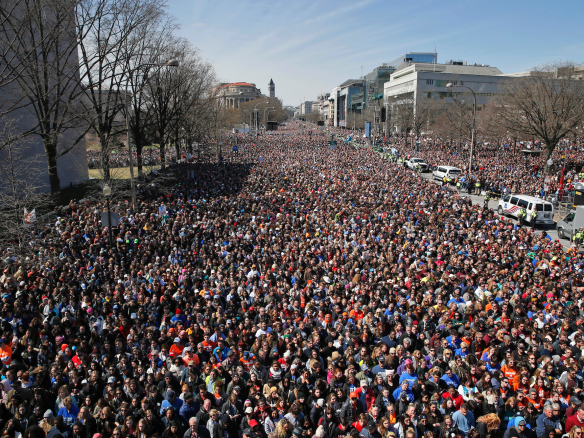
As I’ve gotten older and learned more about our history, it doesn’t feel as good to be an American as it used to. But there are days like yesterday that remind me how good it used to feel and sometimes still does.

21fcb__organizers-estimated-that-roughly-800000-people-turned-up-to-the-main-event-in-dc

Jennifer Rubin of The Washington Post said it much better than I could:

By the hundreds of thousands, they came. They gave impassioned and articulate speeches. The shared their experiences in Chicago, South Los Angeles and Florida. They gave one TV interview after another, displaying remarkable poise and heart-breaking sincerity. Adults decades older watched with awe. These are teenagers. How did these kids learn to do  this? 

The sense of amazement among adults, including jaded members of the media, was palpable — both because supposedly sophisticated adults had not pulled off this kind of change in attitudes about guns in the decades they’d been trying and because the teenagers shredded the talking points, the lies, the cynicism and the indifference that we’ve become accustomed to in our politics.

If this was a movie, you’d think it was inauthentic. However, it may be our image of our fellow Americans and teenagers that has been wildly inaccurate and unfairly negative. Too many of us have bought into the notion that teenagers are passive, addicted to their phones and lacking civic awareness. Too many have been guilted into accepting that “real Americans” are the Trump voters, and that the rest of us are pretenders, pawns of “elites.” The crowd reminded us of the country’s enormous geographic, racial, gender and age diversity. (Plenty of teachers, parents and grandparents turned out.) And in the case of guns, these people are far more representative of the views of the country than the proverbial guy in the Rust Belt diner. 

Social media has its downsides, we have come to learn all too well. But we’ve forgotten amidst the Cambridge Analytica and Facebook scandal and the daily torment of President Trump’s tweets that social media merely amplifies what is there already. It gives the Russians, the haters, the xenophobes a louder voice and the tools to disguise their true identities, but it can also amplify sincere, empathetic voices and knit together a community — an overused but underappreciated phenomenon — without which the students’ organization on a scale of this magnitude would have been impossible. It is all too convenient to blame social media; the actual problem is the small but significant segment of the population behind the nastiness, anger, aggression and refusal to grapple with reality. As is always the case, the solution to bad speech is more speech. If we had forgotten that, the students who have grown up never knowing a world without iPhones surely hadn’t. 

The decision to let only children and teenagers speak was key to the entire endeavor. No canned political speeches; no feigned emotion. The experience of the more than 180,000 students who have been  exposed to gun violence in schools over the past few decades was suddenly very real, very immediate.

Those on the event stage talked about their friends, their certainty in political change, their solidarity with other victims, and their fearlessness in the face of naysayers and cynics. They mocked and condemned the National Rifle Association and the politicians who take their money…. They sounded angry, sad and serious. They spoke about democracy and urged the crowd to vote; they inveighed against party politics….

And so we are left with the stark contrast — the sincerity of the students vs. the canned platitudes of the gun absolutists; the speed and vibrancy of a mass movement vs. the gridlock and sameness of our politics; the dogged determination of teenagers not yet world-weary vs. the sense of futility that pervades our politics. The outcome is not preordained. Yes, democracies are under assault. Xenophobes and nativists certainly have come out from under the rocks. The president has tried to make the abnormal commonplace and the unacceptable  inevitable. But if nothing else, the marchers reminded us we have a choice. We can be fatalistic and passive, or determined and active. If teenagers can take the capital by storm, surely the rest of us can do something more than complain and yell at the TV.

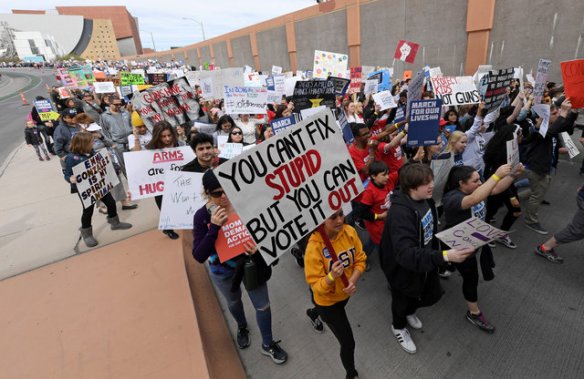
The young lady in the yellow sweatshirt gets the last word:

5ab6d0ae3a2e7828008b48ea-640-416