Whereof One Can Speak đŸ‡ș🇩

Nothing special, one post at a time since 2012

A Plan To Increase Majority Rule

Most bills introduced in Congress never make it out of committee, let alone receive a vote on the House or Senate floor. But even when a member of Congress knows their bill is doomed, they can still have a good reason for introducing it. For one thing, it can identify a problem and let people know how to fix it. 

Earlier this week, Rep. Sean Casten, a Democrat who represents the 6th district of Illinois southwest of Chicago, submitted two bills as part of what he called “A Common Sense Vision for American Democracy”. As part of the same package, he proposed a resolution suggesting an amendment to the Constitution.

He gave a very good speech explaining why he did this. He argued that the principal reason Congress rarely accomplishes anything important, even when it’s something favored by most voters, is that minority rule is built into our system of government. It’s a rather obvious point, but worth repeating: if majority rule was a bigger feature of our government, it would be easier for our government to do things the majority of us want our government to do.

I recommend reading or watching Rep. Casten’s whole speech (although he attributes a point of view to his Republican colleagues that they don’t share). Here’s some of it:

People say: Why is it that people in this institution are failing to do things that are overwhelmingly popular?

When we see those little polls that say Congress has a 20 percent approval rating, that should be a red light that we got to fix things…. If we are going to do that, we have to first acknowledge some unpleasant, if self-evident, truths.

First of all, 
 our Founders actually weren’t perfect. They weren’t Moses. They weren’t Jesus. They were fallible people just like us….

The second thing we got to acknowledge is that our Founders didn’t actually think the Constitution was perfect….

The third thing, and this is the one that I think is most important for us here today, is that our Founders did not understand democracy nearly as well as we do…. They were an amazing group of people. They did an amazing thing, but we have 233 years of wisdom that they did not have….

What’s clear, the answer to that question, ‘‘why is it that we can’t do things that the majority of the American people want?’’ is in large part because while our Founders paid lip service to democracy 
 they didn’t trust that people in a fully democratic society could elect a President, so they created the Electoral College. They created the Senate expressly to frustrate the will of the majority….

When it was founded, the biggest state had 10 times the population of the smallest state. Today, it is up to almost 70. So, we have massively disenfranchised huge numbers of 
 people because of a structure that was designed to disenfranchise large, but not as big, numbers of people.

We kick a bill out of here, you can get 50 votes in the Senate with people representing 17 percent of the United States population.

When our voters ask us why we can’t get things done that are supported by the will of the majority, it is built into our system.

And then finally, our Founders created the Supreme Court with largely no checks and balances — lifetime appointments, no ethics obligations….

Remember, Marbury v. Madison that significantly expanded the power of the Court relative to the legislative branch came after the Constitution was signed. This is a different structure than what they contemplated, and effectively gave the Supreme Court not the ability to write laws but darn close to it, because you get one Supreme Court Justice that flips the majority, and all of a sudden, you can say that our work here, all the good work we put in [in Congress], is unconstitutional and overturned …That is not majoritarian….

In a healthy democracy, we should all be competing for that mythical center of the electorate. We shouldn’t be sitting there and saying: I have a 20-year plan to stack the Court with Justices who will agree with me to overturn the will of the American people.

We shouldn’t be sitting there saying: Well, I can control the Senate if I just find a couple of senate seats in a couple of low-population states with cheap TV markets….

We will be healthier, both of our parties, if we commit ourselves to the idea, as Jefferson said, that if we are not representing the will of the majority, because no form of government ever consistently does, let’s fix it so that we do, which brings me to the three bills we introduced today.

The first bill is a constitutional amendment to add 12 national at-large Senators….Imagine what would happen if 10 percent of the Senate had an interest in representing the will of the American people….It would make it that much harder for them to filibuster a good bill that comes out of here because why would you filibuster something that is supported by the majority of the American people?

It would also, by adding 12 senators, add 12 more electors [to the Electoral College] who represented the popular vote. That would reduce the number of scenarios where we could have the popular vote winner lose an election to the electoral vote winner. That is the first bill.

The second one is to expand this House, and in the next Census, 2030, say let’s go out and look at the smallest State in the Union and say the size of that State is going to set the size of a congressional district, because if we are the House of Representatives, we should make sure that all of us represent as close as we can the same number of people.

The House hasn’t grown since 1911. The population of the United States has grown three and a half times since 1911…. So let’s expand the House and make us more representative. If we did that based on the last Census, that would add something like 130 seats to this House [e.g. California would have 67 representatives instead of 52; Florida would have 37 instead of 28].

Again, that would add more votes to the Electoral College. It would make [presidential elections] more representative.

And then the third bill … is to restore the Supreme Court to their Article III responsibilities….Article III of the Constitution lays out the scope of the Supreme Court. It says that they are responsible for matters of admiralty law, maritime law, matters relating to ambassadors, disputes between the States, and appellate jurisdictions the Congress may see fit to provide from time to time.

If we have a Court that is consistently not fulfilling the will of the American people, if we have a Court that is consistently encroaching on our power here in this Chamber, overturning our judgments and what we do, it is in our power to 
 reduce their appellate jurisdiction…. If the courts are going to say that a law we passed is unconstitutional, we will select from a pool of circuit court judges, appellate court judges, at random, and it will take at least 70 percent of them to overturn a bill…It takes two-thirds for us to overturn a veto, right? Let’s hold them to the same standard….

Also, it would eliminate the shadow docket. Why do we allow ourselves to live in a world where the Supreme Court can just decide to rule on something and not even explain it? Let’s get rid of the shadow docket.

I am not perfect. You aren’t perfect, Mr. Speaker. None of us in this room are perfect. Our Founders weren’t perfect, but we are perfectible, and we have a job that affords us the opportunity and the responsibility to make our government a little bit better, a little bit more responsive, a little bit more democratic.

Unquote.

It may take a long time to do the kind of things Rep. Casten (and others) want to do. It may never happen. But more of us should understand why the president, Congress and the Supreme Court aren’t as representative as they should be. Maybe more of us will vote for politicians who want more majority rule. Maybe one day somebody we vote for will do something about it.

Next time, however, I’ll offer a corrective to Rep. Casten’s speech. He may have been giving his Republican colleagues the benefit of the doubt, but he claimed they believe in something they really don’t.
Is This the Ultimate Fan Mix of “Smile”?

You probably know the story. Riding high in 1966, Brian Wilson and lyricist Van Dyke Parks began work on a new Beach Boys album. It would include the group’s #1 single, “Good Vibrations”, and be called Smile. It was going to be an amazing record (even Leonard Bernstein was impressed). But Brian eventually gave up. Various reasons have been given: opposition from at least one of the Beach Boys; Brian getting cold feet, thinking Smile wouldn’t be sufficiently “commercial”; his drug-fueled paranoia; and his inability to figure out how to put all the pieces together. Even hearing “Strawberry Fields Forever” on the radio in February 1967 (“they got their first”).

Brian finally released his version of Smile in 2004, calling it “Brian Wilson Presents Smile”. The reviews were rapturous (“better 37 years late than never”).

But fans — some of them very talented — have been using the recordings from 1966 and 1967, both official releases and bootlegs, to create their own versions of Smile. Brian left so much music to play with.

Earlier this week, someone who calls himself “Mtt_Brand” on Reddit and “jsp444” on YouTube, whose real name is apparently Jack Stedron, uploaded a version of Smile that he says he worked on for three years. My first reaction was that Smile might have sounded something like this if it all had worked out in 1967.

This recording, Smile: the JSP Mix, uses technology that obviously wasn’t available in the 60s. It might be the ultimate fan mix of Smile. It’s certainly the best I’ve ever heard.

We Still Don’t Know What Happened in October 2016

Two of the last six presidential elections gave us Republican presidents who lost the popular vote. The institution most responsible for those results was our ridiculous, minority-rule Electoral College. But other institutions played important roles. In 2000, it was the Republican majority on the Supreme Court. In 2016, it was the Federal Bureau of Investigation, assisted by the press.

Will Bunch of The Philadelphia Inquirer shows that we still don’t know how America got screwed in October 2020:

It was arguably the most consequential “October Surprise” in the history of American presidential elections. In the waning days of the 2016 race, with polls showing Hillary Clinton clinging to a lead over D____ T____, two last-minute stories broke that rekindled on-the-fence voters’ ethical doubts about Democrat Clinton and quashed a budding scandal around her GOP rival.

Except the “October Surprise” was no surprise to one key player: Rudolph Giuliani, the ex-New York City mayor and T____ insider who later became the 45th president’s attorney. Late that month, Giuliani told Fox News that the trailing Republican nominee had “a surprise or two that you’re going to hear about in the next few days. I mean, I’m talking about some pretty big surprises.”

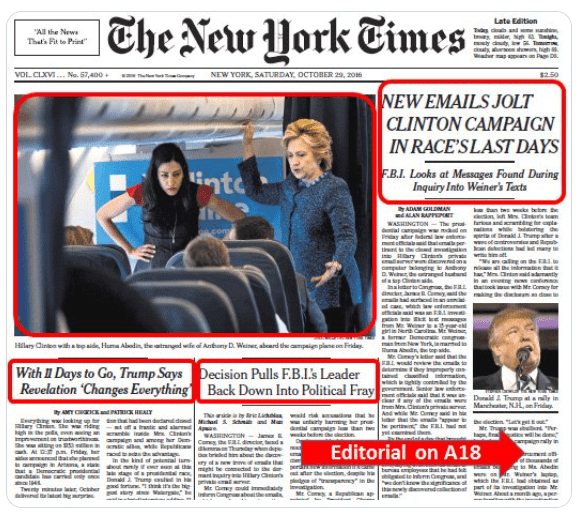
Just two days later, then-FBI director James Comey revealed the bureau had reopened its probe into Clinton’s emails, based on the possible discovery of new communications on a laptop belonging to disgraced New York politico Anthony Weiner. The news jolted the campaign with a particularly strong boost from the New York Times, which devoted two-thirds of its front page to the story — and the notion it was a major blow to Clinton’s prospects.

Untitledff

It was later reported that Comey was motivated to make the unusual announcement about the laptop because he feared leaks from the FBI’s New York field office, which, according to Reuters, had “a faction of investigators based in the office known to be hostile to Hillary Clinton.” Indeed, Giuliani bragged immediately after that he had sources in the FBI, including current agents.

The supposed bombshell — it turned out there was nothing incriminating or particularly new on the laptop — wasn’t the only FBI-related story that boosted T____ in the homestretch of the 2016 campaign. On Oct. 31, citing unnamed “intelligence sources,” the Times reported, “Investigating D____ T____, F.B.I. Sees No Clear Link to Russia.” That article defused a budding scandal about the GOP White House hopeful — at least until after T____’s shock election on Nov. 8, 2016. In the coming days and weeks, the basis of that Times article would melt, but by then the most unlikely POTUS in U.S. history was ensconced in the Oval Office.

There are many reasons for T____s victory, but experts have argued the FBI disclosures were decisive. In 2017, polling guru Nate Silver argued that the Comey probe disclosure cost Clinton as many as 3-4 percentage points and at least 1 percentage point, which would have flipped Pennsylvania, Michigan, and Wisconsin and handed her the Electoral College.

This week’s stunning corruption charges against a top FBI spymaster [whose assignment to the New York office was announced in October 2016] — an agent who by 2018 was known to be working for a Vladimir Putin-tied Russian oligarch — should cause America to rethink everything we think we know about the T____-Russia scandal and how it really happened that T____ won that election.

The government allegations against the former G-man Charles McGonigal (also accused of taking a large foreign payment while still on the FBI payroll) and the outsized American influence of the sanctioned-and-later-indicted Russian billionaire Oleg Deripaska — also tied to U.S. politicians from T____ campaign manager Paul Manafort to Senate GOP leader Mitch McConnell — should make us also look again at what was really up with the FBI in 2016.

How coordinated was the effort in that New York field office to pump up the ultimate nothingburger about Clinton’s emails while pooh-poohing the very real evidence of Russian interference on T____’s behalf, and who were the agents behind it? What was the role, if any, of McGonigal and his international web of intrigue? Was the now-tainted McGonigal a source who told the New York Times that fateful October that Russia was not trying to help Trump win the election — before the U.S. intelligence community determined the exact opposite? If not McGonigal, just who was intentionally misleading America’s most influential news org, and why?

…To be sure, the 2016 FBI leaks weren’t the first time a major news organization has been burned by anonymous law enforcement sources, and regrettably, it probably won’t be the last. Media critics have been talking for years about the Times’ flawed coverage, and how its near certainty that Clinton would win and a desire to show its aggressiveness toward a future president seemed to have skewed its coverage.

It’s not only that America’s so-called paper of record has never apologized for its over-the-top coverage of the Clinton emails or the deeply flawed story about the FBI Trump-Russia probe. It’s that the Times has shown a stunning lack of curiosity about finding out what went wrong….

Last week’s indictment of McGonigal is a classic case of raising more questions than were answered. The evidence presented by prosecutors suggests the FBI counterintelligence expert wasn’t introduced to Deripaska until his waning days with the bureau in 2018, aided by a pair of Russian diplomats. In 2019, after he’d retired, the indictment says McGonigal went to work for the oligarch to help him evade U.S. sanctions and to investigate a rival. But the Times also reported that U.S. counterintelligence — in which McGonigal had been a key player — had tried unsuccessfully to recruit Deripaska as an asset in the years around the 2016 election.

Like the Woody Allen character Zelig, Deripaska — a 55-year-old aluminum magnate who at one time was the richest man in Putin’s Russia — is turning up in the background everywhere in the ongoing corruption of American democracy. The oligarch’s history of multimillion-dollar business dealings with Paul Manafort — T____’s campaign manager in the summer of 2016 — is central to the theory of Russian interference, after it was confirmed that Manafort shared key campaign data with a suspected Russian intelligence agent also connected to Deripaska.

In 2019, Deripaska did manage to get those U.S. sanctions lifted, in a controversial deal backed not only by Team T____ but critically by then-Senate Majority Leader Mitch McConnell. That same year, a Deripaska-linked aluminum company announced it would build a large plant in Kentucky, where McConnell was running for reelection. (It eventually wasn’t built.) This is the same McConnell who, during that critical fall period in 2016, refused to sign a bipartisan statement warning about Russian election interference.

Another coincidence in a scandal that is drowning in so-called coincidences.

It’s becoming clear that the tamping down of the most explosive parts of the Trump-Russia story is the greatest case of gaslighting since the movie [of that name] hit screens in 1944. It’s not just the FBI leaks in New York. We also learned last week — yes, thanks to that same New York Times — about the extraordinary and ethically dubious lengths that T____’s second attorney general, William Barr, and Barr’s handpicked special prosecutor, John Durham, went to to try to prove the FBI was out to sink T____. That’s the exact opposite of what really happened. Indeed, the Times noted the only major criminality turned up in the Durham probe was a potentially explosive new charge of financial impropriety — by D____ T____.

Seven years later, the lack of accountability and justice for the gaslighting of American democracy is appalling. Barr did a remarkable job in blunting the investigation by special counsel Robert Mueller, including squashing his findings about obstruction of justice by the T____ administration. A much-hyped probe by Justice Department inspector general Michael Horowitz into the FBI’s New York office took four long years and failed to find the leakers. And new revelations — including that tip about T____ financial crimes that Italian intelligence passed on to Barr and Durham — continue to surface.

Why does it matter? T____ is no longer president, after all, and America has a lot of other problems, with police brutality and mass shootings currently on the front burner. Yet when it comes to this all-encompassing T____-Russia scandal, the past isn’t even past. The seemingly untouchable 45th president was in New Hampshire and South Carolina this weekend, campaigning to become the 47th. The man that critics call “Moscow Mitch” McConnell could return as majority leader in that same election. And Putin’s obsession with Ukraine — always a focus of his U.S. interference and T____ dealings — has become a war with dire global implications.

More importantly, this never-ending scandal has demolished our trust in so many institutions — an FBI that seems to have corrupted an election, a Justice Department that covered up those deeds, and, yes, a New York Times that enabled several lies instead of exposing them.

What To Do About Right-Wing Rural Voters (and Others)

“Can Anything Be Done To Assuage Rural Rage?” That was the title of Paul Krugman’s NY Times column on Thursday. He described the problem but wasn’t sure how to solve it. On Friday, Brian Beutler made a suggestion in his Big Tent newsletter. First, some of Krugman:

Rural resentment has become a central fact of American politics — in particular, a pillar of support for the rise of right-wing extremism. As the Republican Party has moved ever further into MAGAland, it has lost votes among educated suburban voters; but this has been offset by a drastic rightward shift in rural areas… But is this shift permanent? Can anything be done to assuage rural rage?

The answer will depend on two things: whether it’s possible to improve rural lives and restore rural communities, and whether the voters in these communities will give politicians credit for any improvements that do take place.

Katherine Cramer, the author of The Politics of Resentment … attributes rural resentment to perceptions that rural areas are ignored by policymakers, don’t get their fair share of resources and are disrespected by “city folks”.

As it happens, all three perceptions are largely wrong….

The truth is that ever since the New Deal rural America has received special treatment from policymakers. It’s not just farm subsidies, which [in 2020] accounted for around 40 percent of total farm income. Rural America also benefits from special programs that support housing, utilities and business in general.

In terms of resources, major federal programs disproportionately benefit rural areas, in part because such areas have a disproportionate number of seniors receiving Social Security and Medicare. But even means-tested programs — programs that Republicans often disparage as “welfare” — tilt rural. Notably, at this point rural Americans are more likely than urban Americans to be on Medicaid and receive food stamps.

And because rural America is poorer than urban America, it pays much less per person in federal taxes, so in practice major metropolitan areas hugely subsidize the countryside. These subsidies don’t just support incomes; they support economies: Government and the so-called health care and social assistance sector each employ more people in rural America than agriculture, and what do you think pays for those jobs?

What about rural perceptions of being disrespected? Well, many people have negative views about people with different lifestyles; that’s human nature. There is, however, an unwritten rule in American politics that it’s OK for politicians to seek rural votes by insulting big cities and their residents, but it would be unforgivable for urban politicians to return the favor. “I have to go to New York City soon,” tweeted J.D. Vance during his senatorial campaign. “I have heard it’s disgusting and violent there.” Can you imagine, say, Chuck Schumer saying something similar about rural Ohio, even as a joke?

So the ostensible justifications for rural resentment don’t withstand scrutiny — but that doesn’t mean things are fine. A changing economy has increasingly favored metropolitan areas with large college-educated work forces over small towns. The rural working-age population has been declining, leaving seniors behind. Rural men in their prime working years are much more likely than their metropolitan counterparts to not be working. Rural woes are real.

Ironically, however, the policy agenda of the party most rural voters support would make things even worse, slashing the safety-net programs these voters depend on….

But can they also have a positive agenda for rural renewal? As The Washington Post’s Greg Sargent recently pointed out, the infrastructure spending bills enacted under President Biden, while primarily intended to address climate change, will also create large numbers of blue-collar jobs in rural areas and small cities. They are, in practice, a form of the “place-based industrial policy” some economists have urged to fight America’s growing geographic disparities….

But even if these policies improve rural fortunes, will Democrats get any credit?

Prof. Krugman is skeptical. Brian Beutler is too. But he has a suggestion:

By certain measures, we’re living through a brighter morning in America than the younger half of the population has ever experienced. Not by all measures. [But] unemployment has never been lower. The inflation crisis you heard so much about wasn’t imaginary, but it was more than offset for most workers by higher wages, and in any case, it appears to have ended months ago. A greater percentage of Americans have health insurance than ever before. And the economy is poised for huge investments in domestic manufacturing, infrastructure, and clean energy. 

Plug it all into some of the tidier theories of American politics, and you’d expect us to be living through an era of calm and good feeling, a fallow season for demagogues who fan mass grievances for personal enrichment and political gain.

And yet…. Right-wing madness doesn’t seem to have receded, at least as a temptation for Republican politicians….The reality of our strong economy has not defined perceptions of it, which have tended to resemble doom-laced political reporting and outright propaganda, rather than raw data gathered by government agencies and other researchers. A huge percentage of Americans believes that the country is in the midst of a recession. Inflation remained a major, stated concern for voters long after prices had stabilized….

The prevailing orthodoxy continues to hold that the best way to head off a MAGA takeover runs through the pocketbooks of Republican voters, or by conceding to their cultural grievances….

What if elections were instead about the things that most disgust voters about Republicans? The things that just cost Republicans so dearly in Arizona, Michigan, Pennsylvania and elsewhere? What if the best way to defeat the fascist threat isn’t with a bottom-up approach of deradicalization-through-industrial-policy, but a top-down approach of exposing and revolting against the GOP’s corrupt, medieval politics? Or at least, why not try both?

… In a world where concerted messaging can persuade most people that a good economy is actually bad, and where issue salience is often a function of passing propaganda campaigns and media fixations, it’s … strange to assume that Republican-coded cultural issues are the only ones that might preoccupy voters ahead of an election. Especially after 2022. I think we have enough experience by now to understand what MAGA really is, and how to make Republican politicians regret clothing themselves in it.

Back in 2015 and 2016 the centrist political establishment … were at pains to explain the effect D____ T____ had on his rallygoers—the way they’d thrill to his attacks on Mexicans and Muslims and others—as an artifact of their “economic anxiety.” Journalists needed a way to explain what everyone was seeing without appearing biased against Republicans. Conservatives wanted to paper over the pathologies of the GOP base for brand-management purposes. Progressives wanted to go to bat for the salutary effects of egalitarian economic policy.

I had this gag at the time that admittedly got a bit out of hand, where a T____ supporter, rich or poor, would do something capital-D Deplorable on camera, and I’d say he was simply anxious about wage competition from low-skilled immigrants or whatever. Point is, it was clear even then that the appeal was the fascism itself… Voters don’t dislike Democrats for principally economic reasons. They prefer Republicans because they are swamped with right-wing rhetoric and ideas and lies that they find appealing or presume to be true, and the best way to disrupt that dynamic is to alter the informational stew with new ingredients.

The principal reason to build a more egalitarian polity is that you think it’s important for people to lead fulfilling and secure lives….. If you want people to embrace the promise of liberal democracy, you have to persuade them of its inherent virtues, not fatten their wallets and hope they can be made to believe the extra cash came from liberalism. If you want voters to abandon politicians who are corrupt, dishonest, menacing, you have to convince them that their corruption and dishonesty and menace outweighs anything else about them that might seem appealing. You have to put real effort into making their fundamental faithlessness a liability for them. And we know voters will respond to that effort, because they just did [in the 2022 election].

Something Very Smart About the Stupid Debt Ceiling

Is it mere coincidence that one of the most sensible newspaper columnists working today, Paul Waldman of The Washington Post, almost always expresses opinions I agree with? No, I think not!

Anyway, his column today is so sensible it should be memorized by everybody in Congress and the Biden administration. It deals with the debt ceiling, the idiotic requirement that Congress has to have a new vote whenever the federal government needs to borrow more money to pay for things Congress previously decided to do.

Congress has always acted when called upon to raise the debt limit. Since 1960, Congress has acted 78 separate times to permanently raise, temporarily extend, or revise the definition of the debt limit – 49 times under Republican presidents and 29 times under Democratic presidents [US Treasury].

Congress raised the debt limit three times the last time we had a Republican president (you remember him, the orange one). Now that we have a Democratic president, Republicans are threatening to vote against raising it. That would mean the US government would be unable to make payments it’s legally required to do — for the first time in American history. Nobody knows what would happen then. Almost everybody with a brain thinks it would be a crisis, possibly a disaster, and certainly not something it would be cool to try (unless maybe you think the 2008 financial crisis was worth repeating).

Okay, back to the insightful Paul Waldman:

Even as they try to force a debt ceiling crisis, Republicans insist that they’re the reasonable ones. They just want a fair resolution to this disagreement about whether we should create a needless economic cataclysm by throwing the U.S. government into default. Why won’t the White House negotiate with them?

The White House has flatly rejected the suggestion, saying it simply will not negotiate over whether to default on America’s debts, no ifs, ands or buts. But here’s another idea: If we’re going to have negotiations, let’s make them real. Instead of countering Republicans’ anti-government agenda with a demand to maintain the status quo, Democrats ought to up the ante and insist on their own pro-government agenda.

If you knew nothing about this subject, it might sound like the president is being recalcitrant and Republicans are being sensible. “Let’s sit down together,” says House Speaker Kevin McCarthy (R-Calif.). “Nobody should be taking the position that we should not negotiate,” says Rep. Brian Fitzpatrick (R-Pa.). Even Sen. Joe Manchin III (D-W.Va.) says Democrats “have to negotiate.”

But we’re thinking about “negotiations” all wrong.

The problem begins with the current stance of the two parties. The White House’s position is essentially to maintain the status quo: Congress has appropriated the funds already, and those bills should be paid, which means borrowing the money to cover them. We can argue about how much of the cumulative debt is the responsibility of each party (they’ve both contributed) or how hypocritical Republicans are for pretending to care about debt only when there’s a Democrat in the White House (very). But the administration insists there must be a debt limit increase with no change to current policy.

Republicans, on the other hand, are fantasizing about all the savage cuts they’d like to make to domestic spending, up to and including slashing Social Security and Medicare. So if a negotiation produces a compromise, it would mean more spending cuts than Democrats want but fewer than Republicans seek. Which would still be a victory for the [bad guys].

Instead, Democrats are perfectly free to say the following: With their demand for across-the-board domestic spending reductions, Republicans are in effect proposing cuts to education, health care, economic development, clean energy, infrastructure, enforcement of environmental laws and a great deal more. So here are some of our demands:

  • A significant tax increase on the wealthy
  • An increase in the minimum wage, including indexing it to inflation
  • A national paid family leave program
  • A program to extend the Affordable Care Act’s expansion of Medicaid to the states that have refused to accept it
  • Universal pre-K
  • A permanent expansion of the child tax credit

That could be just the start. Republicans want to negotiate? Then let’s negotiate! Democrats will be willing to take half a loaf on some of these items; for instance, they might be able to accept only a modest tax increase for the wealthy, or an increase of the minimum wage to only $11 an hour rather than $15. That seems reasonable, doesn’t it?

Think about it this way and it’s clear how odd it is that we’re even calling the GOP demand a negotiation. The choices are (1) give Republicans all of what they want, or (2) give Republicans only some of what they want, with the hope that if the outcome is No. 2, then they’ll be kind enough not to shove the U.S. economy off a cliff.

To be clear, the White House is right that there shouldn’t be any negotiations at all. You don’t negotiate with extortionists, and what Republicans are threatening is economic extortion. It shouldn’t be rewarded.

In fact, the White House ought to go further: The president should announce that in the White House’s view, the debt ceiling violates the 14th Amendment, and because it would be unconstitutional for the United States not to make good on its debts, the Treasury Department will ignore it and continue to pay the government’s bills. If Republicans want to file suit and demand that the Supreme Court allow them to destroy the country’s economy, they’re free to try.

But refraining from destroying the economy shouldn’t be considered a favor Republicans do for Democrats, such that the Democrats have to respond by granting Republicans concessions in return. If they want to have a real negotiation in which both sides get some of what they want, then fine.

That’s the only thing that should be treated as an actual negotiation. Otherwise, Biden should simply take care of the problem in the most expeditious way possible.