“Mild” Is Sometimes Damn Bad

Mildness is relative. From The Guardian:

Conventional wisdom suggests that when a sickness is mild, it’s not too much to worry about. But if you’re taking comfort in World Health Organization reports that over 80% of global Covid-19 cases are mild or asymptomatic, think again. As virologists race to understand the biomechanics of Sars-CoV-2, one thing is becoming increasingly clear: even “mild” cases can be more complicated, dangerous and harder to shake than many first thought.

Throughout the pandemic, a notion has persevered that people who have “mild” cases of Covid-19 and do not require an ICU stay or the use of a ventilator are spared from serious health repercussions. Just last week, . . . the US vice-president claimed it’s “a good thing” that nearly half of the new Covid-19 cases surging in 16 states are young Americans, who are at less risk of becoming severely ill than their older counterparts. This kind of rhetoric would lead you to believe that the ordeal of “mildly infected” patients ends within two weeks of becoming ill, at which point they recover and everything goes back to normal.

While that may be the case for some people who get Covid-19, emerging medical research as well as anecdotal evidence from recovery support groups suggest that many survivors of “mild” Covid-19 are not so lucky. They experience lasting side-effects, and doctors are still trying to understand the ramifications.

Some of these side effects can be fatal. Otherwise healthy people who thought they had recovered from coronavirus are reporting persistent and strange symptoms – including strokes.

According to Dr Christopher Kellner, a professor of neurosurgery at Mount Sinai hospital in New York, “mild” cases of Covid-19 in which the patient was not hospitalized for the virus have been linked to blood clotting and severe strokes in people as young as 30. In May, Kellner told Healthline that Mount Sinai had implemented a plan to give anticoagulant drugs to people with Covid-19 to prevent the strokes they were seeing in “younger patients with no or mild symptoms”.

Doctors now know that Covid-19 not only affects the lungs and blood, but kidneys, liver and brain – the last potentially resulting in chronic fatigue and depression, among other symptoms. Although the virus is not yet old enough for long-term effects on those organs to be well understood, they may manifest regardless of whether a patient ever required hospitalization, hindering their recovery process.

Another troubling phenomenon now coming into focus is that of “long-haul” Covid-19 sufferers – people whose experience of the illness has lasted months. For a Dutch report published earlier this month (an excerpt is translated here) researchers surveyed 1,622 Covid-19 patients with an average age of 53, who reported a number of enduring symptoms, including intense fatigue (88%) persistent shortness of breath (75%) and chest pressure (45%). Ninety-one per cent of the patients weren’t hospitalized, suggesting they suffered these side-effects despite their cases of Covid-19 qualifying as “mild”. While 85% of the surveyed patients considered themselves generally healthy before having Covid-19, only 6% still did so one month or more after getting the virus. . . .

“To me, and I think most people, the definition of ‘mild’, passed down from the WHO and other authorities, meant any case that didn’t require hospitalization at all, that anyone who wasn’t hospitalized was just going to have a small cold and could take care of it at home,” [said ] Hannah Davis, the author of a patient-led survey. “From my point of view, this has been a really harmful narrative and absolutely has misinformed the public. . . .

At this stage, when medical professionals and the public alike are learning about Covid-19 as the pandemic unfolds, it’s important to keep in mind how little we truly know about this vastly complicated [and highly contagious] disease . . . .

Unquote.

Broadway actor Nick Cordero, 41, died yesterday after 90 days in the hospital. According to The Guardian, “Cordero entered the emergency room on 30 March and had a succession of health setbacks including mini-strokes, blood clots, sepsis infections, a tracheostomy and a temporary pacemaker implant. He had been on a ventilator and unconscious and had his right leg amputated. A double lung transplant was being explored”.

But remember, he said we’re getting it under control.

“To reduce the incidence or severity of, especially to innocuous levels”

“We have it totally under control,” President Txxxx said in late January. A month later: “The coronavirus is very much under control in the USA”. . . .

The virus is “getting under control,” he said Wednesday.

As reported tonight by The Washington Post, The New York Times and The Los Angeles Times:

The seven-day average for daily new cases in the United States reached a record high — 49,600 — for the 27th straight day.

Thirteen states reported new highs in their seven-day averages. South Carolina, Texas, Arizona, Nevada and California reported record numbers of current Covid-19 hospitalizations.

After Texas reported another single-day record for new cases over the weekend, Austin Mayor Steve Adler said there won’t be enough medical personnel to keep up with the spike in cases if the rate of increase continued unabated in his city. Intensive care units in the city could be overflowing within 10 days. He currently lacks the authority to impose a shelter-in-place order for the city.

Houston Mayor Sylvester Turner said hospitals in his city face staffing shortages as demand for ICU beds is increasing exponentially. Demand for testing has also outstripped the city’s capacity, he said, and the positivity rate has soared from 10 percent a month ago to 25 percent recently.

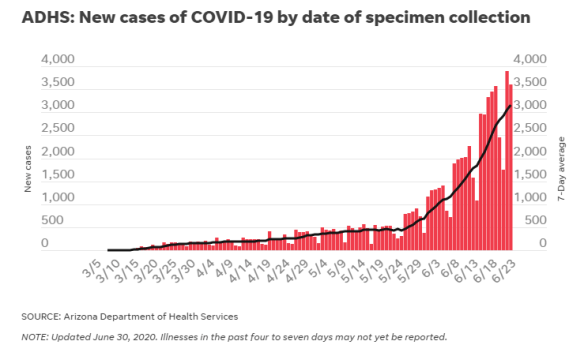
Mayor Kate Gallego of Phoenix said that with cases and death counts soaring in Arizona, testing sites in her city and surrounding Maricopa County are overwhelmed, but the Federal Emergency Management Agency has rebuffed her pleas for help. More than 20 percent of tests in Arizona are coming back positive now, Gallego said. “Public health officials tell me that when you’re doing the appropriate amount of testing, it should be around 2 percent,” she said.

Gallego said federal officials had dismissed her requests to conduct community-based testing in the area after people reported waiting in line for six hours at some testing sites. “We were told they’re moving away from that,” she said, “which feels like they are declaring victory while we’re still in crisis mode”. An aide to the mayor said that FEMA had responded to the city’s most recent request by saying the agency was “getting out of the testing business”.

In Florida, new cases exceeded 10,000 in a day on Sunday for the third time in the past week, after the state posted a record high of 11,400 the previous day. The new infections pushed the state’s total caseload past 200,000, a mark passed by just two other states, New York and California.

Miami Mayor Francis X. Suarez said it was “clear that the growth is exponential at this point. . . It’s extremely worrisome”, noting that positivity rates in Miami-Dade County — the share of tests that come back positive — were also now above 20 percent.

Los Angeles County officials reported more than 3,000 cases for Friday — the highest daily total since the pandemic began. The number of hospital patients with confirmed coronavirus infections jumped 41% in the last three weeks. As of Saturday, there were 1,900 people hospitalized in L.A. County with confirmed cases; 28% of those people were in the ICU and 18% were on ventilators. Officials warned last week about “alarming increases in positivity rates and hospitalizations” and projected the possibility of running out of hospital beds in two to three weeks.

The country’s seven-day average of new deaths did fall, but health experts cautioned that the count of infections would soon drive the number back up.

In addition, the death rate does not capture all of the harm caused by the disease. As many as 15 to 20 percent of known Covid-19 patients may require hospitalization, and of the group admitted, 15 to 20 percent are transferred into intensive care, according to some estimates. Many who have recovered are still struggling to regain their pre-disease lives, and may face long-term health issues.

“The virus is getting under control”, he said.

Nietzsche: Genius of the Heart by Charlie Huenemann

6572902

Charlie Huenemann, a philosophy professor at Utah State, self-published this book in 2009. I don’t know why, because it’s an excellent introduction to Friedrich Nietzsche’s life and thought. Did Prof. Huenemann have trouble finding a publisher? Did he see it as a money-making opportunity? He has a sense of humor (that’s him in the picture when he was younger). Maybe he thought it would be an interesting thing to do.

Huenemann’s thesis is that Nietzsche’s philosophy was an attempt to make his miserable life livable:

I said it two times . . . and now this will make three: Nietzsche’s philosophy was the means by which he reconciled himself to his life. It was an  unfortunate life, beginning in tragedy [two deaths in the family], enduring through sickness and loneliness, ending in insanity [possibly due to a brain tumor, not syphilis], and then being twisted [by his anti-Semitic but apparently well-meaning sister] into abetting humanity’s worst atrocities.

Nietzsche’s task, as he saw it, was  to develop in himself the right attitude, so that no matter how unfortunate this life turned out to be . . . he would be able to surmount it, accept it, and embrace it. All of the magnificent monsters he pressed into his service — the Apollonian and Dionysian forces, his thoroughly skeptical neo-Kantian naturalism, Zarathustra, the eternal return, the will to power, the revaluation of all values — were, in the final analysis, devices, heuristics, visions and touchstones he needed in to order to accomplish this most extraordinary feat. If readers turn to his books in search of arguments for believing in these monsters, or reasons for taking them to be real, they have missed the entire point. The point was not truth. The point was triumph [204-5].

Academic philosophers tend to shy away from analyzing the personal reasons other philosophers have for adopting certain views. The ideas and arguments are what matter. Nietzsche didn’t agree. He believed philosophical positions (and religious beliefs) are explainable by individual psychology — which is partly what Huenemann is doing in this book. Huenemann considers whether Nietzsche would apply that same formula to his own views and decides he wouldn’t.

[Nietzsche] has a lot to say — indeed, many volumes! — about what is good and noble for human beings, and what is sick, weak and despicable. There are indeed facts about these values. His claim is only that the traditional assignment of values — particularly over what is “good or “evil” — is a huge mistake, grounded in a hopelessly inadequate understanding of reality.

This immediately raises a question about Nietzsche’s own consistency with the gospel he preaches. . . . Consider this comic tirade from a later work, Twilight of the Idols: “Finally, let’s consider how naive it is in general to say, ‘Human beings should be such and such!’ Reality shows us a captivating treasury of types . . . and some pathetic bystander of a moralist says to all this, “No! Human beings should be different‘? . . . He even knows how human beings should be, this sanctimonious sniveler”.

Nietzsche grants himself exemption . . . He thinks what what he is doing is significantly different from what other moralists do. . . .Whereas other moralists act as if they have just been handed the tablets of moral commandments from the sky, Nietzsche believes he is digging up his “commandments” from the earth — indeed, from the forces of life itself. His values are not dreamed up or invented, but wrested through bitter experience from genuine confrontations with a hard and unforgiving world [162-3].

Huenemann says “the supreme Nietzschean value is living power. What leads to the flourishing of living power . . . is good; what stifles or diminishes it is bad [167]“. Nietzsche: Genius of the Heart certainly has living power. It’s a lively, informative, sometimes critical account of one of philosophy’s most distinctive thinkers (and not expensive at all).

Witcraft: The Invention of Philosophy in English by Jonathan RĂ©e

This is a big book on a big subject. It’s 600 pages about the history of philosophy, mainly dealing with philosophy as it was practiced in English. But as the author says:

Philosophy in English is as multi-lingual as philosophy in any other language. It has always been fascinated — repelled as well as attracted — by foreign philosophy, and philosophical terms such as idea, logic, nature, politics, virtue, science and spirit, which now pass as linguistic natives, used to be seen as exotic outsiders [8].

The book’s eight chapters roughly concern the philosophical landscape in 50-year increments.There are chapters devoted to 1601, 1651, 1701, 1751 and finally 1951. But RĂ©e never limits himself to those years. They’re merely labels for different eras. So the principal figure in the last chapter is Ludwig Wittgenstein, whose major works were published in 1913 and 1953 (and composed in German).

Witcraft was written for the general reader, although I don’t think it’s superficial. And it’s not the kind of treatment that the poet Stephen Spender complained about:

In the first lesson we were taught that J. S. Mill’s Utilitarianism meant the greatest happiness of the greatest number . . . in the next tutorial we were taught that Mill was wrong . . . The next philosopher was Locke. We were told what he thought and then why he was wrong. Next please. Hume. Hume was wrong also. Then Kant. Kant was wrong, but he was so difficult that no one could be sure of  catching him out [4].

The author hopes that his stories will bring out “the ordinariness of philosophy, as well as its magnificence and its power to change people’s lives”. He sees it as “a carnival rather than a museum: an unruly parade of free spirits, inviting you to join in and make something new” [9].

In that regard, I especially recommend the chapters that revolve around Adam Smith and David Hume (1751), John Stuart Mill and Mary Ann Evans, better known as the novelist George Eliot (1851), the pragmatic philosopher and psychologist William James (1901) and the intense and enigmatic Austrian Ludwig Wittgenstein (1951). They are all thinkers worth knowing about.

By the way, Wikipedia says that Jonathan RĂ©e is “a British freelance historian and philosopher”. Educated at Oxford, he was “previously a Professor of Philosophy at Middlesex University, but gave up a teaching career in order to have more time to think“.

On Not Having a Good Time

A philosophical anecdote from Witcraft, a book by Jonathan Rée:

Kierkegaards’s works were not available in English when Wittgenstein started teaching at Cambridge, but he encouraged his students to read him if they could, especially on questions of ethics. Kierkegaard, according to Wittgenstein, reminded us that we must choose between alternative ways of living, some based on sensual pleasure, others on ethical renunciation, still other on religious rejoicing; but these “categories of life-style”, as Wittgenstein called them, were so different as to be “incommensurable” [they have no common standard of measurement], and if we took our choice seriously we would realize that it must issue from unfathomable anguish rather than dispassionate observation or calm reason. “Mind you I don’t believe what Kierkegaard believed, ” he said, “but of this I am certain, that we are not here in order to have a good time” [607].

Speaking of which, The Guardian reports that “doctors are seeing more and more young patients”:

Until recently, the majority of coronavirus cases that Dr Quinn Snyder, an emergency doctor at one of Arizona’s largest emergency departments, saw were older people. But since mid-May, when the state’s stay-at-home order was lifted, and particularly after the Memorial Day holiday, the demographic has shifted. Snyder says he has seen an “explosion” in cases among 20-44-year-olds.

Some of those, he said, are coming in severely ill – requiring oxygen, intubation and ventilators. “We even had people in that age group die, unfortunately. So it’s very troubling and it’s very difficult to watch young people die from this disease. It’s horrible.”

As cases continue to soar at record levels across the US, which now has over 2.6m cases, there is growing alarm about a surge in younger people getting the virus. On Friday, [the vice president] said half of new cases in the US in recent weeks were adults under 35.

Speaking ahead of the Fourth of July holiday weekend, health experts in hotspot states – which include Arizona, Texas and Florida – warned numbers will continue to rise and that if young people do not take better precautions, hospitals will reach capacity and states could be left with no choice but to completely shut down.

Untitled

ADHS is the Arizona Department of Health Services.