She Made a Mistake, But We Still Need Her

I’ve read Elizabeth Warren’s Medicare For All proposal and think it has some big problems. You can read about it here (there’s a lot to read).

(1) The financing is very complicated. It assumes lots of changes to the tax code. The senator’s 2% Wealth Tax on fortunes over $50 million is a great idea, but raising it to 6% on billionaires, along with the other changes she proposes, makes the whole thing less likely to be enacted and complicates her message.

(2) She says Medicare For All is a long-term goal, but it’s being criticized as if she thinks it could take effect immediately. She has promised to deliver a transition plan, but waiting weeks to explain the transition makes the plan sound too disruptive and even less likely to be enacted.

(3) Although Medicare For All would save the country money overall, nobody is reporting what we would spend without enacting it. It’s simply reported and criticized as the Senator’s very expensive, multi-trillion dollar plan. She needed to emphasize the cost of doing nothing (even though she would have gotten very little cooperation from the press even then).

(4) It isn’t clear how our current Medicare taxes and costs (like deductibles) fit into the plan. Since Medicare costs less than private insurance, it would be reasonable to say Medicare taxes would go up somewhat, but people would save money because they wouldn’t be paying for private insurance? Implying there would be no extra taxes suggests the Senator is again promising too much. Medicare isn’t free now. There is no reason to think it would be free in the future, even with the Senator’s proposals for funding it.

So I think the Senator’s announcement of her Medicare For All plan has been a mistake. Maybe she can get past this by emphasizing that Medicare For All is a goal and would require major changes, and that she supports a public option in the meantime. She has supported a public option in the past. Believe it or not, Joe Biden’s public option plan seems to make sense. (The Bernie Sanders site says you can see the details of his Medicare For All proposal, but when you click on “Details”, there aren’t any.) Somewhere between Biden’s and Sanders’s proposals would be a good place for Senator Warren to be. We need her if we want to replace the Toddler and turn this country around. 

What the House Decided This Week

Sean Casten is a Democrat who represents the 6th Congressional District of Illinois. He went on Twitter this week to explain what the House of Representatives did regarding impeachment:

A brief thread is in order on what we decided to do yesterday, as there seems to be some confusion about what is in [House Resolution] 660:

First, please read the bill. Rather than relying on shoddy journalists or self-interested partisans, go to the original source material: congress.gov/bill/116th-con…

On the substance, let’s first state the obvious: we did not vote to impeach the President yesterday, nor did we vote to initiate an impeachment inquiry, nor did we vote on articles of impeachment. We voted to set the rules for the next (open) phase of the process.

The question we were all asked yesterday was not whether we should move forward, but whether we agree to move forward subject to a specific set of rules.

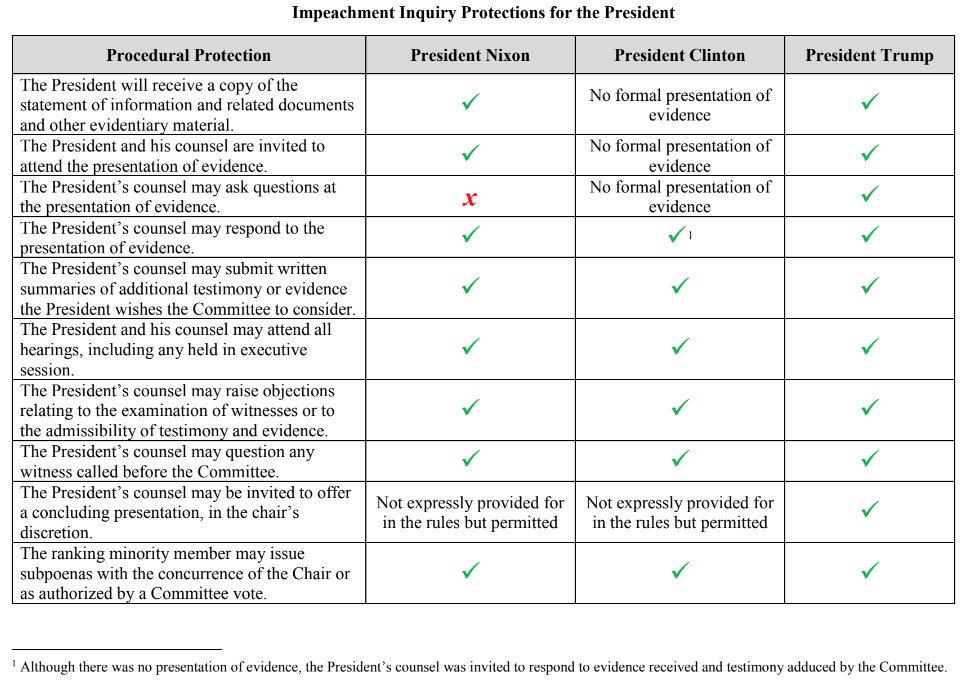
The rules we passed were not only fair, but in some cases more generous to the President than the rules that were passed for the Nixon and Clinton processes.

There is a very important point to be noted in that prior table. The protections afforded by this process are to the President, not his political party. As is appropriate, since he is the subject of our inquiry.

This weird narrative that the minority party deserves greater protection implicitly presumes that the minority party is on trial. No one is making that argument, except perhaps for those who doth protest too much.

So it’s worth asking the question why someone would vote “no” on yesterday’s resolution. There are only three logically possible reasons:

(a) Because you want greater protections to the President in this process than has ever been granted in prior processes

(b) Because you are opposed to majoritarian democracies where the actions of a legislative body require the consent of >50% of the members, or

(c) Because you think the Congress should not inquire as to whether the President should be impeached under any circumstances

That’s the extent of the logical objections. That’s not to say that there can’t be illogical objections of course… so let’s examine some of those.

Some have suggested that the prior phase should have been open. That’s irrelevant to what we do next. History is behind us.

However, the approach taken was fully appropriate given the circumstances.

In the Clinton and Nixon cases, impeachment hearings came AFTER the [Attorney General’s] office had led closed hearings to ensure that witnesses could not coordinate their stories. Barr’s failure to do so, and his efforts to distort the Mueller report forced a different process this time.

Others have suggested that the prior process required a vote of the house. That argument is silly, and unfounded. Every committee in Congress has the right to set their own agenda, subject to the majoritarian opinion of their members.

For example, no one would argue that the Science Committee cannot hold hearings on ocean acidification prior to a full vote of the House.

In the same fashion, it makes no sense to argue that the Intel, Oversight, Judiciary, Ways & Means, Financial Services or Foreign Affairs committees cannot hold hearings subject to their jurisdiction prior to a full vote of the House.

Indeed, if we DID require a full vote of the House to approve the agenda of any committee, the House would never get anything done. Every member of Congress knows that. But some are hoping the public doesn’t. That is irresponsible.

So what happens next? We wrap up closed sessions as soon as we can, and then move into open hearings subject to these rules. We do so with open minds and no pre-determined verdict.

I am sorry – and in many ways, angry – that not a single Republican saw fit to vote in favor of these rules. Their obedience and deference to the Executive branch is an abdication of their responsibilities.

But we – and by we, I mean all of us – cannot allow their obedience to conclude that a partisan vote is bad policy.

With heavy hearts, we move forward. No member of Congress celebrates this moment. But yesterday, I’m glad to at least report that the majority of us voted not to shirk our responsibility.

Unquote. 

I don’t know about the “heavy hearts”. I assume the Congressman means he’d rather not have a president like the Toddler who so clearly deserves to be impeached and removed from office.

I also wonder how many in Congress don’t know how they will vote. There is so much evidence of corruption and abuse of power that having to make up one’s mind now would betray a lack of attention.

There should be several articles of impeachment, not limited to the Ukraine scandal, and each article should include a list of “whereas he did this” and “whereas he did that”. If they can’t come up with 20 pages of “whereas” clauses for each article, they won’t be trying.

Presenting the evidence in detail would make it harder for some of the Toddler’s supporters and some of the nation’s voters to deny the harsh reality of the situation.

A Brief But Powerful Argument For Impeachment

This is from the Twitter account of the historian and journalist Yoni Applebaum:

I want to share one strongly argued case for impeachment, from a leading constitutional scholar, that I stumbled across the other day.

“[The president’s] defenders describe the unthinkable disaster of impeachment. But it should not be unthinkable. The framers of the Constitution did not see impeachment as a doomsday scenario; they thought it necessary to remove bad men from the offices they were subverting.”

“The president’s defenders, experts at changing the subject, prefer to debate whether [he] committed a felony …. [but] ‘high crimes and misdemeanors’ are not limited to actions that are crimes under federal law.”

“It becomes clear that the White House has never before been occupied by such a reckless and narcissistic adventurer. Sociopath is not too strong a word.”

“We are regularly lectured about a constitutional crisis if the House goes forward with hearings and ultimately votes a bill of impeachment for trial in the Senate. Consider the alternative. Perhaps American presidents, by and large, have not been a distinguished lot…”

“….But if we ratify [his] behavior in office, we may expect not just lack lack of distinction in the future but aggressively dishonest, even criminal, conduct. The real calamity will not be that we removed a president from office but that we did not.”

The fire-breathing radical in question? Former U.S. Solicitor General and Supreme Court nominee [and extremely right-wing Republican] Robert Bork, in a glowing review of [neo-fascist] Ann Coulter’s “High Crimes and Misdemeanors,” published in The Wall Street Journal in 1998.

Unquote.

Bork died in 2012, so nobody can ask him if his views on impeachment have “evolved”.

Political Science Says We Should Worry

There is a story in The Washington Post today about more officials in the Toddler’s administration refusing to honor Congressional subpoenas. This isn’t normal behavior. House Democrats could hold these officials in contempt and levy fines. They could even have them arrested, although that’s a power Congress hasn’t used in a long time. So far, the Democrats have asked nicely and sometimes gone to court, but I don’t think a single contested subpoena has been enforced.

Thomas Pepinsky, a professor of government at Cornell, explains why this is a very serious matter:

For decades, Republicans and Democrats fought over the same things: whose values and policies work best for American democracy. But now, those age-old fights are changing. What was once run-of-the-mill partisan competition is being replaced by a disagreement over democracy itself.

This is particularly evident as the president and many of his allies crow about the illegitimacy of the House impeachment inquiry, calling it an attempted coup, and as the White House refuses to comply with multiple congressional subpoenas as part of the probe.

This marks a new phase in American politics. Democrats and Republicans might still disagree about policy, but they are increasingly also at odds over the very foundations of our constitutional order.

Political scientists have a term for what the United States is witnessing right now. It’s called “regime cleavage,” a division within the population marked by conflict about the foundations of the governing system itself—in the American case, our constitutional democracy. In societies facing a regime cleavage, a growing number of citizens and officials believe that norms, institutions and laws may be ignored, subverted or replaced.

And there are serious consequences: An emerging regime cleavage in the United States brought on by [the Toddler] and his defenders could signal that the American public might lose faith in the electoral process altogether or incentivize elected politicians to mount even more direct attacks on the independence of the judiciary and the separation of powers. Regime cleavages emerge only in governing systems in crisis, and our democracy is indeed in crisis.

Just look at the hardening split among the American people on impeachment: The fraction of citizens who oppose the impeachment inquiry is the same as that who approve of the president, signifying that partisan disagreement over policy has turned into a partisan divide over political legitimacy. This cleavage … is clearest in the argument that it would amount to a “coup” to remove the president via conviction in the Senate, and thus that the regular functioning of the legislative branch would be illegitimate. These divisions are over the laws that set out plainly in our Constitution how the president can be subject to sanction.

Regime cleavages are different from other political “cleavages.” Conflict between left and right, for example, over issues such as taxation and redistribution, is healthy. Other cleavages are based on identity, such as racial conflict in South Africa, or religious divides between Hindus and Muslims in India or Protestants and Catholics during the past century in the Netherlands. Identity cleavages can be dangerous, but they are common across the world’s democracies and can be endured, just so long as different groups respect the rule of law and the legitimacy of the electoral process.

Regime cleavages, by contrast, focus the electorate’s attention on the political system as a whole. Instead of seeking office to change the laws to obtain preferred policies, politicians who oppose the democratic order ignore the laws when necessary to achieve their political goals, and their supporters stand by or even endorse those means to their desired ends. Today, when [the Toddler] refuses to comply with the House impeachment inquiry, he makes plain his indifference to the Constitution and to the separation of powers. When Senate Majority Leader Mitch McConnell argues that impeachment overturns an election result, he is doing the same. In the minds of Trump, his allies and, increasingly, his supporters, it’s not just Democrats but American democracy that is the obstacle.

As Harvard political scientists Steven Levitsky and Daniel Ziblatt have argued, democracy can manage political conflict only if citizens and politicians allow the institutions of democracy—elections, representative bodies, the judiciary—to do so. Parties and politicians must not be rewarded for refusing to adhere to laws and institutions. Decades ago, a regime cleavage divided Chileans, with conservatives aligning against the elected government of Salvador Allende and eventually leading to a coup that replaced him with General Augusto Pinochet. The United States has confronted a regime cleavage, too: The last emerged in the 1850s, prior to the Civil War, when many in the slave states began to advocate secession—a clear challenge to the legitimacy of the Union.

Growing fights over executive power can mark an emerging regime cleavage in a democracy like ours….Politics becomes no longer about who delivers the best policy or who best represents voters’ ideals, but rather who can control the executive and how far they can push the limits of the rule of law.

But what distinguishes the current moment … from the normal, albeit worsening, politics of executive-legislative relations in the United States is the politicization of the very notion of executive constraint in the face of an impeachment hearing—this is the source of the regime cleavage.

American politics is not yet fully consumed by this current, emerging regime cleavage. But if it continues without a forceful, bipartisan rebuke, we can expect that politics in the United States will increasingly come to be characterized by the kinds of intractable conflicts … that have characterized presidential democracies in countries like Argentina and, more recently, Taiwan. Our regime cleavage has not yet hardened to the extent that it has in these countries, but if it does, … both sides of the regime cleavage will argue that the other is illegitimate and undemocratic. Voters, understandably, will lose what faith they have left in the value of democracy itself. In the worst-case scenario, presidents and their supporters would be entirely unaccountable to Congress, while their opponents would reject the legitimacy of the presidency altogether.

Even worse: What if [the Toddler] refuses to acknowledge defeat by a Democratic opponent in 2020? What would happen in that case? Might the president’s supporters resort to violence? Might broad segments of the [Republican Party] simply refuse to recognize an elected Democratic executive as well?

Protecting the rule of law, defending the separation of powers and restoring constitutional order to Washington increasingly seem as though they will require the impeachment, conviction and removal from office of the current president. At the very least, Americans of every political persuasion must demand that the administration take part in the impeachment proceedings, even if the Republicans in the Senate ultimately weigh partisanship over evidence in their vote. So long as the executive and legislative branches respect the procedures and powers outlined in the Constitution, we must all respect their legitimacy—regardless of the outcome. If we fail to agree on and abide by our common democratic principles, our emerging regime cleavage will harden, and the future for American democracy will be bleak.

Unquote.
The Story of the Eye by George Bataille, Translated by Joachim Neugroschel

If your local New Jersey library doesn’t have a book, you can usually get it through the state’s Interlibrary Loan Service. It’s usually easy to find several libraries that will loan you their copy of whatever you want. But New Jersey’s statewide system has only one copy of The Story of the Eye. Rider University must have acquired it because it’s a work of academic interest. Other libraries must have avoided getting it because it’s really, really dirty.

The author, George Bataille (1897-1962), was “a French intellectual and literary figure working in literature, philosophy, anthropology, consumerism, sociology and history of art” [Wikipedia]. He wrote “essays, novels and poetry”. He published The Story of the Eye, a novella, in 1928 using a pseudonym. An American publisher issued this translation fifty years later.

Briefly, the story describes the sexual and criminal adventures of two teenagers, an unnamed boy and a girl named Simone. They are joined for a while by another girl, Marcelle, and later by a British nobleman, Lord Edward. Along the way, there is an absurd amount of sex, described in explicit and bizarrely dramatic fashion, mixed in with suicide, murder and lots and lots of bodily fluids, especially urine. There is bullfighting, an interlude in a pigsty and goings on in a cathedral that the Catholic Church would not like at all. Eyes, eggs and eye- or egg-like objects also turn up in various, usually disgusting ways.

In a phrase, The Story of the Eye is an early example of “transgressive fiction”, a literary genre in which the characters violate the norms and expectations of society in various “unusual or illicit” ways. As such, it’s been discussed and celebrated through the years by a number of academics, intellectuals and artists. Someone even used it as the basis for a movie.

I wouldn’t say I exactly enjoyed reading it. It’s a curiosity. I assumed it was supposed to “mean something”, but didn’t know what. So it was a relief to find a brief final chapter that possibly provides a partial explanation. It’s called “Coincidences”. It describes events from the author’s life that may have given rise to his work. His father was disabled and died of syphilis. His mother tried to kill herself. The “author”, or Bataille, refers to “certain images …, the most scandalous, … those on which the conscious floats indefinitely, unable to endure them without an explosion or aberration” [105]. I don’t know if this final chapter actually describes some of the events from Bataille’s life that led to this story. I do know that The Story of the Eye is an explosion and an aberration.