What We Have In Mind (Consciousness Again)

Last week, I suggested that consciousness is a type of brain activity, the kind that consists in having a phenomenal field that includes sights, sounds, pains and the internal monologue depicted by authors as the “stream of consciousness”.

I also recommended that we reserve the phrase “conscious of” for the most important things we’re conscious of, things like our everyday surroundings, our feelings and our thoughts, not consciousness itself. This approach would rule out questions like “Are you conscious of consciousness?” that to me seem misguided and misleading. I don’t think we’re conscious of consciousness, but rather conscious of other things.

To say that we’re conscious “of” other things is to say that the components of consciousness represent other things. Thus, some of the brain activity that is consciousness represents things outside our bodies (e.g. trees falling in the forest). Some of it represents things inside our bodies (e.g. heartburn). And some represents things that exist neither inside nor outside our bodies: abstract things like possibilities (e.g. sanity in Washington), fictional characters (Wonder Woman) and ideas (justice or the number twelve).

From an article about dreaming, which is usually considered a kind of consciousness:

One of the main functions of our brain is to constantly create a model of the world around us, a sort of virtual reality that helps us interact with our environment.

When we’re awake, that model is heavily influenced by what we are seeing and hearing and feeling. But during sleep, when there’s not much input from our senses, the brain’s model of the world is more likely to rely on internal information, like memories or expectations.

I’d add that the model is also a model of the world within us and the abstract world of memory, intention and imagination. But thinking of the model our brains create as “a sort of virtual reality” is what I have in mind (that’s a pun). It’s the “sort” of virtual reality that isn’t virtual, however. Patterns of neural activation in the brain (what the model is made of) are quite real. And it’s a model or representation of other things that are quite real too, like falling trees and sprained ankles.

One of the things that makes our conscious model interesting is that it includes events and processes that are strictly or primarily mental, like having a premonition. I don’t know if such things are representations of unconscious mental events and processes. Maybe they aren’t representations at all; maybe they’re patterns of neural activation that don’t refer to or represent anything else. But the evidence suggests that we all have a lot of unconscious brain activity that plays a very large role in what we think and how we feel.

So it would be consistent with the view I’m trying to explain that when you have something like a premonition, what you’re conscious of is a representation of the underlying brain activity (the unconscious premonition processing), as well as any related events in your body (like chills).

To sum up, the position I’ve arrived at seems to be a strange, possibly ridiculous mixture of ideas associated with two great philosophers who are generally seen as opponents: the idealist George Berkeley and the materialist Thomas Hobbes.

Berkeley (1685-1753) argued that nothing exists independently of minds: “To be is to be perceived (or to perceive)”. A person is an immaterial mind or soul. The physical world (the Earth, for example) doesn’t exist independently of our minds. Fortunately, our individual minds are able to get along because God (a kind of super-mind) synchronizes our perceptions. He makes sure that when I perceive a red apple (in my mind), you do too.

Hobbes (1588-1679) argued that nothing exists except physical stuff. We human beings, including our minds, are material things. Even God may be a kind of material being. When I see a red apple, and you see a red apple, therefore, it’s because there’s an apple out there and it’s red. That’s the whole story. 

Where I’ve ended up is to agree with Berkeley that our consciousness has the various elements in it that he called “perceptions” and “ideas”. But I agree with Hobbes that consciousness is a physical phenomenon, a very cool physical phenomenon, but a physical one just the same. And the reason my perceptions usually line up with yours so nicely is because our perceptions represent the same physical world, albeit observed from our individual perspectives. 
Chicago: City on the Make by Nelson Algren

This is Nelson Algren’s impressionistic essay about his hometown. It was published in 1951 and wasn’t warmly-received by Chicago’s upper crust. Algren looks back fondly on Chicago’s history with an emphasis on the rougher parts of town. An alternate subtitle would have been “I Love This Dirty Town” (a line Burt Lancaster delivered in Sweet Smell of Success about a big city further east).

I read the 60th Anniversary Edition, which includes an afterword Algren wrote in 1961 about Chicago and his book:

In the decade since Chicago: City on the Make appeared, it has gained pertinence. At that time it was a prose poem about my hometown; nothing more.

It was received unfavorably, locally, and I was disappointed when the editor who had solicited it took fright… The book went under the counters…

Under the counters, yet not lost. A translation by Jean-Paul Sartre gained the essay readers abroad…

The essay made the assumption that, in times when the levers of power are held by those who have lost the will to act honestly, it is those who have been excluded from the privileges of our society, and left only its horrors, who forge new levers by which to return honesty to us. The present resolution of a new generation of Negro men and women, now forcing the return of the American promise of dignity for all, sustains the assumption… [105].

The book is filled with references to Chicago characters and events that most outsiders won’t recognize, so the editors kindly added explanatory notes. The notes sometimes explain what doesn’t need explaining and don’t explain what does. That’s one reason I can’t wholeheartedly recommend the book, but if you like prose like this, you might give it a try:

Giants lived here once. It was the kind of town, thirty years gone, that made big men out of little ones. It was geared for great deeds then, as it is geared for small deeds now.

In Vachel Lindsay’s day, in Carl Sandburg’s day, in the silver-colored yesterday, in Darrow’s and Masters’ and Edna Millay’s day, writers and working stiffs alike told policemen where to go, the White Sox won the pennant with a team batting average of .228 and the town was full of light.

Now it’s the place where we do as we’re told, praise poison, bless the F.B.I., yearn wistfully for just one small chance… No giants live on Rush Street any more [52-53]. 

Something Encouraging For a Change

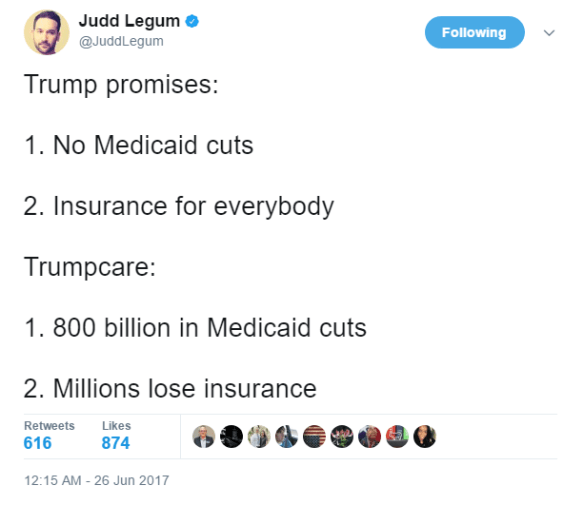
In today’s news, Senator Turtle Face (formally known as Addison Mitchell McConnell, Jr., Republican of Kentucky) delayed the vote on the “Less Money for Health Insurance Equals More Money for Rich People” bill. Presumably, he didn’t have enough Yes votes to pass legislation that nobody (except him and a few rich people?) likes.

This will either give the Republicans a few days to find the necessary Yes votes, or it will give opponents of the bill (of which there are many) the chance to create more No votes. Since the Senate Majority Leader had planned a quick vote on a bill he tried to keep as secret as possible, the postponement appears on balance to be a welcome development.

Proving again that he is indeed the Master Negotiator, the President put on a show at the White House today with Republican Senators, at which he announced:

This will be great if we get it done. And if we don’t get it done, it’s just going to be something that we’re not going to like, and that’s OK, and I understand that very well.

As far as we know, the President has not yet demonstrated in a single case whatsoever that he has any understanding at all of the the American healthcare system, the Affordable Care Act, or the Republican effort to repeal or replace it. Clearly, he is a Big Picture guy.

Consistent with the possibility that this is not Hell, some observers think the Republicans’ struggles are a sign of better things to come. Paul Waldman of The Washington Post writes:

The Republican health-care bill is not dead yet, but it’s in rough shape. Whether it passes or not, it has been an utter debacle for the GOP, making the Affordable Care Act they’re trying to undo more popular than ever, energizing the Democratic base, complicating the relationship between President [DT] and Congress and sowing justified distrust of Republican motives among the broader public.

It has also done something else: moved the debate on health care in America to the left and made single payer much more likely.

Even if the Senate bill fails, Republicans give up and move on to tax reform, and the status quo remains in place, this debate will have had profound effects on our politics. While the Democratic Party may have been moving to the left on health care anyway, its momentum in that direction may now be unstoppable. And the entire country will be more receptive than ever to the arguments Democrats will make. This, by the way, will also be the case if the GOP repeal effort succeeds, because it will make so much that people hate about our health-care system a lot worse.

Let me point to one politician as an illustration. For years, Sen. Elizabeth Warren’s position on single payer has essentially been “Maybe someday” — not opposed to it, but focused in the short term on the more urgent priority of defending and enhancing the ACA. But in an article in today’s Wall Street Journal, we learn that she is now ready to take that plunge:

“President Obama tried to move us forward with health-care coverage by using a conservative model that came from one of the conservative think tanks that had been advanced by a Republican governor in Massachusetts,” she said during an interview in her Senate office last week. “Now it’s time for the next step. And the next step is single payer.”

Warren is not going to be the last Democrat to take this step. In fact, any Democrat who runs for president in 2020 — and there will be a lot of them — will have a hard time explaining to the primary electorate why they don’t want single payer, and most or all of them will probably say they do.

We can make an analogy with what happened in the GOP after the failure of comprehensive immigration reform [in 2013]…. The situations aren’t exactly the same, but … a dramatic political failure — whether it’s yours or the other party’s — can have profound effects on the choices politicians make about how to approach the electorate. And it’s important to understand that while there are some Democratic politicians who emphatically favor single payer and would be unsatisfied with anything less, most of them would be willing to advocate for a range of policy options, depending on what looks politically achievable and what their base demands at a particular moment.

All the ups and downs of the past eight years, from the beginning of the debate on the ACA to the end of the debate on Republican repeal plans, hold many lessons for Democrats who are still eager to address the problems in the American health-care system. Among other things, we know that voters are risk-averse, that they’re extremely sensitive to out-of-pocket costs, that they want security and that arguments about the glories of the free market aren’t going to be persuasive to them. After seeing how desperately unpopular this Republican plan is, Democrats are going to be much less afraid to defend government health care and advocate its expansion.

And they know that whatever they propose next has to be simple and understandable. We can debate whether the ACA had to be as complex as it was, but next time around, no Democrat is going to believe that you can take on President Trump with a technocratic approach to health care. Saying “Here are the 10 tweaks I’d make to the ACA” isn’t going to cut it.

That isn’t to say that whatever plans they propose won’t be fully fleshed out under the hood, but they’ll have to be presented in a way that is easy for voters to understand. And, yes, Republicans will cry about “Washington bureaucrats making decisions for you,” but Democrats are less likely to be intimidated. Ask your parents or grandparents on Medicare how they feel about their coverage — Medicare is the most popular health insurance program we have, and it’s run by Washington bureaucrats.

It’s important to keep in mind that “single payer” isn’t one thing — if you look around the world at highly developed countries, there is a spectrum of health systems with various levels of public and private involvement. But what they have in common is that they achieve universal coverage while working better and costing less than ours. We could well have 15 Democratic presidential candidates proposing 15 different kinds of single payer. Some may be highly socialized systems — what Bernie Sanders would likely advocate if he runs again — but the ones that are most appealing could be hybrid systems of the kind that have been successful in countries such as France. The way it works is that there’s a government plan that covers everyone’s basic needs, but you can also buy supplemental private insurance to get as many more benefits as you want.

Among the advantages of a hybrid system is that one can actually see a path from where we are now to there. That path runs through Medicaid, which now covers nearly 75 million Americans. What if we auto-enrolled everyone under 65 in Medicaid — it’s there if you need it, but if you have different insurance you’d prefer, go ahead and use that instead. No one would be without coverage. Private insurance would evolve into something you buy to fill in the gaps and get perks that Medicaid wouldn’t provide. Instead of covering all your health care, employers could provide the supplemental private insurance.

As a political matter, you could sell this as something that we could transition to over an extended period, and as a system that satisfies the goals of both liberals and conservatives. Liberals get the universal coverage and security they want, and conservatives get the freedom they want — if you’re rich enough to buy a supplemental plan that includes deliveries of Dom Perignon during any hospitalization, go right ahead.

That isn’t to say that Republicans wouldn’t resist and there won’t be more intense arguments about health care, because they would and there will be. But by handling this debate so terribly and proposing something so monstrous, Republicans have opened up the space for Democrats to go much further than they’ve been willing to before. It’s not impossible to foresee Democrats winning the House in 2018, then taking the presidency and the Senate in 2020 — and then taking the first steps toward making single-payer health care in America a reality. 

End quote.

What a Concerned Person Might Do

It’s Monday afternoon and the resistance is heating up. There’s going to be a big demonstration in Washington on Wednesday. A human chain around the Capitol Building has been mentioned.

Meanwhile:

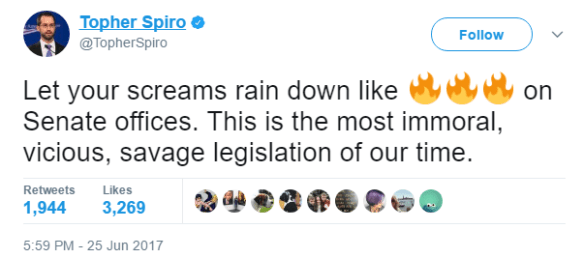
legumspiro

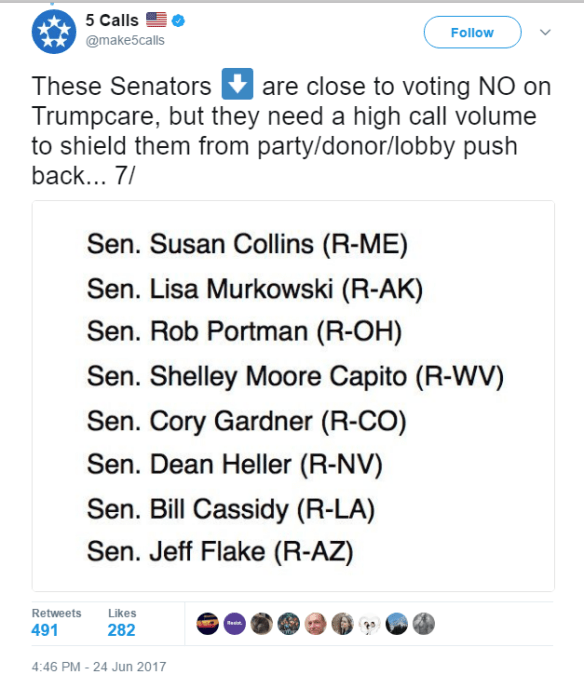
calls

Senators love hearing from people who live in their states. They also love hearing from nice people who claim to live in their states. Such people could try calling Senators through the main Senate switchboard at (202) 224-2131. But it’s often easier to get through to a Senator’s local office, in states like, for instance, Maine, Arkansas and Ohio (see list above).

Emails don’t have as much impact, but Senators also love getting them, especially from people who live in their states (or claim to). You can tell because their contact pages usually refer to the Senators by their first names. So it’s “Contact Jeff” or “Contact Susan”.

If a person wanted to send a nice but not quite accurate email to a Senator, despite not living in the Senator’s state, a person could:

Find a city in that state.

Bring up the map for that city.

Look for a part of town where affluent people probably live (usually somewhere on the outskirts where the streets are curvy or there are lakes or a country club nearby).

Identify a pleasant street name.

Use Zillow to find a nice house on that street. (Zillow will provide the Zip Code too!)

Look for a local business, school or church and save the phone number.

Find the Senator’s contact page. (They all look like Jeff’s.)

Then a person could enter some personal data, specifying a name of their choice, an address on that nice street with a street number of their choice, the Zip Code that Zillow provided, and maybe a phone number with the relevant area code and prefix.

Unfortunately, a person would also have to enter an email address, possibly twice, so it’s good if a person has  an innocuous email address that can be used to receive garbage emails. (I have one; maybe a person should have one too.)

After that, all a person would have to do is maybe select a topic (something like “Health”), possibly type in a subject (like “Senate Health Care Bill”) and then enter a polite plea to vote No on an upcoming piece of abominable legislation that relates to health insurance.

Perhaps something like this, but using a person’s own words: 

Dear Sen. XXX: Please vote No on the Senate Health Care Bill. You know in your heart that it’s a bad bill. It will harm the people of <XXX’s state>. Reporters say that moderate Republicans always give in to the GOP leadership at the last moment. Don’t let that happen, no matter what they promise. We are counting on you. Sincerely yours, <the name that a person chose to use>

I’m not recommending this, of course, because, as President Nixon famously pointed out, “it would be wrong”. But given the stakes (many people will unnecessarily suffer and die if this legislation passes), a concerned person might do it anyway.


In Case You’re One of Those Citizens Who Want to Keep Track

Amy Siskind, a former Wall Street executive, is documenting the odd and troubling things happening in Washington. She publishes a summary every week. Margaret Sullivan of The Washington Post wrote about her efforts:

[In November] Siskind began keeping what she calls the Weekly List, tracking all the ways in which she saw America’s taken-for-granted governmental norms changing in the [DT] era.

The project started small, read by friends and with only a few items a week.

By Week 9, though, the list had gone viral.

“It blew up — I had 2 million views that week,” she said. “People were responding like crazy, saying things like, ‘I’m praying for you.’ ”

As time went on, the list grew much longer and more sophisticated. Here are three of her 85 items from mid-June:

●“Monday, in a bizarre display in front of cameras, Trump’s cabinet members took turns praising him.”

●“AP reported that a company that partners with both Trump and (son-in-law) Jared Kushner is a finalist for a $1.7bn contract to build the new FBI building.

●Vice President Pence hired a big-name “lawyer with Watergate experience to represent him in the Russian probe.”

Now, in Week 32, every item has a source link, and rather than just a few items, there are dozens. (Her weekly audience usually hits hundreds of thousands, she said, on platforms including Medium, Facebook and Twitter.)

The idea, she said, came from her post-election reading about how authoritarian governments take hold — often with incremental changes that seem shocking at first but quickly become normalized. Each post begins with: “Experts in authoritarianism advise to keep a list of things subtly changing around you, so you’ll remember”…

“It’s scary to look back on the early weeks and see what we’ve already gotten used to,” she said. Examples: a secretary of state who rarely speaks publicly, the failure to fill important positions in many agencies, a president who often eschews intelligence briefings in favor of “Fox & Friends.”

“We forget all the things we should be outraged about,” Siskind said.

Jay Rosen, a New York University journalism professor and author of the PressThink blog, called Siskind’s efforts “a service that is thoroughly journalistic and much needed.”

The lists “help people experience the history that is being made and keeps them alive and alert to the dangers of eroding norms,” Rosen said.

In their user-friendly format, he said, they are “one way of dealing with an overload of significant news, a surplus of eventfulness that allows things to hide in plain sight simply because there are too many of them to care about”…

She posts the list on Saturday on Facebook and Twitter, and Sunday on Medium after working on it for 15 or 20 hours a week.

In a similar vein, The New York Times published a piece this weekend called “Trump’s Lies”:

Many Americans have become accustomed to President Trump’s lies. But as regular as they have become, the country should not allow itself to become numb to them. So we have catalogued nearly every outright lie he has told publicly since taking the oath of office….

There is simply no precedent for an American president to spend so much time telling untruths. Every president has shaded the truth or told occasional whoppers. No other president — of either party — has behaved as Trump is behaving….

We have set a conservative standard here, leaving out many dubious statements … [but] we believe his long pattern of using untruths to serve his purposes, as a businessman and politician, means that his statements are not simply careless errors.

We are using the word “lie” deliberately. Not every falsehood is deliberate on Trump’s part. But it would be the height of naïveté to imagine he is merely making honest mistakes. He is lying.

The list begins on January 21st (“I didn’t want to go into Iraq”) and ends on June 21st (“We’re one of the highest taxed nations in the world”). You won’t be surprised to see it’s a long list. If they provide the number of lies, I missed it.

The Times is actually late to this effort. Just as he did during the campaign, Daniel Dale of The Toronto Star is keeping a running list of false things DT says. The list was last updated on June 22nd. It was a big day because DT had a campaign rally in Iowa the night before (isn’t it strange that the President is holding campaign rallies when the next Presidential election is more than three years away? I bet Amy Siskind has mentioned this.)

The Star‘s list has 330 unique entries so far. There’s also a handy search mechanism that allows you to sort his false statements by topic. 

Dale also covered DT’s rally on Wednesday night (“It was just like old times”):

[DT] insulted Hillary Clinton. He insulted Chicago. He attributed a sensational claim to an unnamed buddy of his.

He floated a confusing proposal, promising to change welfare law to something that sounds identical to current welfare law. He executed a dizzying shift in rhetoric, applauding himself for appointing a former Goldman Sachs executive after railing against Goldman Sachs. And he revealed an unbaked plan — to turn his hypothetical giant wall on the Mexican border into a power-generating “solar wall” that would reduce the hypothetical reimbursement bill he still insists he will be sending to Mexico.

More than anything, though, he made things up.

By the way, members of DT’s adminstration and a few Republican politicians are trying to defend the Senate’s healthcare bill. They’re using the only available method: lying about it.