It’s Been With Us For Years, But Gotten Worse

The historian Richard Hofstadter (1916-1970) is known outside academic circles for having written a particular book and a particular essay. The book was Anti-intellectualism in American Life from 1963. The essay was “The Paranoid Style in American Politics” from 1964. I read the essay a few days ago in a collection of Hofstadter’s work. Anyone who wants to understand how we got to this point in American history will benefit from reading Richard Hofstadter.

He explains, for example, the basis for “economic individualism”, the idea that it’s not only more efficient but more ethical that everyone should sink or swim on their own. Thus, poor or working-class conservatives are often against anyone receiving help from the government, even though they could use that help themselves:

On many occasions they approach economic issues as matters of faith and morals rather than matters of fact. For example, people often oppose certain economic policies not because they have been or would be economically hurt by such policies, or even because they have carefully calculated views about their economical efficacy, but because they disapprove on moral grounds of the assumptions on which they think the policies rest….Deficit spending might work to their advantage; but the moral  and psychological effect, which is what they can really understand and feel, is quite otherwise: when society adopts a policy of deficit spending, thrifty [conservatives] feel that their way of life has been officially and insultingly repudiated [“Pseudo-Conservatism Revisited – 1965”].

Hofstadter borrowed the term “pseudo-conservative” from the German thinker Theodore Adorno. He explained why in an earlier essay written in response to McCarthyism:

There is a dynamic of dissent in America today…The new dissent is based upon a relentless demand for conformity… Its exponents, although they believe themselves to be conservatives and usually employ the rhetoric of conservatism, show signs of a serious and restless dissatisfaction with American life, traditions and institutions. They have little in common with the temperate and compromising spirit of true conservatism in the classical sense of the word…Their political reactions express rather a profound … hatred of our society and its ways – a hatred which one would hesitate to impute to them if one did not have suggestive evidence from clinical techniques and from their own modes of expression [From “The Pseudo-Conservative Revolt”, 1954].

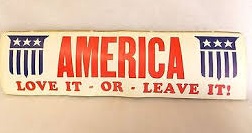
Remind you of anyone you know? I mean, who in public life expresses more contempt for America in the 21st century than the next President and his fans, the vocal minority that wants to make this country “great” (i.e. “white”) again? Maybe the Democrats should have revived those popular bumper stickers from the 1960s, the ones aimed at Volkswagen-driving hippies and protesters.  
download-4

Finally, here’s what Hofstadter said about the Republicans’ first pseudo-conservative Presidential nominee, Senator Barry Goldwater:

Unquestionably, Goldwater’s ideas do retain some shreds and scraps of genuine conservatism, but the main course of his career puts him closer to the right-wing ideologues who were essential to his success, who shaped his tactics, who responded to his line of argument… How are we to explain the character of a “conservative” whose whole political life has been spent urging a sharp break with the past, whose great moment as a party leader was marked by a repudiation of our traditional political ways, whose followers were so notable for their destructive and divisive energies, and whose public reputation was marked not with standpattism or excessive caution but with wayward impulse and recklessness? [“Goldwater and Pseudo-Conservative Politics”, 1964].

Again, remind you of anyone you know?

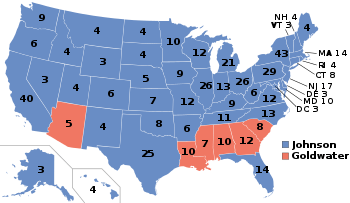
Fortunately, Lyndon Johnson beat Goldwater by 26 million votes (rather than 3 million) and by 61% to 27% (rather than 48% to 46%). Goldwater only won six states in the 1964 election: the five former slave states of the Deep South and his home state of Arizona. That gave him 52 electoral votes compared to Johnson’s 486. 
electoralcollege1964-svg

In addition to being a pseudo-conservative, Goldwater had no particular qualifications to be President. Before being elected to the Senate, he managed the family department store. In the Senate, he played no significant role. In Hofstadter’s words, “his main business there was simply to vote No”. He was still an “outsider” even after 12 years in Washington.

Goldwater’s extreme positions and lackluster qualifications contributed to his historic defeat. Fifty-two years later, due to a variety of circumstances, another pseudo-conservative, this time with no government experience at all, won narrow victories in enough states to win the White House. Given their appeal to the same sorts of voters, and given the fact that our next President is obviously suffering from a personality disorder (whereas Goldwater was relatively normal in that regard), it’s fair to say our democracy is showing signs of wear and tear that are beyond serious.

Addendum:

The journalist James Fallows recently reported the following conversation with a U.S. Senator:

Q:  How many of your colleagues know that there is something wrong with T***p?
A:  All of them, obviously.
Q:  Which Republican will be the first to say so?
A:  Ummmm….
Keith Olberman Has a Message for the President-Elect’s Supporters

Mr. Olberman promises not to yell, and he doesn’t.

How Shall We Describe the Orange Menace?

Language helps us cope with the world. That’s why using the right words matters. Telling your companion there’s “something” behind her would be accurate, but telling her it’s a “bear” would be better, assuming it really was a bear.

This explains the continuing effort to find the right terminology for President-elect Orange Menace. He’s been called “insane” and a “demagogue”, a “con man” and a “thug”.  He’s been described as an “arrogant orange idiot”.

In fact, those last three words, “arrogant”, “orange” and “idiot” are the three most popular responses at Trump In One Word. That’s the helpful site where you can submit a pungent word of your choice to describe him, see which words have been chosen most often, and even find out what words your (anonymous) neighbors selected (good job, neighbors!).

Which brings me to the “fascist” issue. Some observers think the next President is clearly a fascist or at least exhibits strong fascistic tendencies. Others see similarities but don’t think he satisfies enough of the criteria (yet anyway) to put him in the same category as Mussolini, Hitler or Francisco Franco. All the experts agree he’s an authoritarian, right-wing demagogue, but they don’t all agree that he’s a “fascist”. The truth is they don’t even agree on how to define the term. Hence, the “fascist” problem.

[Before we proceed, please note that I recently began using the Google Chrome extension Rename T___p. That’s why you will see “*****” where the O.M.’s name appears in the text I’ll be quoting. It’s a very nice tool. I chose “*****” for everyday use, but it was gratifying to see that “Orange Menace” is the 13th most popular T___p replacement – not as popular as “Fuckface Von Clownstick”, of course – but still doing very well. The extension is free and available here.]

One scholar, Sarah Kendzior, has argued that we should compare the O.M. to the rulers of a few countries we don’t usually hear about:

Left out – as always – have been the dictatorships of former Soviet Central Asia: Uzbekistan, Turkmenistan, Tajikistan, Kazakhstan, and (to a lesser degree) Kyrgyzstan.

The Central Asian states are dictatorships. They are also spectacular. And it is by examining this–dictatorship as spectacle–that the parallels to ***** emerge… The nation becomes a brand; the dictator, a brand ambassador; the people, a captive audience….

…Spectacle soothes the masses while distracting them from their suffering. *****, a master of the American reality TV genre which has made a spectacle of human suffering – he made “You’re fired!” a beloved tagline … – knows how to make an audience feel included through the theatrical exclusion of others. This tactic carries over into *****’s rallies, where protesters are booted — and sometimes beaten — with fanfare. It also carries over into his policies, which are structured around exclusion: a wall against Mexico, banned entry for foreign Muslims, a database for U.S. Muslims, and a media denied access unless they acquiesce to *****’s demands…

The most obvious corollary to ***** is Turkmenistan’s deceased leader Niyazov … best known for the monuments and dictates bolstering his personality cult. They included building a giant golden statue of himself which rotated to face the sun; renaming the months and common words, like “bread”, after his relatives; and the Ruhnama, a collection of autobiographical anecdotes … and parables which all citizens were required to read. (A giant electronic version of the Ruhnama blared Niyazov’s wisdom from its perch in the capital.)….

“I’m personally against seeing my pictures and statues in the streets, but it’s what the people want,” explained Niyazov when asked about his ubiquitous visage. It is easy to imagine ***** making similar claims… It is also easy to imagine [him] building a giant golden statue of himself that revolves to face the sun.

Unfortunately, there’s no word that means “the leader of a dictatorship in former Soviet Central Asia”. And the phrase “***** is another Niyzaov” probably wouldn’t catch on.

In a similar vein, however, a few writers have suggested that “caudillo” would be a good label for the Orange Menace. It’s Spanish for “leader”. Thus, Franco proclaimed himself “El Caudillo” just like Mussolini was “Il Duce” and Hitler “Der Führer”. One might object that ***** isn’t as fascistic as those other villains, but the word has a longer and more varied history than its use in the glorification of Francisco Franco.

Paul Campos at the Lawyers, Guns & Money blog explains:

The classic Caudillo is a charismatic populist, who attacks the existing political and economic establishment with what might be called trans-ideological enthusiasm.  He claims that he and he alone has the ability to solve the nation’s problems, and to be the voice of the dispossessed.  He bullies his opponents, he persecutes any media who do not grovel before him, he boasts of his supposed sexual prowess, he has a narcissistic and therefore unquenchable thirst for public adulation, he is openly contemptuous of formal legal restraints, and he talks constantly of restoring the nation to its former grandeur.  To bolster his political base he uses the latest social media to speak as directly as possible to his followers, cutting out traditional forms of governmental and journalistic intermediation.  And he loves to make lots of absurd and expensive promises, often in the form of spectacularly ridiculous government projects, many of which are designed to keep out or expel contaminating and subversive foreign influences.

Remind you of anyone?

Mr. Campos then asks why this bizarre and dangerous person has made such an alarming dent in our politics:

I suspect the answer has much to do with the extent that the United States economy is coming to resemble many a Latin American breeding ground for narcissistic despots.  In terms of relative levels of economic inequality, the U.S. now looks much more like Latin America than Europe, and the trend is only getting stronger.  As Omar Encarnacion notes:

“… *****, like many caudillos, has capitalized upon his status as a political outsider. This status, ***** argues, best allows him to blow up the current political system and to replace it with something that would work for everyone, but especially for those feeling left behind.”

… All of which is to say that, especially now, it would benefit us all to pay much more attention to both the history and the present circumstances of our various southern neighbors.

Words matter, because they help us make our way in the world. Beginning January 20, the words we use may be more important than any we living Americans have ever used before.

Do You Think Americans Are Getting What They Deserve?

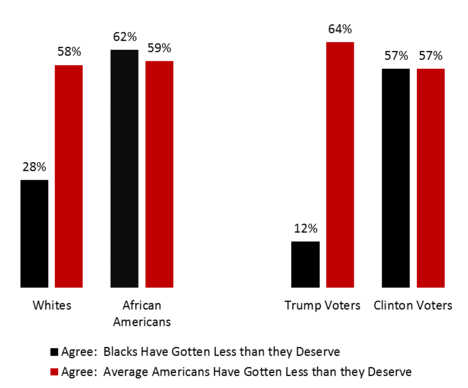
The chart below is the result of a poll of 1,000 Americans who mirror the population of the country as a whole. The question they were asked was:

Do you agree or disagree with the following statements?

  1. Over the past few years, blacks have gotten less than they deserve.
  2. Over the past few years, average Americans have gotten less than they deserve.

The results:

Most blacks and Clinton voters are in very close agreement: neither group has gotten what they deserve.

By the same percentage, whites think that average (i.e. mostly white) Americans haven’t gotten what they deserve. Blacks, however, have done well. 

Trump voters also agree that average Americans haven’t gotten what they deserve. They’re very sure, however, that blacks have been living on easy street.

2016-12-19-1482185503-3679361-trump_deserve-thumb

The political scientist who reported the results concludes:

It appears, then, that Trump voters weren’t simply motivated by their widespread belief that average Americans are being left behind. Rather, their strong suspicion that African Americans are getting too much—a belief held by the overwhelming majority of Trump voters—was a much stronger predictor of their vote choices in last month’s election.

Racially resentful beliefs that African Americans are getting more than they deserve were so strongly linked to support for Trump, in fact, that their impact on both the 2016 Republican Primary and the general election were larger than they had ever been before.

Another conclusion we should draw is that America’s race problem and America’s politics won’t improve much until there are fewer of us white people around.