Who Says Republicans Don’t Have a Sense of Humor?

Example 1:

“House Republicans have found a subject for their opening review of conflicts of interest under Donald Trump: the federal official in charge of investigating conflicts of interest.”

Yes, the Republican chairman of the House Oversight Committee, Jason Chaffetz of Utah, is mad at the head of the Office of Government Ethics for pointing out (as both Democratic and Republican ethics lawyers agree) that the President-elect’s “plan” to avoid his many, many conflicts of interest is “meaningless”. There are hysterical details here. 

Last night, I found the ethics official’s explanation of his negativity at the Office of Government Ethics site. It was a four-page PDF file, but the lawyer who wrote it isn’t nearly as funny as Rep. Chaffetz. Unfortunately, the link isn’t working at the moment (because of heavy traffic or those madcap Russians). But maybe it will work for you.

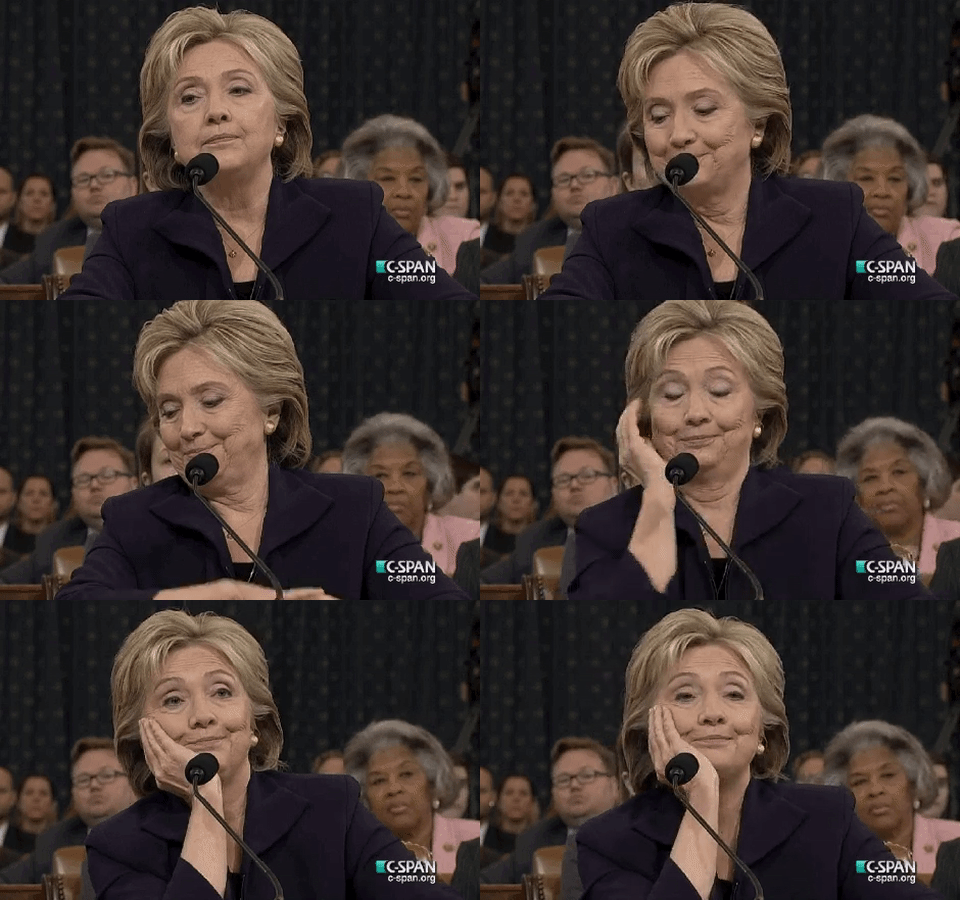
In a related, even more priceless development, Rep. Chaffetz announced a few days ago that he plans to keep investigating Hillary Clinton’s emails! This lovable scamp Chaffetz is relentless!

Yet:

When asked about T__p’s potential business conflicts, [chairman Chaffetz] noted that the law‎ exempts the president of the United States, calling the push from Democrats to launch a committee investigation on T__p’s business ties “premature at best.” [CNN]

I suppose “premature at best” implies “totally ridiculous at worst”!

best-dad-jokes

giphy

tumblr_me7cg67ys31raj8mk


All right, now that I’ve recovered my composure…

Example 2:

It might seem like yesterday, but it was almost seven years ago that America’s first step toward universal healthcare became law. It was officially called the Patient Protection and Affordable Care Act, but rapidly became known as Obamacare. The law included many (in fact, mostly) conservative ideas, but in the end not one Republican Senator voted for it. In fact, Republicans immediately began calling for the law’s repeal.

Now that the Republicans control Congress and are about to occupy the White House, they’re beginning the effort to repeal the ACA, but questions are being raised, even by Republicans. Should the law be repealed in toto, which would mean taking health insurance away from millions of people, including lots of Republican voters? Or should it be left in place until the law’s terrific right-wing replacement is all ready to go? 

Since they’ve had seven years to think about it, they must have something wonderful (“My God, it’s full of stars!”) waiting in the wings. So here’s what happened last night at Speaker of the House Paul Ryan’s nationally-televised “town hall”.

From the GQ site:

The event began with a question from a polite, middle-aged gentleman named Jeff Jeans, a small-business owner:

“I was a Republican, and I worked for the Reagan and Bush campaigns. Just like you, I was opposed to the Affordable Care Act. When it was passed, I told my wife we would close our business before I complied with this law. Then, at 49, I was given six weeks to live with a very curable type of cancer. We offered three times the cost of my treatment, which was rejected. They required an insurance card. Thanks to the Affordable Care Act, I’m standing here today, alive. Being both a small businessperson [and] someone with preexisting conditions, I rely on the Affordable Care Act to be able to purchase my own insurance. Why would you repeal the Affordable Care Act without a replacement?”

Chuckling nervously like a local-news anchor who suddenly lost his teleprompter feed, Ryan began explaining to Jeans that his party in fact does have a proposal—it’s just a secret one that he still hasn’t shared with his colleagues. Jeans, however, still needed to twist the knife.

RYAN: We wouldn’t do that. We want to replace it with something better. First of all, I’m glad you’re standing here! I mean, really, seriously, I—

JEANS: Can I say one thing? I hate to interrupt you.

RYAN: Yeah, yeah, yeah.

JEANS: I want to thank President Obama from the bottom of my heart, because I would be dead if it weren’t for him.

Seeking further information, I was led to a site called “A Better Health Care Plan”. It’s run by a bunch of Republicans who call themselves the “American Action Network”. The first thing you see is a link to a YouTube video: “A New Path Forward”. Here’s the video’s entire script: 

Imagine a new path forward. Health insurance that provides more choices and better care at lower costs. A system that puts patients and doctors in charge, provides peace of mind to people with pre-existing conditions, and paves the way for new cures by eliminating senseless regulations. House Republicans have a plan to get there without disrupting existing coverage, giving your family the health care they deserve.

You’re then invited to visit the very site you’re on, “A Better Health Care Plan”, for further information. And here it is: 

House Republicans have a plan to get there

Our Congress is fighting for us: lowering costs, providing more control and more choices to pick a plan that meets our needs, not a plan that Washington mandates.

That’s all the further information provided. In toto.

Now who doesn’t think Republicans have a terrific sense of humor? 
uxwwgnz


The Paranoid Style in American Politics by Richard Hofstadter

The historian Richard Hofstadter (1916-1970) is known outside academic circles for having written a particular book and a particular essay. The book was Anti-intellectualism in American Life from 1963. The essay was “The Paranoid Style in American Politics” from 1964.

This is a book of Hofstadter’s collected essays. His famous essay gives the book its title; there are three other essays on the same topic. “The Pseudo-Conservative Revolt” was written in response to McCarthyism. “Pseudo-Conservatism Revisited” and “Goldwater and Pseudo-Conservative Politics” were written in response to Senator Barry Goldwater’s successful effort to win the Republican nomination for President.

These essays may have been written more than 50 years ago, but they are highly relevant today, given America’s disastrous election two months ago. Our next President ran a classic pseudo-conservative campaign, claiming to be a “conservative” but appealing to the same right-wing extremism that characterized the likes of Sen. Joe McCarthy, the John Birch Society and Barry Goldwater. (The President-elect owes his greater success in 2016 to the fact that “normal” Republicans are much more extreme than they used to be.)

Hofstadter explores the history of right-wing extremism through the 20th century, but concentrates on developments since World War 2. He explains that as more people did well in economic terms, a reactionary minority grew angrier and angrier about changes in society. Conservatism became a form of radicalism, with seething hatred toward moderate politicians and deep resentment of the progress made by women and African-Americans. Anyone who wants to understand how we got to the current low point in American history will benefit from reading Richard Hofstadter.

The Best Short Summary of the Affordable Care Act (ACA) Situation You’ll Find

In a blog post called “There Will Be No Obamacare Replacement”, Paul Krugman quotes himself from seven years ago. What he says deserves to be quoted at length and shared widely.

Quote:

“You may be surprised at the evident panic now seizing Republicans, who finally — thanks to [FBI Director] James Comey and [evil dictator] Vladimir Putin — are in a position to do what they always wanted, and kill Obamacare. How can it be that they’re not ready with a replacement plan?

That is, you may be surprised if you spent the entire Obama era paying no attention to the substantive policy issues — which is a pretty good description of the Republicans, now that you think about it.

From the beginning, those of us who did think it through realized that anything like universal coverage could only be achieved in one of two ways: single payer, which was not going to be politically possible, or a three-legged stool of regulation, mandates, and subsidies. Here’s how I put it exactly 7 years ago:

Start with the proposition that we don’t want our fellow citizens denied coverage because of preexisting conditions — which is a very popular position, so much so that even conservatives generally share it, or at least pretend to.

So why not just impose community rating — no discrimination based on medical history?

Well, the answer, backed up by lots of real-world experience, is that this leads to an adverse-selection death spiral: healthy people choose to go uninsured until they get sick, leading to a poor risk pool, leading to high premiums, leading even more healthy people dropping out.

So you have to back community rating up with an individual mandate: people must be required to purchase insurance even if they don’t currently think they need it.

But what if they can’t afford insurance? Well, you have to have subsidies that cover part of premiums for lower-income Americans.

In short, you end up with the health care bill that’s about to get enacted. There’s hardly anything arbitrary about the structure: once the decision was made to rely on private insurers rather than a single-payer system — and look, single-payer wasn’t going to happen — it had to be more or less what we’re getting. It wasn’t about ideology, or greediness, it was about making the thing work.

[Still quoting the professor here] It’s actually amazing how thoroughly the right turned a blind eye to this logic, and some — maybe even a majority — are still in denial. But this is as ironclad a policy argument as I’ve ever seen; and it means that you can’t tamper with the basic structure without throwing tens of millions of people out of coverage. You can’t even scale back the spending very much — Obamacare is somewhat underfunded as is.

Will they decide to go ahead anyway, and risk opening the eyes of working-class voters to the way they’ve been scammed? I have no idea….”

End Quote.

The Affordable Care Act really was the “conservative” approach to universal health insurance, a variation on the plan signed into law by the Republican Governor of Massachusetts, Mitt Romney. But the Republican Party decided to oppose everything President Obama did. That meant they had to oppose the ACA too. Now they’re stuck trying to replace a major law they should have been in favor of all along. 

Almost final word from Prof. Krugman:

…if Republicans do end up paying a big political price for their willful policy ignorance, it couldn’t happen to more deserving people.

I’d change that last sentence to read “pay a big political price for playing extremely partisan politics with the health and well-being of the American people”, but the part about the “more deserving people” is perfect.

Capitalism and Inequality

Quote: “Since 1974, the top 1% and the bottom 50% have swapped their relative shares of the national income… Unless we radically transform our capitalist system, which will require building a movement capable of challenging and overcoming the power of those who own and direct our economic processes, working people in the United States face the likelihood of an ever-worsening future.”

mhl's avatarReports from the Economic Front

Defenders of capitalism in the United States often choose not to use that term when naming our system, preferring instead the phrase “market system.”  Market system sounds so much better, evoking notions of fair and mutually beneficial trades, equality, and so on.  The use of that term draws attention away from the actual workings of our system.

In brief, capitalism is a system structured by the private ownership of productive assets and driven by the actions of those who seek to maximize the private profits of the owners.  Such an understanding immediately raises questions about how some people and not others come to own productive wealth and the broader social consequences of their pursuit of profit.

Those are important questions because it is increasingly apparent that while capitalism continues to produce substantial benefits for the largest asset owners, those benefits have increasingly been secured through the promotion of policies –…

View original post 760 more words

The Devastating Transformation of Work in the US

Quote: “Corporate profits and income inequality have grown in large part because US firms have successfully taken advantage of the weak state of unions and labor organizing … to transform work relations. Increasingly, workers, regardless of their educational level, find themselves forced to take jobs with few if any benefits and no long-term or ongoing relationship with their employer.”

mhl's avatarReports from the Economic Front

Two of the best-known labor economists in the US,  Lawrence F. Katz and Alan B. Krueger, recently published a study of the rise of so-called alternative work arrangements.

Here is what they found:

The percentage of workers engaged in alternative work arrangements – defined as temporary help agency workers, on-call workers, contract workers, and independent contractors or freelancers – rose from 10.1 percent [of all employed workers] in February 2005 to 15.8 percent in late 2015.

That is a huge jump, especially since the percentage of workers with alternative work arrangements barely budged over the period February 1995 to February 2005; it was only 9.3 in 1995.

But their most startling finding is the following:

A striking implication of these estimates is that all of the net employment growth in the U.S. economy from 2005 to 2015 appears to have occurred in alternative work arrangements. Total employment according to the…

View original post 883 more words