Pro-Market or Pro-Big Business?

“Donald Trump, Crony Capitalist” is a nice little article by Luigi Zingales, a professor at the University of Chicago’s business school. He analyzes one aspect of Trump’s surprising presidential campaign: the fact that Trump presents himself as a critic of big business, even though he’s a long-standing member of “the pro-business establishment”.

One of the best parts of Zingales’s article is his explanation of the difference between big business and the free market. He says the Republican establishment has spent years obscuring that difference, claiming to be champions of the free market while serving as “big business’s mouthpiece”.

Supporting the market means being in favor of competition and against concentrated economic power. Zingales cites Theodore Roosevelt, a Republican President from a century ago. From Wikipedia:

One of Roosevelt’s first notable acts as president was to deliver a 20,000-word address to Congress asking it to curb the power of large corporations (called “trusts”). He also spoke in support of organized labor to further chagrin big business … For his aggressive use of United States antitrust law, he became known as the “trust-buster”. He brought 40 antitrust suits, and broke up major companies, such as the largest railroad and Standard Oil, the largest oil company.

Being pro-market means you’re against monopolies (in which one company controls a market) and oligopolies (in which a few companies do). It also means you’re in favor of government regulations and policies that help make markets competitive. A fair, properly functioning market requires that the playing field be level, not slanted to the advantage of insiders or the powerful.

Big business, however, is totally in favor of special advantages when it increases profits. As Zingales says, “business executives are only pro-market when they want to enter a new sector”. But:

[Once] they become established in a sector, they favor entry restrictions, excessive licensing, distortive regulation and corporate subsidies. Those policies are pro-business (in the sense that they favor existing businesses), but they are harmful and distort a competitive market economy.

Zingales points out, for example, how rare it is for Republican politicians to call for antitrust enforcement, the prosecution of white-collar criminals and pro-market policies like fostering competition in the market for prescription drugs. That’s because the men who run the Republican Party are in the business of protecting big business, not the market.

Many of his supporters think Trump is fervently pro-market, but:

As a businessman Mr. Trump has a longstanding habit of using his money and power aggressively to obtain special deals from the government… He is, in short, the essence of that commingling of big business and government that goes under the name of crony capitalism.

Anyway, it’s a good little article that’s worth reading even if you’re sick of hearing about the Republican freak show currently touring the country.

Parting thought:

The Bill of Rights would have been better if the Second Amendment, including its call for a properly-regulated militia, had never been written. In its place, we could have had an amendment like this:

A well-regulated Market, being necessary to the prosperity of a free State, the right of the people to enjoy the benefits of fair competition shall not be infringed except to benefit the Nation as a whole.

Meaning Is a Many-Splendored Thing, Part 2

Roy Scranton’s “We’re Doomed. Now What?” begins with a different premise than Charlie Hueneman’s “Everything Is Meaningless – But That’s Okay” (which I went on about two weeks ago). Scranton thinks that global warming, escalating violence or a combination of the two will one day put our species out of its misery:

Today, as every hour brings new alarms of war and climate disaster, we might wish we could take Nietzsche’s place. He had to cope only with the death of God, after all, while we must come to terms with the death of our world….

We stand today on a precipice of annihilation that Nietzsche could not have even imagined. There is little reason to hope that we’ll be able to slow down global warming before we pass a tipping point….The West Antarctic ice sheet is collapsing, Greenland is melting, permafrost across the world is liquefying, and methane has been detected leaking from sea floors and Siberian craters: it’s probably already too late to stop these feedbacks, which means it’s probably already too late to stop apocalyptic planetary warming. Meanwhile the world slides into hate-filled, bloody havoc, like the last act of a particularly ugly Shakespearean tragedy.

It’s fair to say that without a major technological breakthrough on one hand or the collapse of the carbon-based global economy on the other, the amount of carbon dioxide in the atmosphere will continue to increase. That could have horrific consequences. A “runaway” greenhouse effect may have given Venus its thick atmosphere of carbon dioxide and average surface temperature of 842 degrees.

Scranton implies that we’re doomed because four common responses to the global warming crisis are seriously misguided. He says “denialists” deny the problem exists, “accelerationists” think more technology is the answer, “incrementalists” favor the kind of modest changes already being made, and “activists” argue that “we have to fight, even though we’re sure to lose”. He thinks “we respond according to our prejudices”.

He then calls attention to what could be thought of as a fifth type of response, except that it’s closer to no response at all. Scranton thinks nihilism “defines our current moment”. Too many of us believe that “if all is already lost, nothing matters anyway”. What he apparently has in mind is the point of view sometimes referred to as “existential nihilism”. That’s the idea that life, whether individual lives or human life as a whole, lacks meaning, purpose or value.

What evidence is there for this increasing nihilism? Scranton mentions four television programs (I’ve watched two of them – they’re very good). Maybe more convincingly, he says “you can see it in the rush to war, sectarianism and racial hatred”. There is also the advance of “scientific materialism”, which has been undermining religious beliefs since at least the 17th century.

But war, sectarianism and racial hatred aren’t examples of nihilism. Nobody goes to war because they think everything is meaningless. People don’t divide into sects because they lack purpose. Racists value some people more than others for no good reason. That’s stupid, but not nihilistic. Science conflicts with some religious doctrine, but people who take science seriously aren’t generally amoral. So, putting aside the issue of nihilism for the moment, what does Scranton say we should do?

Oddly, by the end of the article, Scranton has declared himself to be a kind of “activist”. He believes some of us will survive global warming. Our species isn’t due for extinction. Therefore:

…it’s up to us … to secure the future of the human species. We can’t do it by clinging to the progressivist, profit-seeking, technology-can-fix-it ideology of fossil-fueled capitalism. We can’t do it by trying to control the future. We need to learn to let our current civilization die, to accept our mortality and practice humility. We need to work together to transform a global order of meaning focused on accumulation into a new order of meaning that knows the value of limits, transience and restraint.

In other words, we need to find meaning in taking care of the planet, not in the all the stuff we can get from burning carbon. We can’t wait for the global carbon-based economy to collapse. If we want to keep the planet habitable for human beings (a few of us anyway) and other living things, we need to immediately cut back our use of fossil fuels.

I’m sure Scranton would like to explain how we can accomplish this. How will it come to pass that so many people will change their way of looking at the world, of valuing what oil and coal do for us? Global warming isn’t such an obviously imminent crisis that the powerful or the mass of humanity will quickly reorient their thinking. It’s not as if a planet-destroying asteroid is heading our way. Nor are we in danger of running out of fossil fuels in the foreseeable future. There are billions of tons of the stuff just waiting to be extracted.

But all that Scranton offers as a way forward is to cite Nietzsche. The German philosopher set forth a position known as “perspectivism”. It’s not exactly clear what he meant by that (clarity wasn’t one of his strengths), but the general idea is that we each have our own perspective on the world; none of our perspectives give us access to the world as it really is; so the best we can do is view the world from as many points of view as possible. Adopting more and more perspectives can get us closer to the truth, even though we can never attain absolute, completely objective, non-perspectival truth about anything at all.

At least that’s how Scranton interprets Nietzsche. Life may be meaningless. The planet is probably doomed. But human beings have a tremendous capacity to find meaning in all kinds of situations. We need to use that capacity to view the planet’s future from as many perspectives as possible, human and non-human:

We need to learn to see not just with Western eyes but with Islamic eyes and Inuit eyes, not just with human eyes but with golden-cheeked warbler eyes, coho salmon eyes and polar bear eyes…

If we can manage that, difficult as it may be, we may be able to stop the Earth from becoming another Venus.

Perhaps you agree about adopting new perspectives, but I think it’s highly unlikely that the world’s leaders or the mass of humanity will ever stop finding most of life’s meaning in the here and now, based on their own particular points of view. Denialists will continue denying there’s a problem. Technologists will continue looking for technological solutions. Incrementalists will advocate or settle for incremental change. Activists like Scranton will propose new ways of finding meaning, while nihilists won’t think it matters what happens.

My own view is that the human race may get lucky but probably won’t. We should, however, still make intense efforts to stop burning so much carbon, while making life as decent as possible for those of us who are already here, including the fish of the sea, the fowl of the air, and everything that travels or grows upon the earth (except maybe mosquitoes and poison ivy). We have to balance the near future in which life is hard for so many and the more distant future in which life may not be possible at all. We will probably fail, but it’s the right thing to do.
Brief Political Commentary

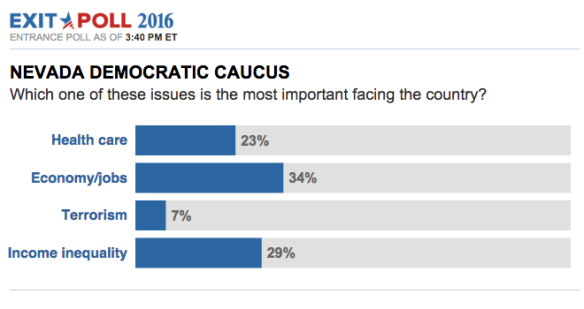
Voters who attended the Democratic caucuses in Nevada yesterday were asked to identify the most important issue facing America. 34% said the economy and jobs; 7% said terrorism.

NVDem_Issues_02202016

Voters in the Republican primary in South Carolina were asked the same question. 28% said the economy and jobs, but 32% said terrorism.

SGOP_IssuesV2_02202016I haven’t been able to determine whether the Democrats and Republicans were given the same list of issues to choose from, but it’s still remarkable that one-third of Republican voters chose terrorism as the most important issue we face. In fact, it’s remarkable that 7% of the Democrats said the same thing.

Unless these people think there is a strong chance that terrorists (of whatever political persuasion, not just Islamic fundamentalists) will attack America with nuclear or biological weapons, it’s silly to put terrorism at the top of the list. (In fact, given how silly it is, I have to wonder – mostly facetiously – whether some of those Democrats were devious Republicans attending the Democratic caucuses in order to make trouble, something the rules in Nevada allowed).

Here in New Jersey, we don’t get to participate in the nomination process until June, when it won’t matter what we think or how we vote. But if anyone asked me, I’d put global warming first, because of its possibly catastrophic consequences. After that, it would be hard to choose between the economy and jobs; money in politics; and the number of Americans who have lost their minds and vote for Republicans.

Meaning Is a Many-Splendored Thing

Since reading a couple of articles that deal with the subject, I’ve been meaning (intending) to write about the meaning (significance) of life.

Back in October, Charlie Hueneman, a philosophy professor at Utah State, posted “Everything Is Meaningless – But That’s Okay”. Then, in December, Roy Scranton, a writer working on his Ph.D. in English, delivered “We’re Doomed. Now What?”. Hueneman and Scranton both start out negative and end up positive. That happens a lot on this topic.

Hueneman begins by describing supposedly meaningless activities, ones that “have no point to them – nothing is achieved, no purpose can be fathomed, and the work we dedicate to them is entirely wasted”. If meaningful activities are the opposite, he says, they have a point. They’re done for reasons.

He then asks the same question about our lives as a whole. Do our lives have a point? Instead of offering an answer, however, he quickly moves to the whole universe. Does the universe have a point?

I don’t think this is a fruitful way to think about the meaning of life. We shouldn’t expect the meaning of particular activities like brushing our teeth to be the same kind of meaning that could attach to a person’s entire life. Why would a person’s life, something that consists of lots of actions but also many, many experiences, most of which have no purpose and aren’t intentionally acquired, be meaningful in the same way as an individual action?

It’s even more questionable to expect the universe to have a meaning in the sense of having a purpose. Hueneman mentions entropy: maybe the universe’s purpose is to wind down and even out. But it’s one thing to say that what happens in the universe tends to go in one direction and another to say that it all happens for a reason. So Hueneman concludes that “all existence is meaningless”. Nothing, not even brushing our teeth, has a point (despite what your dentist says).

To the objection that “we create our own meaning, with the ends we set and the decisions we make”, Hueneman replies that we can’t create meaning. We can merely pretend that our actions are meaningful. Why can we merely pretend? Because we could decide that any activity at all is meaningful, even those that seem obviously meaningless. Furthermore, since all of our actions will come to nothing in the end (when the sun explodes, for example), there is no point to any of our actions now.

None of Huenman’s points are convincing, but even if they were, that wouldn’t be a problem, since he goes on to explain why he thinks living in a meaningless universe is okay. It’s okay because we have the ability to enjoy or find value in pointless activities, even if we understand that they’re pointless. Everything we do is ultimately pointless, but it can still be worth doing:

The distinction I’m invoking is this. A pursuit is made meaningful in virtue of being part of some larger purpose or end that exists apart from us. But a pursuit or activity or achievement can be pleasurable or valuable by meeting some condition set by us – either deliberately (as in staged contests), or simply by us being the sort of beings we are. We generally are the sort of beings who like having fun, seeing beautiful things, and helping one another. And that’s why we value these things – regardless of the fact that they are ultimately meaningless.

What Hueneman has done here is to offer a questionable definition of “meaningful” and then use that questionable definition to declare everything meaningless. Given his definition, only things that serve a higher purpose apart from us are meaningful. But not to worry, since we can find enjoyment and value in life anyway.

It  would have made more sense for Hueneman to admit up front that we find meaning in all kinds of things, whether or not they serve a higher purpose. We don’t pretend to find them meaningful; we actually do. Some activities and experiences are meaningful for us because they’re enjoyable (or painful) or we think they’re valuable or because they serve our purposes or someone else’s. There is no need to confuse the issue by worrying about whether the universe has a purpose, whatever that could possibly be. If you find something meaningful, it’s meaningful for you, whether that something is your teeth, your life, the history of the universe or stories about heaven and hell.

Of course, this doesn’t mean that whatever a person finds meaningful has significance or substance beyond what that person thinks or feels. There are those among us who think the movements and positions of the planets are extremely meaningful. I, for example, was born on a certain day sixty-odd years ago, so I and millions of others should understand that today (actually yesterday) might be hectic. Nevertheless, we should remember not to hurt anyone “who has walked a small distance” with us. We should also use our excellent sense of humor to “bridge the gap” between us and our “superiors” (which will be difficult for me, since I retired several years ago). Astrologists and their fans who really believe in astrology find meaning where more down-to-earth people don’t. Unfortunately, the meaning they find doesn’t correspond to reality in terms of allowing them to make good predictions or devise helpful explanations, but they do find astrology meaningful.

In conclusion, it’s hard to say whether we find meaning or create it. We don’t usually pretend to find it (although there are ministers who have lost their faith, various politicians and hucksters, and those of us who want to protect somebody’s feelings). If we create meaning, most of us don’t consciously create it. If anyone ever has, it’s probably the people who originally made up stories like the ones about Mount Olympus, Shiva and the burning bush; or Plato and Aristotle when they explained the world in terms of ideal forms or final causes. Most of us use the tools we have (our desires, our experiences, our biology) to find meaning where we can. Sometimes we find it. Sometimes we don’t.

Next time I’ll get to that other article, the one that says we’re all doomed but we should take meaningful action anyway.

Myra Breckinridge by Gore Vidal

Gore Vidal’s novel was quite scandalous when it was published in 1968. It’s the story of a man (Myron) who became a woman (Myra). She’s working in Hollywood now and has dedicated herself to something like reformulating the American concept of masculinity. She thinks she’ll accomplish this by having her way with an attractive young man who wants to be a movie star. Along the way, she falls in love with the young man’s girlfriend and schemes to take control of movie cowboy Buck Loner’s Acting Academy for Aspiring Young Actors and Actresses. As one would expect, her mission isn’t a complete success. 

It’s a satirical novel, so there are some larger-than-life characters, including Myra. She has an extraordinarily high opinion of herself, but eventually concludes that she “certainly went through a pretentious phase”. It’s worth reading, partly because Vidal was a talented writer with a gift for wry commentary. But it’s not terribly funny and nowhere near as shocking as it was in 1968.