Michel de Montaigne was a 16th century French nobleman who was active in politics but mostly concerned with writing essays. He may have been the first blogger. Bakewell portrays Montaigne as having a modern sensibility, although he followed the Stoics and Epicureans in some ways. Montaigne wrote about all kinds of topics (including his kidney stones) and always tried to see both sides of an issue. He even tried to see life from his cat’s perspective. Much of his writing seems to have been thinking out loud as he mulled over his topics and went off on tangents. In that regard, she compares his essays to Tristram Shandy. I wonder if the actual essays are as good as advertised (all 1,000 pages of them).
Monthly Archives: July 2015
What’s It All About, Woody?
In Woody Allen’s latest movie, Irrational Man, Joaquin Phoenix plays Abe, a moody philosophy professor, while Emma Stone plays Jill, a cheerful undergraduate, who etc. etc. etc.
New York Times critic Manhola Dargis describes Jill as “an eager A student who’s attracted to Abe because that’s how she was written”. That’s very nicely put, but our topic isn’t cinema or gender. Our topic is whether life is meaningless.
From the Times review of Irrational Man:
In Woody Allen’s 1987 drama “September,” a writer and a physicist walk into a room … when the writer asks the physicist, “Is there anything more terrifying than the destruction of the world?” The physicist, sunk deep in gloomy shadow, answers, “Yeah, the knowledge that it doesn’t matter one way or the other — that it’s all random, radiating aimlessly out of nothing and eventually vanishing forever.” The physicist says that he’s not talking about the world. “I’m talking about the universe,” adding, “all space, all time, just a temporary convulsion.”
The exchange is in keeping with Mr. Allen’s oft-repeated insistence, on-screen and off, that life is meaningless, which may be true even if he seems feverishly bent on refuting it with his prodigious cinematic output.
Nobody has ever accused me of always, or even generally, looking on the bright side of things, but I don’t see any connection at all between the end of the universe and the meaning of life. So maybe Woody Allen, who is rather intelligent and can be relatively funny, is having a bit of fun when he suggests that life is meaningless because, meaningless because, in the distant future, the whole shebang will come to nothing.
Apparently not. It was easy to find videos in which Allen, speaking as himself, not through one of his characters, expresses an extremely bleak view of our situation. In one video, for example, when asked to comment on Macbeth’s complaint that life is “full of sound and fury, signifying nothing”, Allen offers this:
You die and eventually the sun burns out … eventually all the planets and all the stars … the entire universe goes, disappears, and nothing is left at all … and you think to yourself, it is a lot of noise and sound and fury and where is it going? It’s not going anyplace.
He then imagines a cycle in which all of humanity is replaced every 100 years. Each time, people take their lives very seriously, yet “it seems like a big meaningless thing”. Strangely, however, he concludes that “even knowing the worst … it’s still worthwhile …it’s still important to go on”. Further, it’s the artist’s job to help the rest of us understand why this is so.
Not that it makes any difference, but physicists aren’t really sure how the universe will end. Will there be a Big Freeze? Big Rip? Big Crunch? Big Bounce? One reason they’re not sure is that they don’t know enough about dark energy, the strange force that seems to be making the universe expand more quickly. But however it ends, the universe should keep going for billions of years. Its ultimate destination may be nowhere at all, but in the meantime, a whole lot of stuff, including us, will be traveling every which way.
Citing events like the end of the universe or the explosion of the sun as reasons for the meaninglessness of life could be the most ridiculous thing I’ve ever heard a public figure say. It’s like saying that traveling around the world or visiting the Moon is pointless because you’re going to end up back in your own bed and, besides, you’re not going to live forever.
Life has meaning for anyone who finds it meaningful. None of our experiences, memories, expectations, accomplishments or relationships are inherently meaningful – meaningful in themselves – but they are often meaningful to us and other people. That’s why we say things like “that really meant a lot to me” or (as I heard in a movie this week) “you mean nothing to me”.
To be meaningful in this sense is to be significant. It’s true that we sometimes perceive significance where there really isn’t any, but we don’t always get it wrong. Was it meaningful to you when you finished that task, visited that place, played that song, met that person? Well, no it wasn’t, because billions of years from now, there won’t be anything in the universe except black holes, and they’ll eventually disappear too! Making this supposed connection explicit – “life can only have meaning if the universe lasts forever” – shows what an absurd, lazy idea it is.
To be fair to Woody Allen, however, he might have another idea in mind. When people say life is meaningless, they sometimes mean that life has no ultimate purpose. Our individual purposes (putting food on the table, learning how to surf, becoming a banker) don’t seem important enough in the grand scheme of things. Isn’t there a bigger purpose to all of this?
Perhaps we’re here to propagate the species (until there’s no room on Earth for one more person?). Or help the universe or the Absolute become aware of itself (good one, Hegel). Or to fulfill a divine plan, like glorifying the supreme being forever and ever (the ego!). Or maybe we humans are only here as unwitting contestants in a vast competition run by the rulers of the galaxy to see which planet can produce the best muffins? That’s a possibility.
In addition to the difficulty of identifying which particular cosmic purpose we’re here to serve, there’s another big problem with this idea. Whatever purpose we’re serving, it most likely isn’t ours (especially if we don’t know what it is). Living in order to serve someone or something else’s higher purpose means that we are being treated as a means, not an end. That’s the opposite of what Kant argued is the basis of morality: to treat people as ends in themselves, not as means to achieving something else. Unless we can correctly identify a higher purpose and then adopt it as our own, the desire to serve a higher purpose is the desire to be used.
In a similar context, Nietzsche criticized what he called “the ascetic ideal”, a way of thinking that helps the less psychologically advanced among us (the “herd”) avoid “suicidal nihilism”. The ascetic ideal, as embodied by Christian morality, requires that:
there is nothing on earth of any power which does not first have to receive a meaning, a right to existence, a value from it, as a tool to its work, as a way and means to its goal [On the Genealogy of Morality, III, 23).
Knowing that we were being used to serve an overriding purpose in the way Nietzsche describes service to the ascetic ideal would certainly add meaning to our lives. That’s true. But whether it would be a desirable meaning is another question.
The world in which we find ourselves should make us wonder what higher purpose would justify or explain what goes on around here. Nature is red in tooth and claw for most living beings. We humans do have Beethoven and Michelangelo, as Woody Allen often says, and surprisingly many people around the world are fairly satisfied with their lives, but consider all the horrendous crap we have to deal with (often at the hands of other humans).
Finding out that all of humanity’s pain and suffering happens for a reason would be adding insult to injury. The world is like this on purpose? It’s more agreeable and understandable that it just worked out this way. If I learned that this whole enterprise was set in motion by some higher-ups (or -up), I’d be very surprised, but also very disappointed. Couldn’t they do a better job? Are we living in a beta version?
They better damn well enjoy our muffins.
Postscript of 7/27/15:
From the 16th century French essayist Michel de Montaigne: “Life should be an aim unto itself; a purpose unto itself” (Essays, III, 12).
Smarter Works Better Than Tougher – Stairway Postscript
The French phrase “l’esprit de l’escalier” refers to that unpleasant moment when you realize what you should have said. According to the usual source, Denis Diderot originated the expression:
During a dinner at the home of the statesman Jacques Necker, a remark was made to Diderot which left him speechless at the time, because, he explains, “a sensitive man, such as myself, overwhelmed by the argument leveled against him, becomes confused and can only think clearly again [when he reaches] the bottom of the stairs” (“l’homme sensible, comme moi, tout entier à ce qu’on lui objecte, perd la tête et ne se retrouve qu’au bas de l’escalier“).
Hence, the wit (not the spirit) of the stairs.
The phrase doesn’t quite apply to what happened this afternoon, but it’s close enough. I was driving to the grocery store when I realized what I should have included in my previous post. I should have mentioned Greece’s ongoing financial crisis. Sensible people understand that Greece will never be able to pay back everything it owes, partly because the economic austerity demanded by its creditors has slowed the Greek economy, making Greece poorer and even less able to pay off its debts. Even the International Monetary Fund, one of Greece’s creditors, understands this. The Greeks need debt relief, like the Germans received after World War 2.
The Germans, however, believe they and the other creditors need to get tougher with Greece. More austerity and more pain will eventually convince the Greeks to get their fiscal house in order or drive Greece out of the eurozone, leading to who knows what consequences for the Greeks, Europe and the rest of the world. In this case, the Germans, like the Republicans, prefer tougher over smarter.
But how was I going to get Germany’s bad behavior into a post about the Republicans? (Believe it or not, I’ve got literary standards.) Then it hit me, probably when I was making a right turn. Remember that rabid speech given by arch-right winger, modern-day fascist Pat Buchanan at the 1992 Republican National Convention? The late Molly Ivins said “it probably sounded better in the original German”.
See, it fits together after all. It’s what I should have said.
In Foreign Policy, Smarter Works Better Than Tougher
The world will be a better place when normal relations are established between the United States and Cuba. But right-wing politicians disagree. They think we should treat Cuba even worse than we do now. If we tighten the screws on Cuba, the Cuban people will eventually rise up or their government will see the error of its ways.
Likewise, it will be a step forward when the United States and Iran establish better relations. Right-wing politicians disagree. They think we should treat Iran worse than we do now. We shouldn’t negotiate with Iran. We should tighten the screws even further and threaten military action. The Iranian people will rise up or their government will see the light.
The Atlantic has an interesting little article called “Why the Iran Deal Makes Obama’s Critics So Angry” that helps explain the Republican obsession with “toughness” in foreign policy:
When critics focus incessantly on the gap between the present [Iran nuclear] deal and a perfect one, what they’re really doing is blaming Obama for the fact that the United States is not omnipotent. This isn’t surprising given that American omnipotence is the guiding assumption behind contemporary Republican foreign policy. Ask any GOP presidential candidate except Rand Paul what they propose doing about any global hotspot and their answer is the same: be tougher. America must take a harder line against Iran’s nuclear program, against ISIS, against Bashar al-Assad, against Russian intervention in Ukraine and against Chinese ambitions in the South China Sea….
….[Behind Obama’s] drive for an Iranian nuclear deal is the effort to make American foreign policy “solvent” again by bringing America’s ends into alignment with its means. That means recognizing that the United States cannot bludgeon Iran into total submission, either economically or militarily. The U.S. tried that in Iraq.
It is precisely this recognition that makes the Iran deal so infuriating to Obama’s critics. It codifies the limits of American power. And recognizing the limits of American power also means recognizing the limits of American exceptionalism. It means recognizing that no matter how deeply Americans believe in their country’s unique virtue, the United States is subject to the same restraints that have governed great powers in the past. For the Republican right, that’s a deeply unwelcome realization. For many other Americans, it’s a relief. It’s a sign that, finally, the Bush era in American foreign policy is over.
It’s a Matter of Perspective
One afternoon, about four years ago, I was walking along in our neighborhood when it occurred to me that every perception or thought we have, every emotion we feel, every conclusion we reach, every command we issue or question we ask is from our particular, individual perspective.
Well, of course. That’s a truism, a statement so obviously true it’s hardly worth stating. We each have our own perspective. So what?
I don’t know, but ever since then I’ve been thinking about what it means to have a perspective or be from a perspective, and how different perspectives relate to each other. Not every waking moment, of course. But you might be surprised how often you’ll see the word “perspective” or a similar expression like “point of view” or “frame of reference” once you start paying attention.
For instance, there’s the way paintings or drawings give the impression that a two-dimensional surface has three dimensions. Turner used perspective when he painted Oxford’s High Street:

Underlying the artistic technique is the fact that we each have a physical perspective from which we observe the world. Each observer has what physicists call a “reference frame”, a “coordinate system attached to [the] individual observer’s perspective”, from which measurements are made. It’s one of the key concepts in Einstein’s theory of relativity.
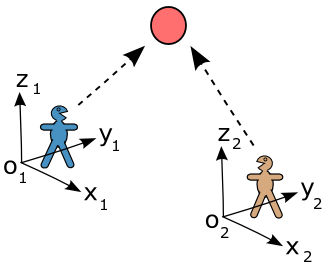
In addition to our physical perspective, we each have what our own “personal” perspective. It includes our particular desires, needs and interests. Personally speaking, It seems like a good idea — from my perspective — to be writing this (I have my reasons). From your personal perspective, it might be better to take a walk or go to bed.
Another type of perspective depends on what conceptual schemes or ways of thinking. We usually deal with the world from what we think is a practical or prudential perspective, but sometimes opt for a perspective that’s ethical or religious. We complain about politicians who function from a purely political perspective and celebrate those who champion a scientific or global perspective. There are so many perspectives that library shelves sag under books with inviting (?) subtitles like “Ecological and Experimental Perspectives”, “A Probabilistic Perspective”, “Perspectives from Philosophy, Psychology and Theology”, “Multicultural Perspectives” and “A Supply-Chain Perspective”.
In future posts, I’d like to occasionally discuss perspective from various perspectives. For example, why choose one perspective instead of another? Are multiple perspectives always better? How can a perspective be justified? Can it only be done from another perspective? Is there or should there be a hierarchy of perspectives? Is it really possible to adopt someone else’s perspective? Does morality depend on being able to do so? How does the philosophical position called “perspectivism”, associated with Nieztsche, differ from relativism? And is perspectivism preferable to the better-known view?
For now, here’s a passage from Sarah Bakewell’s How to Live: Or a Life of Montaigne in One Question and Twenty Attempts at an Answer:
In the view of William James, as of Leonard Woolf and Montaigne, we do not live immured in our separate perspectives, like Descartes in his room.We live porously and sociably. We can glide out of our own minds, if only for a few moments, in order to occupy another being’s point of view. This ability is the real meaning of “Be convivial”, this chapter’s answer to the question of how to live, and the best hope for civilization.
 Whereof One Can Speak 🇺🇦
You must be logged in to post a comment.