Isaac Asimov Meets the Terminator and Guess Who Wins

According to The Atlantic, the Pentagon is going to award $7.5 million for research on how to teach ethics to robots. The idea is that robots might (or will) one day be in situations that demand ethical decision-making. For example, if a robot is on a mission to deliver ammunition to troops on the battlefield but encounters a wounded soldier along the way, should the robot delay its mission in order to take the wounded soldier to safety? Or risk the deaths of the soldiers who need that ammunition?

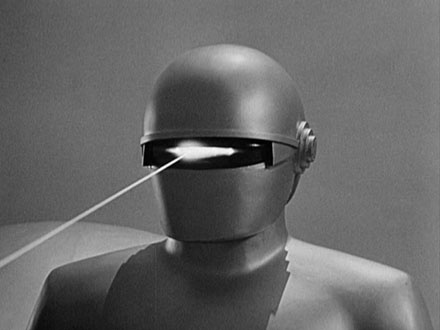
Since philosophers are still arguing about what ethical rules we should follow, and ethical questions don’t always have correct answers anyway, futuristic battlefield robots may need a coin flipping module. That way they won’t come to a halt, emit clouds of smoke and announce “Does not compute!” over and over.

Of course, the talented software developers who program these robots with a sense of right and wrong will avoid really poor error processing like that (presumably, they’ll have seen Star Trek too, so they’ll know what situations to code for). The big question isn’t whether robots can eventually be programmed to make life-and-death decisions, but whether we should put robots in situations that require that kind of decision-making.

the-day-the-earth-stood-still-special-edition-20081204031732410-000

Fortunately, Pentagon policy currently prohibits letting robots decide who to kill. Human beings still have that responsibility. However, the Pentagon’s policy can be changed without the approval of the President, the Secretary of Defense or Congress. And although a U.N. official recently called for a moratorium on “lethal autonomous robotics”, it’s doubtful that even a temporary ban will be enacted. It’s even more doubtful that the world leader in military technology and the use thereof would honor such a ban if it were.

After all, most politicians will prefer putting robots at risk on the battlefield instead of men and women, even if that means the robots occasionally screw up and kill the wrong men, women and children. And, of course, once the politicians and generals think the robots are ready, they’ll find it much easier to unleash the (automated and autonomous) dogs of war.

(PS – The actual quote from Julius Caesar is “‘Cry Havoc!’, and let slip the dogs of war”. Serves me right for trying to be a bit poetic.)

A Paragraph About Memory

There was a review in the New York Times this weekend of the third volume of Karl Ove Knausgaard’s six-volume, autobiographical novel My Struggle. I especially liked this paragraph from the reviewer Rivka Galchen:

In and out of the book, Knausgaard repeatedly claims to have a weak memory, a claim one might argue the book belies, but I believe him. Knausgaard forgets most everything (which is very different from everything) the way we all forget most everything, and he might forget even a little bit more than the rest of us. His grandfather tells him a story about having once joined a rescue mission for a plane that crashed in nearby mountains. No one survived, the grandfather says, but he remembers seeing the captain’s head: “His hair was perfect! Combed back. Not a strand out of place.” It’s a kind of gruesome metonymy for memory itself: So much life gone, and this one head in the snow is what remains in the mind’s eye. The past returns to us like light almost entirely obscured by a heavy, dark screen in which memory has made a few pinholes; we see very little, really, yet we look upon it as if at the starry vault of the heavens.

But why are bad memories often more powerful than good ones? I wonder if Knausgaard has anything to say about that.

(Thanks to linuxgal of Terminal Cruise for motivating me to remember reading the paragraph about memory. According to Professor Rosenberg, of course, it was just a matter of electricity flowing in and out (see previous post).)

A Guide to Reality, Part 13

Chapter 8 of Alex Rosenberg’s The Atheist’s Guide to Reality: Enjoying Life Without Illusions is called “The Brain Does Everything Without Thinking About Anything At All”. Without thinking about anything at all? That sounds like another of Rosenberg’s rhetorical exaggerations.

He grants that it’s perfectly natural for us to believe that our conscious minds allow us to think about this and that. Yet he claims that science tells us otherwise:

Among the seemingly unquestionable truths science makes us deny is the idea that we have any purposes at all, that we ever make plans — for today, tomorrow or next year. Science must even deny the basic notion that we ever really think about the past and the future or even that our conscious thoughts ever give any meaning to the actions that express them [165].

But despite this claim about science and the title of the chapter, Rosenberg doesn’t really “deny that we think accurately and act intelligently in the world”. It’s just (just!) that we don’t “do it in anything like the way almost everyone thinks we do”. In other words, we think but we don’t think “about”.

Before getting to his argument against “aboutness”, Rosenberg offers the observation that science is merely “common sense continually improving itself, rebuilding itself, correcting itself, until it is no longer recognizable as common sense” [167]. That seems like a correct understanding of science; it’s not as if science is a separate realm completely divorced from what’s called “common sense”. When done correctly, science is a cumulative process involving steps that are each in turn commonsensical, i.e. based on sound reasoning or information:

Science begins as common sense. Each step in the development of science is taken by common sense. The accumulation of those commonsense steps … has produced a body of science that no one any longer recognizes as common sense. But that’s what it is. The real common sense is relativity and quantum mechanics, atomic chemistry and natural selection. That’s why we should believe it in preference to what ordinary experience suggests [169].

So, if you have a mental image of the Eiffel Tower or suddenly remember that the Bastille was stormed in 1789, ordinary introspection suggests that you’re having a thought about Paris. But, according to Rosenberg, that’s a mistake. Assuming that this thought of yours that’s supposedly about Paris consists in or at least reflects activity in your brain (the organ you use to think), that would imply that there must be something in your brain that represents Paris. We know, however, that any such representation isn’t a tiny picture or map of Paris. Brain cells aren’t arranged like tiny pictures.

But perhaps there’s a kind of symbol in your brain, an arrangement of neurons that your brain somehow interprets as representing Paris? Rosenberg rejects this possibility, arguing that any such interpretation would require a second set of neurons:

[The second set of neurons] can’t interpret the Paris neurons as being about Paris unless some other part of [the second set] is, separately and independently, about Paris [too]. These will be the neurons that “say” that the Paris neurons are about Paris; they will be about the Paris neurons the way the Paris neurons are about Paris [178]. 

Rosenberg argues that this type of arrangement would lead to an unacceptable infinite regress. There would have to be a third set of neurons about the second set, and so on, and so on.

I confess that I’m having trouble understanding why the regress is necessary. In Rosenberg’s notes, he references a book called Memory: From Mind to Molecules, by the neuroscientists Larry Squire and Eric Kandel, which he says explains “how the brain stores information without any aboutness”. Maybe it’s clearer there.

However, if we grant that Rosenberg’s argument is correct and one part of the brain interpreting another (symbol-like) part of the brain would require an impossible infinite regress, it still seems questionable whether he has shown that nothing in the brain can be about anything. What his argument will have shown is that one part of the brain can’t interpret some other, symbolic part of the brain. Perhaps thoughts can be “about” something in some other way.

Rosenberg next offers an interesting account of how our brains work. Briefly put, human brains work pretty much like the brains of sea slugs and rats. Scientists have discovered that all of us organisms learn by connecting neurons together. Individual neurons are relatively simple input/output devices. Link them together and they become more complex input/output devices. The key difference between our brains and those belong to sea slugs and rats is that ours have more neurons and more links.

When a sea slug is conditioned to respond a certain way to a particular stimulus (like one of Pavlov’s dogs),

[the training] releases proteins that opens up the channels, the synapses, between the neurons, so it is easier for molecules of calcium, potassium, sodium and chloride to move through their gaps, carrying electrical charges between the neurons. This produces short-term memory in the sea slug. Training over a longer period does the same thing, but also stimulates genes in the neurons’ nuclei to build new synapses that last for some time. The more synapses, the longer the conditioning lasts. The result is long-term memory in the sea slug [181].

The process in your brain was similar when you learned to recognize your mother’s face. Rosenberg cites an experiment in which researchers were able to temporarily disable the neurons that allowed their subject to recognize her mother. Since she still recognized her mother’s voice, she couldn’t understand why this stranger sounded just like her mother.

Rosenberg concludes that there is nothing in our brains that is “about” anything:

None of these sets of circuits are about anything….The small sets of specialized input/output circuits that respond to your mom’s face, as well as the large set that responds to your mom [in different ways], are no different from millions of other such sets in your brain, except in one way: they respond to a distinct electrical input with a distinct electrical output….That’s why they are not about anything. Piling up a lot of neural circuits that are not about anything at all can’t turn them into a thought about stuff out there in the world [184]. 

Of course, how the activation of neural circuits in our brains results in conscious thoughts that seem to be “about” something remains a mystery. Today, for no apparent reason, I had a brief thought about Roxy Music, the 70s rock band. Maybe something in my environment (which happened to be a parking lot) triggered that particular mental response. Or maybe there was some seemingly random electrical activity in my brain that suddenly made Roxy Music come to mind. 

I still don’t see why we should deny that my thought this afternoon was about Roxy Music, even if the neural mechanics involved were quite simple at the cellular level. If some of my neurons will lead me to answer “Roxy Music” when I’m asked what group Bryan Ferry was in, or will get me to think of Roxy Music once in a while, perhaps we should accept the fact that there are arrangements of neurons in my head that are about Roxy Music.

Philosophers use the term “intentionality” instead of “aboutness”. They’ve been trying to understand intentionality for a long time. How can one thing be “about” another thing? Rosenberg seems to agree that intentionality is mysterious. He also thinks it’s an illusion. Maybe he’s right. In the last part of chapter 8, he brings computer science into the discussion. That’s a topic that will have to wait for another time.
Bacteria Are Our Friends, Except When They’re Not

It’s good to remind ourselves occasionally that we human beings are little worlds of a sort. Each of our bodies is composed of trillions of cells (about 40 trillion, based on a recent estimate), each going about their individual business, and many more microorganisms, mainly bacteria, each going about their business too.

I’m not sure why it’s good to remind ourselves of this fact, but it seems like something worth keeping in mind. It might, for example, help us not be so fearful of bacteria. They’re not necessarily bad for us. For one thing, they help us with digestion. More surprisingly, some scientists believe that, before people began frequent applications of soap and shampoo, one kind of bacteria (Nitrosomonas eutropha) flourished on people’s skin, acting as a “built-in cleanser, deodorant, anti-inflammatory and immune booster by feeding on the ammonia in our sweat and converting it into nitrite and nitric oxide”.

That’s the theory behind an article in the New York Times by a woman who went one month without using soap or shampoo. Aside from her greasy hair, she didn’t notice any ill effects. Nobody complained about her odor. In fact, after encouraging the growth of N. eutropha on her body for a month, her skin was in better shape than when she started the experiment. The scientists involved hope that bacteria might one day be used to treat various skin conditions, like eczema and acne, and even help certain wounds heal more quickly.

That’s the good news. The bad news (which is much worse than the other news is good), is that medical authorities are calling attention yet again to the spread of dangerous antibiotic-resistant bacteria. The Guardian reports that a group of senior British scientists expressed concern last week that we face “the prospect of people dying from routine infections because effective antibiotics no longer exist”. One scientist said:

In the near future it is possible that a scratch from a rose thorn could become septic. Without effective antibiotics, septicaemia could easily set in and result in death. It is a terrible prospect, but a very real one. We are facing a return to the state of affairs that existed before antibiotics were discovered.

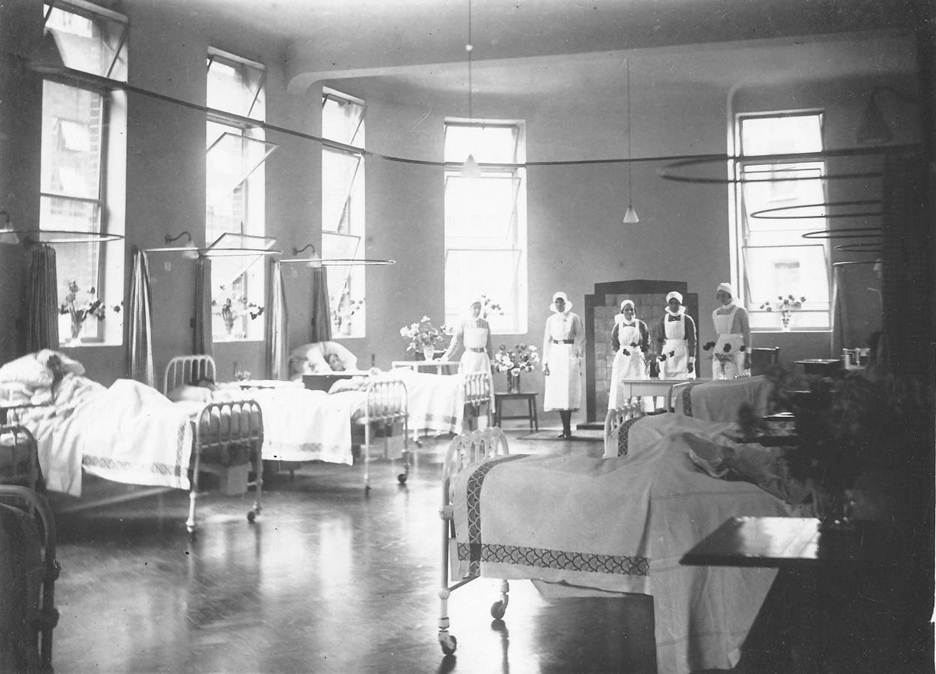
Any kind of surgery and treatments that affect the immune system could all become life-threatening. As a stop-gap measure, the scientists recommend that hospitals go back to having old-fashioned rooms with widely-separated beds and windows that can be opened to allow in fresh air. 

lewes_victoria_hospital_ward

Unfortunately for us communities of cells and bacteria, the drug companies aren’t developing new antibiotics, because there is little profit to be made off drugs that people only take for a short period of time. Chalk another one up for capitalism and the free market. 

As dangerous bacteria continue to evolve, it becomes increasingly likely that epidemics will sweep the world before new antibiotics or other treatments will be available, unless there is increased government support for the needed research. The alternative is to wait for the problem to get so bad that it becomes profitable to fix it. 

Taking these developments into account, it’s safe to assume that one day many of us will be dead from bacterial diseases we don’t know how to fight. But our skin will be in the best shape ever.

Dreaming About Democracy

In a speech to the House of Commons in 1947, Winston Churchill uttered one of the best-known and most profound witticisms on the subject of democracy, although he was apparently quoting someone else:

Many forms of Gov­ern­ment have been tried, and will be tried in this world of sin and woe. No one pre­tends that democ­racy is per­fect or all-wise. Indeed, it has been said that democ­racy is the worst form of Gov­ern­ment except for all those other forms that have been tried from time to time…

Benjamin Franklin was responsible for the other best-known and profound remark on the subject. One of the delegates to the Constitutional Convention in 1787 recorded the following exchange in his diary:

A lady asked Dr. Franklin, Well Doctor what have we got, a republic or a monarchy? A republic, replied the Doctor, if you can keep it.

Churchill and Franklin summed up the situation quite nicely. Few people these days (at least around here) question whether some kind of democracy is the best form of government. Most of the discussion now regards whether we’re losing our democracy or have already lost it.

In that vein, one of Salon’s writers, Andrew O’Hehir, published an article a few days ago called “This Is Not What Democracy Looks Like”. O’Hehir argues that our democracy is hardly a democracy at all and, furthermore, it’s unlikely to get any better (more democratic) than it already is:

We have to consider the possibility that the current state of American politics, with its bizarre combination of poisoned, polarized and artificially overheated debate along with total paralysis on every substantive issue and widespread apathy and discontent, is what we get after 200-odd years. It’s not a detour in the history of Jeffersonian democracy but something closer to a natural outcome. We also must consider that our version of a democratic system is not, in fact, designed to reflect the will of the people … but to manipulate and channel it in acceptable directions.  

On O’hehir’s view, those who believe our dysfunctional democracy might one day evolve toward a more democratic ideal are as misguided as the defenders of the Soviet Union who thought the state would eventually wither away and be replaced by a truly egalitarian form of communism. Given the influence of money in our political system and the increasingly bizarre politics of the Republican Party, it may in fact be too late for America to become less oligarchic and plutocratic. O’hehir may be right about that.

Still, he doesn’t suggest anywhere in the article that Churchill was wrong and we should prefer aristocracy or anarchy instead. He only argues that democracy is a fantasy, which seems to imply that we should all relax and accept our politics for what it is, a tool of the rich and powerful meant to keep the rest of us in line. Why try to elect better politicians or advocate particular reforms if nothing is going to improve? At this point, our best strategy might be looking for refugee status in Scandinavia.

Assuming that Sweden and Denmark aren’t realistic options for most of us, it seems to me that we might as well do what we can to make America more democratic, even if we can’t do very much. It isn’t out of the question that there will be a reaction in coming years to the right-wing onslaught of the past several decades. It certainly seems possible that we could one day institute real campaign finance reform, for example. We could make it easier for everyone to vote. The Fairness Doctrine that once called for broadcasters to present opposing viewpoints on important public issues could conceivably be resuscitated and even strengthened. We might make the tax code more progressive again. Regulations that interfere with the most rapacious forms of capitalism might be adopted. It isn’t impossible that labor unions will reverse their recent decline.

It seems unnecessarily pessimistic to conclude from the past 30 or 40 years that we might never have another New Deal. Or too assume that corporate capitalism can never be replaced by democratic socialism, even in the United States. Human institutions do evolve. Maybe it will take a crisis of some sort. Or maybe we just need to help. 

Meanwhile, it doesn’t hurt to occasionally remind ourselves why democracy is worth fighting for. To quote the great American philosopher John Dewey:

Democracy is much broader than a special political form, a method of conducting government, of making laws and carrying on governmental administration by means of popular suffrage and elected officers. It is that, of course. But it is something broader and deeper than that. The political and governmental phase of democracy is a means, the best means so far found, for realizing ends that lie in the wide domain of human relationships and the development of human personality. It is … a way of life, social and individual. The key-note of democracy as a way of life may be expressed, it seems to me, as the necessity for the participation of every mature human being in formation of the values that regulate the living of men together, [which] is necessary from the standpoint of both the general social welfare and the full development of human beings as individuals.

Universal suffrage, recurring elections, responsibility of those who are in political power to the voters, and the other factors of democratic government are means that have been found expedient for realizing democracy as the truly human way of living…. Democratic political forms are simply the best means that human wit has devised up to a special time in history. But they rest upon the idea that no man or limited set of men is wise enough or good enough to rule others without their consent; the positive meaning of this statement is that all those who are affected by social institutions must have a share in producing and managing them.  [“Democracy and Educational Adminstration”, 1937]