Unbalanced and Ignorant, Even Today

Henry Adams was an historian and journalist, the grandson of John Quincy Adams and the great-grandson of John Adams. Forty years after the Civil War, he wrote an autobiography in the third-person: The Education of Henry Adams.

This is an excerpt from chapter 7, “Treason (1860-61)”:

“Adams found himself seeking education in a world that seemed to him both unwise and ignorant. The Southern secessionists were certainly unbalanced in mind — fit for medical treatment, like other victims of hallucination — haunted by suspicion, by idées fixes, by violent morbid excitement, but this was not all. They were stupendously ignorant of the world. As a class, the cotton-planters were mentally one-sided, ill-balanced, and provincial to a degree rarely known. They were a close [sic] society on whom the new fountains of power had poured a stream of wealth and slaves that acted like oil on flame. They showed a young student his first object-lesson of the way in which excess of power worked when held by inadequate hands”.

This description reminds me of certain players on the contemporary political scene, many of whom live in the South even today. 
The Southern Strategy

In an article about the “Southern Way of Life”, Michael Lind argues that cheap labor is the basis for the South’s economic and political system, not racism. Slaves were surely low-paid workers, but so far the Southern system has survived whether cheap labor was provided by slaves, sharecroppers, indentured servants, the poorly educated or the supposed beneficiaries of “right to work (without unions)” laws:

“From the 19th century to the 21st, the oligarchs of the American South have sought to defend the Southern system, what used to be known as the Southern Way of Life.

Notwithstanding slavery, segregation and today’s covert racism, the Southern system has always been based on economics, not race.  Its rulers have always seen the comparative advantage of the South as arising from the South’s character as a low-wage, low-tax, low-regulation site in the U.S. and world economy.  The Southern strategy of attracting foreign investment from New York, London and other centers of capital depends on having a local Southern workforce that is forced to work at low wages by the absence of bargaining power.

Anything that increases the bargaining power of Southern workers vs. Southern employers must be opposed, in the interest of the South’s regional economic development model.  Unions, federal wage and workplace regulations, and a generous, national welfare state all increase the bargaining power of Southern workers, by reducing their economic desperation.  Anti-union right-to-work laws, state control of wages and workplace regulations, and an inadequate welfare state all make Southern workers more helpless, pliant and dependent on the mercy of their employers.”

It’s obvious that the Republican Party, which draws many of its leaders and much of its electoral strength from the South, is trying to convert our whole country to the Southern system. It’s class warfare, but in some quarters it’s considered impolite to say so.

http://www.salon.com/2012/10/10/slave_states_vs_free_states_2012/

Why Obama Now?

I enthusiastically endorse the message and quality of this video written and directed by Lucas Grey, an animator for The Simpsons.

Except for the misspelling of “insurance” at 1:40:

Also available at http://whyobamanow.org/.

Why Listening to TV Commentary Might Drive a Person Crazy

Today’s big story was that the nation’s official unemployment rate dropped to 7.8%. This is good news if you want the economy to improve.

Of course, it’s well-known that the unemployment rate calculated by the Bureau of Labor Statistics isn’t precise. It’s a statistical approximation based on various kinds of data. But the official rate does generally indicate whether unemployment is going up or down and roughly how many people are out of work.

Lately, when the number has been bad, Republicans have used this as evidence against the Democrats. Today, when the number was good, Republicans loudly suggested that the Obama administration somehow manipulated the number to its advantage. Right. When you like a number, it’s accurate. When you don’t, it’s phony. This behavior is so clearly hypocritical and self-serving that it’s hardly worth pointing out.

Unfortunately, I happened to switch to a cable news station today while the TV’s sound was on. What I immediately heard was this remark from one of the panelists: “I’m not smart enough to speculate on whether the number is accurate or not”.

Well, you’re apparently smart enough to be on TV. Shouldn’t you be smart enough to know that there is no reason to speculate at all? The unemployment rate is calculated by civil servants. There has never been any evidence that politicians have manipulated the official unemployment rate to their advantage. Isn’t it obvious that the Republicans are questioning the number this time because it’s bad news for them? Isn’t it obvious that people in the media were manipulated into speculating about the number’s accuracy in order to cast doubt in some voter’s minds about the economy and thereby affect the election? 

If you’re going to offer your opinions on television, you should at least be smart enough to know when to speculate and when not to.

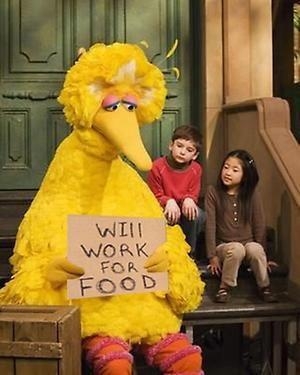
The Moment That Will Be Remembered

I couldn’t bring myself to watch the presidential debate last night — I’d get too angry when one guy was talking, and too frustrated when the other guy was, plus there’s the annoying moderator.

But the debate has already generated one memorable moment, possibly the one that will stick in people’s memories for a long time:

317502_10151037771736792_435611346_n

For more evidence, scroll through this:

http://www.dailykos.com/story/2012/10/04/1140178/-For-those-who-don-t-think-Romney-s-Big-Bird-moment-is-a-major-thing